Monday, 28 September 2020

AN ARTISTIC FUTURE FOR WELSH WOOL


We are once again limited in
 what where we can go, and who we can be with. 
I’ve been spending some happy hours recalling the summer of 2019 (bet you have too...). That was my 'arts and crafts of Wales' summer, when I spent sunny days visiting some of the working mills of West Wales. 

These mills, and the work they're now doing, got me interested in the history of  Welsh tapestry wool. I had conversations with the workers, who told me about their finished products and the sustainability and the carbon footprint of traditional weaving. I chatted to some of the designers about their contemporary artistic endeavours. I had many cups of coffee and quite a few delicious lunches, and took in quite a lot of the lovely countryside and coast.


  The tradition of weaving sheep's wool in            Wales expanded from prehistoric times through the middle ages, relying on the fast-running streams of west Wales, especially around the Teifi, (which runs through the heart of Ceredigion where I live) to provide power. Rural mills,  processing local fleeces, produced the Carthenni double-weave tapestry, which is unique to Wales.


Deeply rooted in Welsh tradition, double weave uses a strong 

2-ply yarn producing a hard-wearing reversible fabric. In past centuries, every mill had its signature design. Two layers of fabric are woven one above the other, interchanging at points forming ‘pockets’, and enabling bold areas of pattern to be created. However, when the Wool Marketing Board came into being in the 1950s, Welsh yarn found itself blended mostly into carpet yarns. The weaving mills began to fail and the iconic Carthenni patterns were almost lost.


National Woollen Museum


I started my discoveries by visiting the National Woollen Museum, 20 minutes from my house. Formally, it was 'Melin Teifi', and produced  shirts and shawls, blankets and bedcovers, woollen stockings and socks, which were sold in the surrounding countryside – and to the rest of the world.  Reopened now after Covid, you can see the sympathetically restored  machines in operation, and follow the process from Fleece to Fabric.


But I also wanted to find the working mills around my way, because recently there has been a renaissance – a new fusion of tradition and modernity – using contemporary marketing techniques to secure a future. However, there is an issue with both attracting apprentices and maintaining the desire for sustainable, artisanal, small scale, locally based goods. 


Melin Tregwynt is a whitewashed mill in a remote wooded valley It's been continually used for nearly 200 years, so the buildings have an industrial feel of oily cogs, dusty air and busy weavers, while the shop’s display style is distinctly high-end high street.


They supply John Lewis and Mulberry and say, Weathering wars, recessions and the passing of time, the looms have continued to work their magic since the 17th century, when local farmers would bring their fleeces to be spun into yarn  and woven into sturdy Welsh wool blankets.'


     The design team take centuries-old Cartheni    and ‘revive and design’ unique pattern ideas. They describe their technique as, '…inspired by our heritage, the archive built up over a hundred years of production and love of colour. Some fabrics in our current collection…are brand new but still inspired buy the landscape and tradition of Wales.' Tegwynt has regenerated the tradition of Patagonian double-weave (where Welsh-speaking immigrant weaves took on a South American flavour). The designers are also influenced by the Welsh landscape, Welsh lace, traditional Welsh quilting  and the ‘sense of spirit of place’.


In the visitor centre, a poster shows dying methods of previous centuries. These generated  muted colours and I noted the mill’s contemporary colour combinations are equally muted – grey and beige,
 lilac, ochre yellow, powder blue, amber and pink. 

Jayne Pierson, who previously worked for McQueen and Westwood, uses the mill’s fabrics to create fashion items which have starred in a Vogue fashion shoot…'I've created something that is a slow, sustainable fashion that is taking something age-old and reinventing it and upcycling it and making it relevant now to a younger consumer. Maybe younger people aren't so familiar with the heritage of Welsh wool - [they can] look at it again and be introduced and turned onto something that is actually very beautiful…'

Solva Mill is only a mile from the splendid Pembrokeshire beach of the same name.

Solva spent quite a lot of cash on restoring the mill wheel to working order, to reinforce their ethical credentials. By using carpet quality Welsh wool, Solva have become specialist weavers of exceptionally long-lasting floor rugs, runners and stair carpets. They feature symbolic designs synonymous with Welsh textiles.


To extend their marketing, the shop stocks locally designed textile art that fits its underlying ethos, including designs by seamstress Emma Iles, who has been inspired by the rugged Solva landscape to develop Seaforth Designs. She is


first inspired by fabric. 'I’d find a piece of soft woven grey herringbone wool with different weft and weaves that would look prefect for a dunlin. But now the collection is evolving. I see oystercatchers in the harbour and decide to add them to the collection, so go on the hunt for charcoal tweeds, and work that way round.' 

Felin Fach is extremely proud of remaining as close to traditional methods as possible. They use a high percentage of wool, alpaca, mohair, linen and silk sourced from local farms or smallholdings. They hand dye  using natural botanical plant extracts such as Madder, Weld, Indigo and Logwood.                      

The fixing agent is Alum, a nontoxic water-soluble


metallic salt and they hand finish using water from springs at the Mill.…
Whilst botanical dye is a more time consuming option there is a beauty and depth of colour to natural dye that becomes more beautiful with age…Our Welsh Tapestry Blankets are woven on traditional looms and created in limited numbers with personal care and attention.

Just a mile from my house, is  Curlew Weavers, a centuries-old family business which originally made its own dyes and used the little river Ceri (my local river, that nuns into the Teifi)  to drive looms. Roger Poulson owns and runs the mill at a profit. When I needed curtains, I went to him, knowing that I'd be hanging real Welsh Carthinni woven wool,  hand-made on machinery that hasn’t much changed over the centuries.                                                                  Roger told me, 'I use an artist’s eye to evolve new designs, choosing colour combinations from available dyes and allowing the ‘weft’  to dictate patterns.'                                                           


My curtain design features three yarns close

on the colour spectrum, and one from the opposite end – gorgeous autumnal oranges and browns, with royal blue. Stand back and the blue subtly turns the entire thing to a golden hue. 

Rodger upgraded his family’s business model radically, focusing on the sustainability of small-space production. 'I offer carding, spinning and weaving for Rare and  Specialist Breeders and organic farmers, while making a range of upholstery fabrics, throws, garments and dyed, spun yarn in skeins.' He supplies the Welsh Office, the QE2 and even Downing Street. 'My products have a small carbon footprintSheep are part of a natural carbon cycle, because wool is a planet-friendly fibre with a long, recyclable lifespan which takes far less water than cotton in the manufacturing process.'


Unable to cope with the vast industrialisation of textile production, the Welsh woollen industry has reinvented its intent and objectives, using the romance of its esteemed past and the revival of hand-made crafts to create a future for the family mills. It now has to concentrate on the next generation skill-set by offering attractive apprenticeships

and keep a close eye on textile trends.


If you would like to know more about this subject, why not start with Wikipedia, Woollen Industry in Wales https://en.wikipedia.org/wiki/Woollen_industry_in_Wales 

The National Woollen Museum is open to you, by rebooking free tickets; https://museum.wales/wool/


Most of these mills are open right now, but check their websites;

Melin Tregwynt,  https://melintregwynt.co.uk

Solva Mill https://www.solvawoollenmill.co.uk/wondersofwool 

Felin Fach https://www.felinfach.com 

 and you can find Emma Iles, Seaforth Designs, here; https://www.seaforthdesigns.com 

Saturday, 26 September 2020

Writing a Young Person's Novel, Nina's Seven Basic Steps.


People are asking me regularly now, about the book I began writing two years ago. Questions like 'how long does it take to write a novel' and 'however do you start' and 'do you have a process for writing a book?' and, 'how do you know that you're done?'

In his famous and much-loved book on writing (which of course he called  On Writing), Stephen King advocates that you; start with an idea and some characters, and seeing where it takes you...

I still follow this plan, but I've found it works better if it's better defined, not so vague as see where it takes you... So I break  idea/characters/write on into 7 basic steps. What are they? Read on, dear subscriber...

1. The idea

I've recently written here about how my idea of my children's novel Just


My Luck 
came into being, using the unlikely-named 'Commonplace Book' But I also like using a mood board, and when I started my latest book The Wrong I Did,  which is for 14+ to adult readers, I blogged about the mood board I created here These pictures, postcards, snatches of little items and cuttings from magazine made me learn a lot about my characters by looking, rather than by writing. It helped me get a feel for the two characters I started with, Caitlin and Lily, sorting out how they met, and why that was important to the story.

2. Decide on a location

Caitlin and Lily grew up in my hometown of Bristol. They met on the day Caitlin's father died from a heart attack; the day her mother went right off the rails. Lily was the pharmacist's daughter and Caitlin thinks she is the wonderful person she has ever met.

But I really wanted to set some of the book in Aberystwyth. It has huge atmosphere as a West Wales seaside town, but it's also full of culture, with a big university. The countryside is wild and atmospheric. Caitlin arrives  as a traumatised, but streetwise, 16 year-old. She begins to find her way round, allowing the reader to engage with the starling murmurations, the cliff railway, the seafront, where her 'sort of' boyfriend serves pulled pork sandwiches to the punters, and the National Library of Wales, where her  Welsh-speaking foster mother works.

3. Get to know your characters

Steadily, as Caitlin revealed her story to me, I could see that there would be a few important other characters in this story. To start with, I thought about Caitlin's relationship to each other those.  The way she hates £££ on sight, because she wanted to go back and live with her mother, of course. The way she remembers (( her social worker at the secure unit she's been detained in since she was fourteen, and the terror his image strikes in her heart. The sudden fear when $$ approaches her in Chapter One, telling he wants to tell her story. She thinks he's been sent from !! who was in charger of her movements all those years ago, when she was a tracker. And the powerful bond she forms with && after finding him half dead next to dumper bin at the back of the Aberystwyth shopping centre.

4.  Decide on themes

The best stories speak to us on multiple levels, an opportunity to explore key issues within society. I wanted to explore the newish phenomenon of 'County Lines', which seem impervious to police intervention. They are secret, clandestine. They use children as a front for drug-related activities. This is Caitlin's past, but she's now trying to leave it behind.

5.Outline the story into 3 acts

 This  formula may be old, and a bit  mechanical, but it helps maintain a structure as you write the words of your story. There are many more complex ways for structuring but sometimes the  simplest way is the best. 

Even so, I wasn't simple about it! I needed an outline of the story as it happens to Caitlin, before I could start looking at the story as it appears to the reader. 

1 Caitlin's father dies when she's 11. She tries to help her mother, who is hooked on sleepers and tranquelizers. She approaches a tracker – a drug dealer at school – and is soon sucked into the life of supplying. 

2 The second act is told in flashback, like the first. Caitlin is found guilty of murder and supplying heroin and serves two years in a secure unit for young people. But is this actually 'the wrong she did'?

3 She moves to Aber to get away from all these memories, but of course, they follow her here. She realises it's not going to be easy to escape from her previous life. The trackers want her back. 

6. Create a chapter summary for the entire book.

Once I had my three acts of young Cailin's life, I needed to plot out what happens in real time. The story starts in Aber. Caitlin has been there for six weeks, and she now knows she pregnant. She won't tell Melissa, though, and plans to go back to see her mum and get a medical abortion. At the same time, she's got to avoid $$, who wants to tell her story in his newspaper. And she's really worried about @@ because he's be rushed into ITU with sepsis. Oh, and as well as working at the care home, she's suppose to start College, even though that's the last thing she has time for right now.  I spend a lot of time working out how  each chapter will work; where I'll drop in the flashbacks, and when I should ramp up the tension and the action or drop a twist into the story. My roadmap is 25 chapter headings, although I know any of these can change if I think of something better  I use the headings as roadsigns to keep on the right route.

7. Get to the end first. Go back to the beginning after.

Some of you will know that this is a Lewis Carol quote. It makes sense. Don’t get lost in writing bits and pieces and trying to shoehorn them in somehow. If you go from start to end then the story will flow much better. Should inspiration strike for a later part, you can write it and use your chapter summary to slot it in, but don’t get distracted by things that aren’t relevant to this book.


Thursday, 24 September 2020

Barbara Kingsolver’s The Poisonwood Bible: Creating great character voices


Creating the voice of characters who feel realistic, authentic and engrossing is one of the most difficult parts of writing. My latest blogpost for the OPEN COLLEGE OF THE ARTS blogsite looks my favourite Barbara Kingsolver novel, The Poisonwood Bible, where she creates five independent and distinctive voices. Each female member of the Price family narrates their version of this story. The magic trick Kingsolver achieves as a writer is to make their voices entirely original and independent of each other. When I read the book, this was the remarkable thing that struck me hardest. It was as if Kingsolver truly knew the five women whose stories she will tell.  You can read the blog post here; https://www.oca-student.com/weareoca/creating-great-character-voices-barbara-kingsolver’s-poisonwood-bible

In the summer of 1959, the Price family carry everything they need on a lumbering plane and fly to the Belgian Congo to take up a missionary post in a village called Kilanga on the Kwilu River.  The Poisonwood Bible, (1988), follows three decades of their lives in postcolonial Africa. Barbara Kingsolver spent time in the Congo as a small girl "We were there just after independence, but I had no idea of the political intrigue of that era," she says. For Kingsolver, The Poisonwood Bible is an “allegory of the captive witness. We've inherited this history of terrible things done, that enriched us in the US and Europe by

Monday, 7 September 2020

Just My Luck by Nina Milton: out in paperback!

      I'm proud to announce Just My Luck is

    now available as a paperback from Amazon.


...

Just My Luck is a book for confident readers of around 8 to13 years old. Dynamic and radical, Just My Luck deals with race issues in inner cities in the present day and in a historical context. 

I first had the idea for this book when skimming through the Sunday supplements one afternoon and was suddenly absorbed by an article on genetic history….the story of people who’d discovered that they have ancestors that did not belong to the cultural, social, national or even racial group they always imagined they were part of. I cut it out, for no better reason than it was interesting. As a writer, I keep things that are interesting, putting them into my Commonplace Book...a shoe box full of little snippets of interest.

I  started to write a story about a girl who discovered she had black African ancestry, despite being blonde with blue eyes. This girl became Helen, who, at the end of the story, is still a little discombobulated by the discovery... “I thought I knew who I was. I’ve always known who I was. And now, I’m not sure any more.” 


Researching racial tension and prejudice closely, it became clear that, despite huge awareness of these problems, things were almost no better for black and minority people...and especially worrying for children, who are often taunted, bullied and even physically attacked because of the colour of their skin. My main character and narrator, Brandon, doesn't articulate this directly. Instead, after thirteen years of warding off what other people think of him, believes he's been handed all the bad luck in the world...
I’m the one who gets ketchup down me when we all bite into burgers. I’m the one who gets the puncture when we all ride over broken glass. That’s my luck – non-existent. 
It doesn’t worry me too much. I’m a bit of a comedian, I usually turn things into a joke.

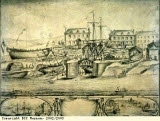
Bristol dock at the height of the slave trade


On a trip to the Bristol ice rink with Helen, a racist gang threatens the two friends. Brandon insists Helen gets her dad to take her home, while he stays to face the gang. Brandon knows this is just his luck...and his 
problem. But Helen and her Dad have not gone home. They arrive just in time to save Brandon from a beating. But this scare makes Brandon clam up; he refuses to acknowledge what has happened and refuses to go to the police, even though he could identify the gang.

While his own story is developing, Brandon tells us the story of Jake Silver. Helen has discovered a perplexing sepia photo among her late grandma's effects, and they find themselves uncovering the story of Jake Silver, an eighteenth century slave brought to Bristol from the West Indies to be a page boy to an evil mistress...We had to make him up, partly, fill in the spaces of his life by imagining it, like doing a jigsaw where a lot of the pieces are blank, tossing ideas between us, trying to work out what it would be like to be Jake. As Brandon learns of the courage Jake showed 200 years ago, he sees how his actions lead to the sort of luck he deserves. He puts his fears to one side – in life, you make your own good luck..

He’s standing on the dockside. People walk round him, eye him up, check if his teeth are sound. He doesn’t exist for them, except as something that might be of use...


Because Brandon likes to be thought of as a joker,  the  writing style is witty, upbeat and easy to read, even for children who are still struggling to read. The action begins quickly and builds into several thrilling peaks. The hard-hitting themes of the story effect children’s lives today, opening  out issues and information that will widen the understanding eight to thirteen year olds of both genders.  


Just My Luck is a modern adventure story, which allows its characters freedom to have exploits in the ‘real world’, to follow a ‘quest’, and to learn about the history of slavery, and
its aftermath, as Helen and Brandon
 grow through the discoveries they make within their story. 


A treasure trove for ten-year-olds that deals with big issues without ever sermonising. Encompassing family history, slavery and modern-day racism this should be a gem for teachers looking for fiction that will bring the curriculum to life while providing a cracking readAli Bacon, author of  In the Blink of an Eye         

Embark on Nina Milton…and you won’t stop reading… Naomi Lewis, Book Review, Sunday Observer 


Buy your copy by clicking here.


This edition of Just My Luck 

is dedicated to every person

who has lost their life 

in the fight for racial justice


Thursday, 23 July 2020

STARTING TO WRITE: Villains; what would do without them?


In my latest blogpost for the Open College of the Arts, I ask the question, "What would we do without villains?"

I examine the idea that fiction needs villains, and ask; can stories survive without active opposition or  hostility from any quarter, human, or not? Can a writer completely do without an antagonist? Even the most worthy literature falls very flat without dramatic tension, and that does have to spring from some kind of conflict, which is usually described as the antagonist, whether this is a supernatural entity, an internal struggle, a jealous lover, or tsunami. 

I look at different types of antagonists, contagonists and protagonists through some interesting books, from Misery to Gone Girl. From Les Miserable to One Flew over the Cuckoo's
Nest. From the Catcher in the Rye to Big Fish.

And what conclusions do I reach? Do we really need the evil villain in our stories? Just remember the first principle of writing is – no conflict, no story.

Saturday, 18 July 2020

Middlemarch by George Eliot; Stellar Authors

MIDDLEMARCH by George Eliot

'Read Classic', an occasional series of posts on 

Kitchen Table Writers


Last year, I read Andy Miller’s hilarious best seller, The Year of Reading Dangerously. His

bonkers idea? That he should actually read all the classic novels that he daily pretended he had already read. Books like Don Quixote, Beowulf, War and Peace…fifty in all…consuming them on his long commute to work as a publisher’s editor.

Alan Bennett describes a classic novel as one that; everyone is assumed to have read and often thinks they have.  As I chuckled my way through Miller’s entertaining book, I too, wondered if there were any classics out there I had ‘pretended’ I’d read


I came up with George Eliot's definitive, eight part, four volume masterpiece, Middlemarch. I’d started it yonks ago, and really

enjoyed the first chapter, which introduces us to two spirited and contemporary sisters, Dorothea, a quick, bright girl who has a hugely honest and socially-aware heart, and Celia, who is focused on finding a rich hubby. 

For some reason, I laid it to one side and forgot about it. When the novel was televised, some years ago, I didn’t have a TV, but did catch one episode on someone else’s screen, where I quickly worked out that we were all supposed to hate Edward Casaubon, who is cold, insecure and mean-spirited. Quite soon in the novel, Dorothea makes a disastrous error of judgement and marries this unpleasant man. She believes he is a great intellectual whom she can assist and learn from.


I knew I wasn’t alone in my fascination for the Reverend Casaubon after coming across this in an agony aunt online page; 

Masterpiece Theatre production;

Edward Casaubon played by Patrick Malahide

My boyfriend has been reading me the novel Middlemarch out loud, and the character we both find the most compelling is Dr. Casaubon. We’ve had long discussions about his foibles and the pathos of his insecurities. My boyfriend recently brought up the hypothetical idea of “solemn play”—someone who has a fetish for pretending to be like Casaubon toward Dorothea, refusing sex and making her instead do long, pointless tasks for him. In his eyes, this role-playing would be rife with erotic sublimation. At first I thought this was hilarious, but he has brought it up several times and mentioned buying a cassock…
(To read the advice given, click here )


With that scintillating image in mind, I started Middlemarch again at page one, ploughing through while bearing Miller’s words in mind…that, ‘a few hundred pages in, I realised I cared about these people. Suddenly, I couldn’t put the book down’.


It soon became clear I was reading a story that was modernistic in its plot and structure, and that Virginia Woolf was right; it is ‘written for grown-up people’. 


Eliot subtly yet penetratingly delves into the the minds of the many main characters; their hopes, their fears, their failings. I visualised this huge cast of perfectly ordinary provincial townspeople as they rode or walked its streets and byways and went in and out of town houses, cottages and the country mansions that were satellites around the town.


Soon, I fully believed that they were as real as I was. Like Miller, I couldn’t put this book down. It was heavy, yet I carried to to France in February because I couldn’t bear to leave these characters behind. I was hooked.


We focus in on three sets of lovers; the ordeal of Dorothea’s life with Edward Casaubon; the ‘too hot to not cool down’ romance between Terious Lydgate,  a progressive doctor who truly wants to do good for the health of the townspeople, and Rosamond Vincy, who’s head is full of fashion, flounces and other fancies. 


Her brother Fred is as shallow as she is. If they lived now, they’d be minor Youtube stars, letting us into their lavish lifestyle, which neither of them can afford. Fred is deeply in love with Mary Garth, the level-headed daughter of Caleb and Susan, lower-middle-class people

 who are struggling financially. Mary loves Fred, 

but refuses to marry him until he finds a steady occupation.                 


As Dorothea comes to doubt her husband’s unfinished magnum opus, she develops a friendship with Will Ladislaw, his idealistic cousin. Casaubon shows his true colours; controlling and jealous. He changes his will to make sure she never marries Ladislaw if he dies…which he then proceeds to do with more drama than he’s ever done anything before in his entire life.


Business, politics religion and society are all examined under Eliot’s, microscope, helping her further unpick the complications of human motivation. Rosamond’s expensive lifestyle has led the Lydgates into financial ruin, and Lydgate seeks a loan from Nicholas Bulstrode, a widely disliked banker. Balstrode is being blackmailed by Raffles, who knows about his unsavoury past. Raffles falls ill and Balstrode asks Lydgate to tend him. He deliberately ignores the doctors advice, and Raffles dies at Balstrode’s great house. Questions arise, and the Lydgates’ position in the town becomes untenable. Only Dorothea, has the power to help them, but Rosamond already believes that the wealthy widow is a threat to he marraige.


As I hurtled towards the final chapters, there were so many questions to answer, and so many issues to resolve. Would Terious and Rosamond stay together? Would Fred finally come good and win Mary’s hand? And what is the future for Dorothea? Could she find

the inner strength to throw over her huge inheritance, ignore 

her late husbands coercions and marry Will Ladislaw?                                                                                                        


The only way you can find out is by reading the book.


                            It’s dangerous, but I fully recommend it.


Check out the other 'Read Classic' Reviews; 

Moby-Dick by Herman Melville

The Road by Cormac McCarthy

Dracula by Bram Stoker


Frontispiece illustration is 

Copyright  Eleanor Davis, 

 cartoonist and illustrator  


 3 final illustration from top down;                                         Dorothea and Will Ladislaw, 

Tertious and Rosamond Lydgate,

 Mary and Fred,

all courtesy of Wikipedia.


Wednesday, 8 July 2020

STARTING TO WRITE Burrowing into Your Wrting––Close Observation

Observing closely...one of the secrets to great writing, the key to finding your writing muse. And so simple! Just spend a small amount of time paying close attention to your environment. Register the sensory responses you have for ten minutes or so, focusing on your inner relationship to them…that link between what you sense (see, hear, feel, taste, smell, understand, infer, intuit). I call this 'burrowing into your writing' because sometimes I lose myself into this process. It becomes a 'brown study', more or less, I'm entering a gentle trance-like state that will help me create my words. 

In this blogpost for #WeAreOCA, I look at what some renown writers on writing have to say about observing closely, then offer some further work you can do to help your abilities with close observation, until you too can 'burrow into your writing', deeper and deeper. to the places with the most potency, where your muse awaits you.


Click on the link here to read the rest of this post at WeareOCA from the Open College of the Arts. 

Friday, 26 June 2020

Seven Books that show #Blacklivesmatter

The #BlackLivesMatter protest in Cardiff, Wales has a proud history of showing its compassion and support, not just notionally, but in action.
 Picture, Angharad Arnold.

One of the ways #blacklivesmatter wants to help bring equality and justice to black and minority ethnic people (and children) is by educating those who have never had to think about their role in the Western World. They’ve put out a call for everyone to better understand the experiences of black people and through that make their own contribution to proactively changing the society they live in.


When I was researching Just My Luck, I read an enormous quantity of non-fiction,

especially books on the history of Caribbean slavery, the way racism works in the UK, and black memoir.


That’s why I’m so proud that Just My Luck is being re-released in Kindle at this exact time, although, of course racism has been with us forever, and the Black Lives Matter movement was formed almost a decade ago, after yet another shooting and conviction of the policeman holding the gun.


I’m convinced that if you want to know about a difficult and complex subject that effects people’s lives, the best place to start is a novel…not just my book, but many for both young people and adults. 


Here’s my list of seven great books that will both educate and entertain you:


The Hate U Give

This was Angie Thomas’ 2017 debut novel, which, for all you hopeful writers out there, began as a story she wrote in college over the police shooting of Oscar Grant in 2009.Starr, a 16-year-old black girl who has a place at an elite school, witnesses a white police officer shoot and kill her childhood friend, Khalil. What should she do with this experience? Will speaking up change anything?  I devoured this book; it's a gripping and emotional read, whatever your age.


The Underground Railroad

This Pulitzer Prize winer is about Cora, a slave on a cotton plantation, and an outcast even among her fellow Africans. She learns about the Underground railroad and makes a bid for freedom. Colston Whitehead’s story is multilayered, describing the secret network of tracks and tunnels used for escape, and every stop along the way to the North offers more risk and terror.


The Confessions of Frannie Langton

Published last year, Sara Collin’s story moves from the plantations of Jamaica to the drawing rooms of London. One of my favourite books this year, it's a beautiful and haunting tale. 


Lieutenant Hotshot

The story of an invisible child, by Julia North.  Modetse is brainwashed when conscripted ito the horror of the Resistance Army at 11 years old. What chance can Modetse ever have of truly finding himself again, or rescuing his little sister Thandi?


The Last Runaway
Tracy Chevalier is the author of 10 novels, including the international bestseller Girl with a Pearl Earring, which has sold over 5 million copies and been made into an Oscar-nominated film starring Scarlett Johansson and Colin Firth. In The Last RunawayHonor Bright, a quaker, emigrates from England to Ohio in the 1850s. She gets involved in helping runaway slaves trying to reach Canada, help that can result in fines, jail, or even losing her husband's property. 

The Help
I read this book by Kathy Stockett shortly after it was released; since then it's become a film. Read or view to learn more about the American Deep South in the sixties, following the stories of two black maids, MInnie and Aibileen, and the white university graduate, Skeeter, who wants to help broadcast the injustice of their lives to the world.

Just My Luck
On July 1st, my story of two thirteen year-olds who get caught up in racial bullying is release on Kindle; you can pre-order now.
Three stories merge; Helen was going through her grandmother's things when she begins to wonder if she has a  link to Jake Silver, a slave boy brought to England from the West Indies in the late 18th century. Meanwhile how can Brandon overcome his fears about the gang who has threatened him and tell his story to the police?
With an upbeat and fast-paced style, a quest to solve and hard-hitting storyline, Just My Luck will appeal to a wide audience – grown-ups and young readers alike – especially for its historical content and in tackling the subject of racial violence in the 21st century head-on. 
Kindle released on 1st July; paperback version available in time for Christmas!