

Well, I’ve now had chance to absorb the entire longlist for the Booker Prize 26, and herein lies my thoughts. The Booker describes itself as looking for sustained fiction that challenges, even innovates, in style, voice and subject matter. That suggests it will focus on fairly experimental fiction which pushes boundaries, and, although I don’t think they overtly state that claim, it’s often true.
I’ve been reading the Booker list since the 70s, and seen it lose its way a few times (see below…), but also pinpoint trends and discover amazing voices. It certainly allows people to focus their reading if they want to explore contemporary literary fiction.
It’s my observation that the difference between the Booker and The Women’s Prize is that the latter often goes for a rollickingly well-told story, above innovation and experimentation even though, in the past, the prize has rightly gone to experimental work such as A Girl is a Half-formed Thing.
This year, I’m heartily hoping that the Booker doesn’t forget that, ultimately, what people long for is a great story is told well.
I’d say this year is a weak year. There’s certainly plenty of experimentation to be had on the longlist; a lot of the books omit speech marks, and one of these has no dialogue at all. Two are quite absurdist, which is fun, but often means that story is lacking.
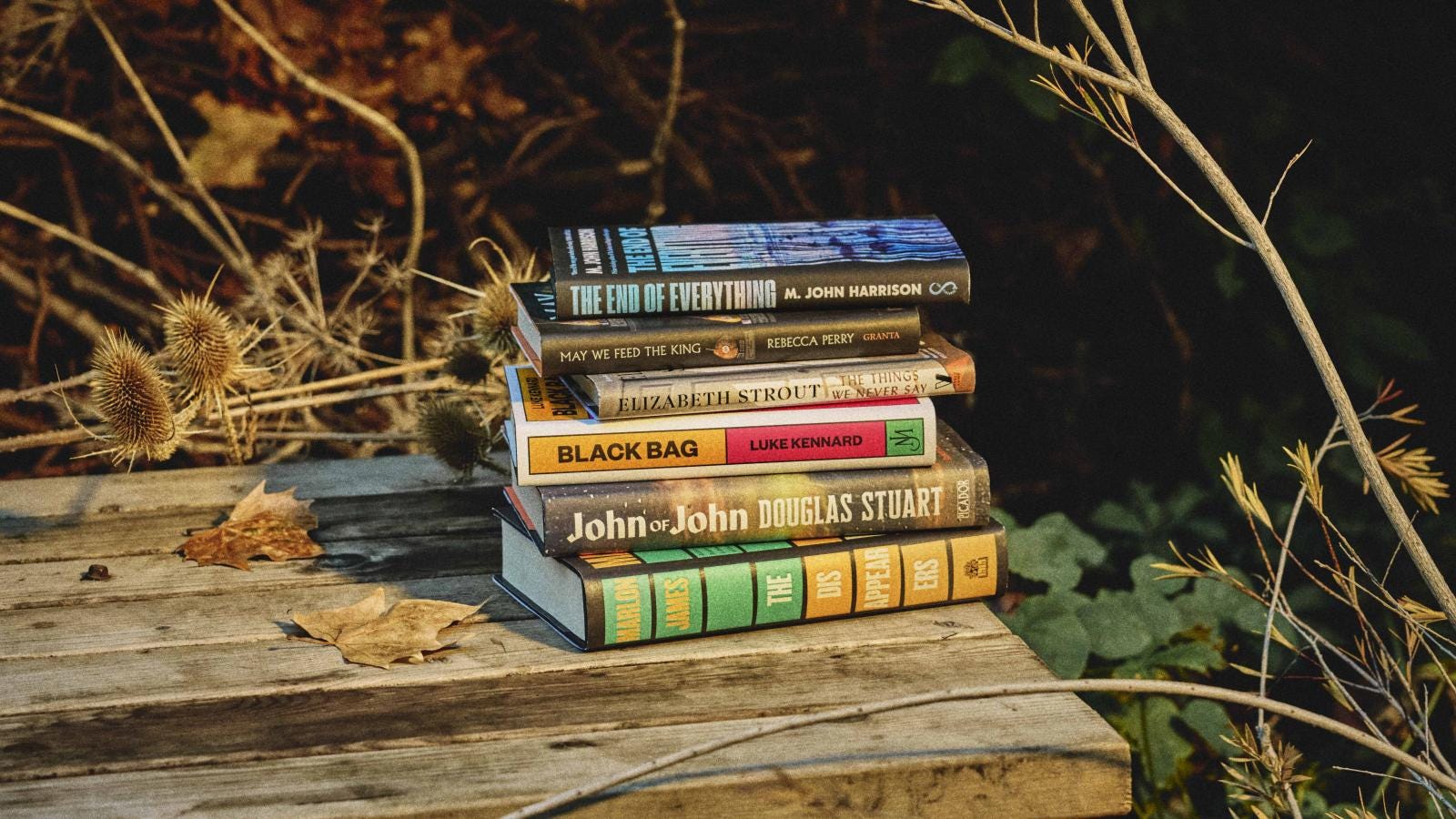
May We Feed the King by Rebecca Perry isn’t short on storytelling despite a very experimental approach, which includes, as far as I can glean, no mention of the protagonists names. A curator of a grand house reveals the story of a centuries-dead king who’s work she is celebrating. We’re deeply into her thought processes which are focused on work to the point of wanting to sleep in the grand house. Perry describes everything with a lyrical tone–she’s a poet and this is clearly demonstrated.
I enjoyed her story, although it is rather thin, but it was hard to get into the medieval story. Even so, it won the Waterstones Debut Fiction Prize 2026, perhaps because of the deeper meanings which focus on the history of power, it seems to me. I don’t rate this as a strong contender, but I’ve been surprised (shocked!!!) before now.
The End of Everything by M John Harrison. I was unrecommended this book by reading friend…unrecommended in that she described it as ‘ultimately shite’. And she’s partly right, it does move rather slowly, when we examine actual story content. Like the novel above, it seems to be Cli-fi; focusing on the scenario of what will happen when civilisation eventually collapses. Something arrives on a beach which is clearly a threat. Harrison is a major stylist in the fantasy and science fiction genres, and I like his writing, but this did, in a wierd way, drag…it may have made a better long short story.
Black Bag by Luke Kennard is witty, entertaining, makes sense even though it’s rather absurd, focusing strongly on our obsession with internet living and influencing It actually uses a real psychological experiment conducted in 1967 at Oregon State University as its basic plotline.
This story was also longer than it’s actually content should dictate, but Kennard is a veteran novelist, and knows the secret behind hiding their ‘soggy middle’ successfully. Sex! Lots slightly kinky sex! Worked for me. I think he fell down on his deneoument, but I didn’t care, fully enjoyed this. However, I was surprised to see it pop up on the shortlist and I don’t think it will win.
The Disappeared by Marlon James was my next read. I loved his earlier Booker winner (7 killings), but his later books failed to capivate me. Now we’re back in Jamaica. I’m already used to his Tolstoyianly unwieldy cast list and his gloriously complex plotting, not to mention having to get my head around the Jamacan accent in all its glory (for 7 killings, playing Bob Marley as I read did the trick), but I enjoyed this thoroughly. The book has its detractors, but these might be the same readers who are not keen on Tolstoy et al. It is the longest book on the list; the longlisted Helen of Nowhere is 460 pages shorter; a large percentage of the books are quite short. And, I'm wondering–do the judges have to be careful about awarding the prize a second time? Is there an unwritten rule? This is book I feel I sometimes skimmed through, and this is book I'd really like to read again, properly this time.
John of John. Douglas Stuart may fall into the same trap as James…in 2020 he won the Booker with his debut novel, Shuggie Bain. I loved that book, whic was so emotionally absorbing. John of John is mature, as if in the meantime, Stuart had decided to really become a writer (his day job is fashion designer). It’s a rollicking, slightly heartbreaking story, which pulls you in and holds you fast and gets your turning the pages quickly. Will its storytelling qualities be as much a problem for the judges as being a previous winner? I get the feeling this is the pick of ‘the guy on the tube’, and deservedly so. Real characters and a gripping story with–yes really–a proper, satisfying ending.
The Things We Never Say by Elizabeth Strout. Finally, my pick. Okay, if John of John wins, I’ll be delighted, but I think this one will tip the balance. Strout has been ‘the bridesmaid’ long enough. She was longlisted in 2016 for My Name Is Lucy Barton and shortlisted in 2022 for Oh William! and won the Pulitzer Prize in 2009 for the wonderful Olive Kitteridge. The reason I’d like her to win is not only because this a great book, but also I think it’s her greatest novel yet, suggesting she’s still growing as a writer. As always, there’s exquisite prose and profound insight into the way we humans live, but I do adore the way it does what it says on the tin…it’s about the things we never say.
Which brings us onto the also-rans. Often, it's easy to decide which books will fall by the wayside, but this year, the judges did plump for some quirky literary preferences; rather obsurdist, rather sparse, wide psychic distances from the narrator, too much playing around with surrealism, satire, language, structure, length, grotesque meanings, strange symbology, wickedly confusing layers…so much playing around with our minds, just as the Booker always loves to do…it became quite impossible to see which of these novels would find there way through to the shortlist. I've read four of the seven that didn't make it, and am happy to say none of them were on my 'yes please' list. Apart perhaps from The Shadow of the Object. This is a book of two halves and I think the second half might have 'done for it' Flora visits her parents in Mexico, and gets bitten by the family dog, when she creates a shadow on the wall with her hand. In hospital, she makes a close friend, an elderly woman called Wilhelmina, who is obsessed with her collection of magic lanterns. When Wilhelmina dies, Flora takes her ashes home to Max, Wilhelmina’s son. They begin an on-off affair, and Max holds a magic lantern event at her workplace, where she polishes silver. A thinnish plot but with lots of symbolic reflections, and an enjoyable, chewy story, with a lot of meaning beneath the many shiny surfaces. While Wilhelmina believes ‘we have but a finite number’ of emotions', in Missouri Williams The Vivisectors, Agathe tells us she has almost no emotions at all. She’s happy to work for a fraudulent professor at a crumbling university, and in doing so support her position on a modern, college crime; upsetting someone without meaning to. Meanwhile, nature is on the move, taking over gardens and even the concreted city. It's hard to make sense of all this, although there does seem to be sense, deep below the nonsensical surface. Makenna Goodman’s Helen of Nowhere is equally obtuse. It is structured as a six-act play of monologues with some exchanges of dialogue. Ironic and illuminating, I did like the way it looks at self-delusion, but I felt underwhelmed by the sad, pointless characterisations. Finally, I read Switzy, by Emma Cline. This is reasonably well done; an elderly man looks back on his life, the failings and failures, while on the way to Dignitas. It has a formula that has already won the Booker, Penelope Lively’s lovely Moon Tiger had a similar ‘look back in sorrow while dying’ theme.
 |
| This motely crew is picking the winner |
I always want the great story…rather than the experimentally challenging novel…to win, and yet, of course, we must experiment, we must challenge. Anyway, on Tuesday, 9th November, at an evening party, the winning title will be announced and we will all know who’s this year’s Golden Writer. Time to make your choice; do let me know in the comment section.


