Showing posts with label Children and Young Adults.. Show all posts

Saturday, 13 February 2021

Trail-blazing Teen Writers – "How They Got Published – Stories of Writing Success",


 Trail-blazing Teen Writers. 

In this occasional series, "How They Got Published  – Stories of Writing Success", we look at how writers got their very first contract; the story of how that happened and how they are so very willing to share their advice with other hopeful writers. 

This time we look at some writers of Young Adult fiction; a popular genre both to write in, and be read in. Teens are not the only readers of YA fiction; adults love it too and due to its popularity, the publishing houses also are on the hunt for good teen fiction. Here are four writers who 'made it' with their very first novel.

Sue Lynn Tan was born in Malaysia, studied in London and France, and currently lives in Hong Kong with her family. Her first book, published in 2022, Daughter of the Moon Goddess has been described as a ‘epic, romantic — an all-consuming work of literary fantasy, with a perilous quest, legendary creatures and vicious enemies, and a moment where the protagonist, Xingyinm, must make a vital decision between losing all she loves or plunging the realm into chaos.

Tan’s fantasy world is rooted in a non-western canon using the myth of Chang’e, the Moon Goddess, who was married to Houyi, the archer who shot the nine suns. Houyi was gifted an elixir of immortality but did not drink it, as he did not want to be parted from his wife. Yet Chang’e drank it instead, becoming immortal and flying to the moon. Here, she takes to Utopia State of Mind about the aspirations she gained from the myth and how she transformed it into a YA novel, her thoughts on the characters, and the editing she undertook.

While researching the legend, I was struck by its variations: Was Chang’e originally an immortal or mortal? Did she drink the elixir to save the people from a tyrannical Houyi, or to save it from thieves, or did she want to become a goddess? And in the end, did she reunite with her husband or live out her eternal years in solitude on the moon? Perhaps the variations morphed to portray Chang’e in a different light, though we will never know the answer. What is certain is that she is a much-loved figure, and one that I adore myself. I studied the different variations of the legend of Chang’e and Houyi, though I could not include them all in the story. I also researched archery – the materials of ancient bows, an archer’s posture, the sound the arrows made as they sliced through the air. I especially loved researching Chinese dragons which are quite different from their Western counterparts: though equally as powerful, they are typically wingless, creatures of water, benevolent and kind.

‘I love Xingyin’s resilience and hope. When she faces devastation and disappointment, she does despair like anyone might, but does not yield to it. Yet her nature can be reckless and impatient, particularly for things she finds hard or which she is eager for. Xingyin is a skilled archer with strong magic, but of equal importance is her intelligence and emotional depth—her ability to empathize with her enemies, even those she despises, to try to understand their motivations.

‘Xingyin’s love for her mother is the driving force behind her ambition to return home, and free her. Their bond is especially close because the moon is a solitary place, and they only have each other for company, along with a single attendant. It is not always a smooth relationship for Chang’e is dealing with heartbreak from her separation from her husband, and there are things that she is reluctant to share. Yet Xingyin is empathic and compassionate, and considerate of her mother’s feelings.

‘I tend to find drafting more challenging than editing—figuring out the story at the same time as developing the characters, although it is also the most exciting stage. For me, it is a slower process, with a lot of back and forth. I enjoy editing, refining the story and thinking about how it can be made better, although it depends on the deadline as well.’  (Utopia State of Mind 2022)


Before Luke Palmer began his debut YA novel, Grow, he wrote poetry; a debut pamphlet of poems, Spring in the Hospital, won the Prole Pamphlet contest in 2018. Grow (2021), which has been studied throughout this pathway, is published Firefly Press. Grow has strong themes of racism, terrorism, rape, grief and loss, and cultural coercion:  Josh is struggling to cope with his father's recent death at the hands of terrorists when he becomes attracted to a white supremacist group which tightens its hold over him. But Palmer counteracts this by offing moments of respite for the protagonist, when he  becomes involved in some ‘gorilla gardening’ with a school mate.  The introduction to this landscape coincides with Josh waking with the dawn, face down on the ground, after taking a beating the night before:

        ‘’The blackbird turns its head, flied off. I watch it as it comes to rest on a stone wall about five metres in front of me. Patches of moss, cascades of great leaves with purple flowers cover most of the wall’s significant height. I realise there are walls on three sides of me and, with the wooden boarding at my back, I’d say I was lying in a pretty even-sided square.                                           The blackbird trills on, and above its head a scurry of wings brings two more birds into view. I don’t know what these birds are, but when they move they look like pale blue streaks. One of them arches its flight to land on the branches of a small tree in the corner of the square. When it lands, I see its chest is yellow against the bush’s purple spears of flowers. I force myself up, every joint in my body complaining.'   (Pg 43)

Palmer talks here about the trigger for this story:

‘A few years ago, I was sitting in a room full of teaching colleagues attending a compulsory Prevent strategy training session. A general murmur of dissent went through the room at another case study of radicalisation of a young Muslim student in a school hundreds of miles away. This school’s percentage of non-white students was well below 10%. There had never been a Muslim student on roll. Radicalisation was Someone Else’s Problem.

The next case study involved a young white male. Teachers in his school had grown concerned after he voiced several right-wing opinions in his lessons. Following an investigation, a number of bomb-making materials were found in his bedroom along with plans to attack a nearby mosque. The earlier murmur of dissent turned to one of realisation – radicalisation wasn’t just one way. We’d all been having more and more frequent conversations with students around the increasingly polarised sides of the Brexit debate, and the rising tide of nationalism. Pupils were getting angry – the kind of anger that bubbles up when young people are engaging in vital but un-nameable conflicts with aspects of themselves; aspects that cut straight to the heart of identity and selfhood. All around me, names of certain students started to circulate, and questions were asked about how to challenge radical and pervasive viewpoints, and to address this anger in the classroom. This is where the book that became Grow first started.

I wanted to write a book which addressed that anger; that explored the difficulties of coming of age against a backdrop of increasing animosity and xenophobia towards elements of our society, of toxic ideologies that try to breed and harness that anger, and of competing models of how to be a good citizen. I wanted its central character to be pulled by the extreme ends of this spectrum, enticed and revolted by them in equal measure. I wanted him, above all, to suffer through his anger in the way one suffers through grief. But I also wanted him to come out the other side wiser, more aware.

And I wanted to write a book that was believable, now. A book about multiculturalism that rings true for the many people who don’t experience it on a daily basis except mediated through their computer or phone screens. People in a society where suspected far right radicalisation now outweighs any other referral to agencies involved with the Prevent strategy. Perhaps those two things are connected.

But most of all I wanted to write a book about growing up, about changing, about becoming the person you want to become, about relationships with mothers, fathers and friends. I wanted to write a book about connections, that might speak beyond its immediate context to the core of that anger; the need to be understood.

The book that I wrote is Grow. The wonderful team at Firefly Press have helped me to bring this important story into the world, and for that I’m eternally grateful.’     (Palmer 2021)

Tomi Adeyemi is a Nigerian-American novelist known for her novel Children of Blood and Bone (2018). the first in the Legacy of OrĂ¯sha trilogy. It won the 2018 Andre Norton Award for Young Adult Science Fiction and Fantasy and went on to win the 2019 Waterstones Book Prize. She is also now a creative writing coach, and was one of Time’s “Pioneers" 100 Most Influential People of 2020. Here, she talks about her love of YA fiction, and offers some advice to students of the form.

It was painfully clear what writing is for me and what it's always been for me, which is just my lifeboat, It's this outlet for me and this sort of companion through this really insane process of being alive.

I think why YA speaks to all of us is not just because it's so emotionally intense and usually more plot driven because it has to be,” she says. “We're not separated from who we were growing up.

Focus on cultivating your ‘inner world’ of creativity before worrying about what the world thinks of your work. Dive into yourself and put what’s on your mind on the page. If you solidify that inner world that you dive into for that creativity and for that process and for what it does for you — something that you have 24/7 access to right now, that you don't need an agent or a publisher to give you — that's all you need. The other stuff can come.’     (Mosely & Hagan, 2021)

Angie Thomas is still perhaps best known for her very first book; The Hate U Give (2017), is told entirely in a single first person POV, using the present tense, and yet its thematic depth is constantly engaging – and terrifying. Here she talks about her early misgivings, and wondering if her writing would matter:


‘I think at the time it was just, I'm just going to have the audacity to write these books about young people who look like me and neighborhoods like mine. And if I just have to sell them out the back of my truck, then that's what I'm going to do. It's important for white kids to read about Black kids and read about the different kinds of Black kids. But on the other hand, we have this whole idea that anything done by a Black author or a marginalized author has to be excellent when we should be able to do a range of kinds of books. We shouldn't have to hit a certain level to be able to get a seat at the table.

I once had a white parent come up to me at an event and she was like, ‘I don't know if my 14 year old is ready to read ‘The Hate U Give.’ And I said ‘Well, could you tell that to the Black parent who was having a conversation with their 9 year old about what to do if they're stopped by a cop?’    (Giorgis, 2019)

You might like to research new YA authors you’ve discovered and loved reading. Your first stop is the internet, especially author blogs, YouTube and publishing websites. You might also find your author speaks directly to their readership at the back of their novels, and in magazines/journals that focus on literature or writing.

To read more 'how the got published' blogposts, click here

Friday, 1 January 2021

2021– Here We All Come!

When I walked out of my door  this morning, it was hardly light; the sun still is rising at around 8.15 in West Wales. The moon was well up above the western horizon. Although technically in its 'waning gibbous' phase, it is still pretty full to the naked eye and the phenomenon of seeing the bright full moon and the first glimmers of rising sun was inspiring.


Seeing these two great celestial bodies together, reminded me of a passage in the 2nd Shaman Mystery;
 
The full moon hung low in the west, glowing like a Christmas bauble, outflanking the real baubles in every shop window. It was bitter cold in my garden as the moon sank on its steady course. Six of us stood on my lawn, holding hands through our gloves, our faces raised to watch the moon set. Magically, this full moon would drop below the horizon just after the winter solstice sun would rise above it. We’d set up a pagan circle under the dying moon, in almost the same way as I set up my therapy room. We cleansed it with a besom broom and smoking incense, and a sprinkling of Glastonbury water. I took my wand of yew and cast a circle which would enclose us and keep us safe. We called in the powers of the four directions; north, east, south, west and the central powers that come from a place and time so sacred, it existed before any place or any time. The centre of our circle was marked by a lantern (didn’t think a candle would last the event), which let out enough light for us to see where we walked while the sun rose. It was already getting lighter in the garden; dawn was arriving long before we would see the sun rise over the rooftops. But we could see into the west, where the moon’s last light was fading as dawn broke. I thought about the way the solstice sun would hang in the its southern-most latitude for three or four days, where its path from horizon to horizon was so short it offered nothing more than a glimmer of warmth and a few hours of light, making the night interminable. Once those three solstice days were through, the sun would begin to move northwards. It would grow warmer, week by week, And every day, the sun would rise earlier and set later.  

I whistled my dog into the field beside my garden. It is clothed in snow, and the glow from the moon coated the snowy field in an eerie yellow light. This is our morning ritual, to get out and walk around the 10 acre field together before even a cup of tea.

As I crunched through the snow, a thought occurred to me. What's the connection between you, me and everyone else on the planet today?

Probably you can guess.

"We're all heading into a new year. 2021, the 'coming of age' year of this century and the year above almost all remembered years where everyone is voicing one thought";

 LET'S HOPE IT'S BETTER THAN LAST YEAR!

2020 was a pretty dismal year in so very many ways. The pandemic raised its head very early on  and has dominated every news headline, every action, and almost every thought process since the spring. It's not over, but thanks the the intensely hard work and brilliant minds behind several vaccines, there is now light...light that is echoed by the sun's steady progress from deepest, darkest midwinter into a new spring.

The darkness of the winter morning, and the soft glow of the moon and the growing sparkle of the rising sun on the snow. cannot help but remind me of the way the covid pandemic has offered little glimmers of light. The way, despite being locked down and often isolated in their homes, people have risen above themselves in remarkable ways. Some have focused on keeping their physical health together, achieving longer runs, further walks, better yoga postures. Others have had to cope with difficulties in  mental health A lot of us spend time reconnecting with themselves, perhaps concentrating on a renewed appreciation of the little things. Some wonderful souls have raised millions of pounds, but for others, the thing they are most grateful for. is the fact that they are still here in this world. Perhaps we learn, when things are taken away from us, how to appreciated.

My husband has concentrated on learning the hardest language in the world (we both think); Welsh.  Puzzle magazines and 'learn an instrument' videos have had a great time of it in this crisis. I've baked myself into a floury mess, even trying my hand at sourdough with limited success. I have a friend who has walked miles (within the daily limits) and learnt to  photograph wildlife as he ambled along, People have  taken on new pets,  redecorated or rediscovered painting as a hobby, I've seen a lot  old garments up-cycled  into new ones. All over the UK, people have crafted up a storm. Tom Daley crotched a pair of personalised swimming trunks (and a cardigan for his son)!  Katherine Jenkins sang into her phone and gave Facebook viewers a weekly dose of music for free. while other celebrities used their kudos to raise funds or ginger-up government action. I think we've all learned something about ourselves in the past year. I've heard this from so many people. New understanding of the slow and mindful processes has permeated this process, for when we slow things down, we see them in new and more intricate ways.

Lockdown has allowed a lot of writers a huge chance to write. In the next few days, the 3rd Shaman Mystery, Beneath the Tor, will be once again available in Kindle as well as paperback.  

Meanwhile, I've been putting the finishing touches to the 4th Shaman MysteryThrough the Floodgatewhich is now in production. This story is set in another period of deviations; the tragic floods of 2014. The Somerset Levels, which devotees of the Shamanic Mystery Series will know is where our hero, Sabbie Dare, lives, was deep underwater during that winter. This sparked my imagination and Through the Floodgate. was born, took shape, and now, I believe is the most relevant and thrilling book of all the series.

I'll be letting you know about these  events in the coming days and weeks. 

Meanwhile, of course I wrote on. I have almost finished my latest book for young adults. There will be more news about that soon, too.

All of that hasn't stopped 2020 being a grim time, I know. Death has stalked us even as we stayed in our houses. Not all who died did so of the new virus. Around the world there has been natural disasters, manmade disasters, police and state brutality We need to learn from all of this as we move into 2021. We could all do with getting back to normal,  visiting friends, heading off to a concert, browsing a library, having family round. 

So I'd like to know...

What have my readers been up to, since the start of 2020? What have you started  doing,  learnt about yourself, achieved through hard work or luck? And what do you wish for this promiseful year?

I'd love to know; leave a comment below.  In the meantime, I can only wish you

A most blessed, peaceful and hopeful 

new year, 

with wishes that you will get just the right level of excitement in 

2021


Saturday, 26 September 2020

Writing a Young Person's Novel, Nina's Seven Basic Steps.


People are asking me regularly now, about the book I began writing two years ago. Questions like 'how long does it take to write a novel' and 'however do you start' and 'do you have a process for writing a book?' and, 'how do you know that you're done?'

In his famous and much-loved book on writing (which of course he called  On Writing), Stephen King advocates that you; start with an idea and some characters, and seeing where it takes you...

I still follow this plan, but I've found it works better if it's better defined, not so vague as see where it takes you... So I break  idea/characters/write on into 7 basic steps. What are they? Read on, dear subscriber...

1. The idea

I've recently written here about how my idea of my children's novel Just


My Luck 
came into being, using the unlikely-named 'Commonplace Book' But I also like using a mood board, and when I started my latest book The Wrong I Did,  which is for 14+ to adult readers, I blogged about the mood board I created here These pictures, postcards, snatches of little items and cuttings from magazine made me learn a lot about my characters by looking, rather than by writing. It helped me get a feel for the two characters I started with, Caitlin and Lily, sorting out how they met, and why that was important to the story.

2. Decide on a location

Caitlin and Lily grew up in my hometown of Bristol. They met on the day Caitlin's father died from a heart attack; the day her mother went right off the rails. Lily was the pharmacist's daughter and Caitlin thinks she is the wonderful person she has ever met.

But I really wanted to set some of the book in Aberystwyth. It has huge atmosphere as a West Wales seaside town, but it's also full of culture, with a big university. The countryside is wild and atmospheric. Caitlin arrives  as a traumatised, but streetwise, 16 year-old. She begins to find her way round, allowing the reader to engage with the starling murmurations, the cliff railway, the seafront, where her 'sort of' boyfriend serves pulled pork sandwiches to the punters, and the National Library of Wales, where her  Welsh-speaking foster mother works.

3. Get to know your characters

Steadily, as Caitlin revealed her story to me, I could see that there would be a few important other characters in this story. To start with, I thought about Caitlin's relationship to each other those.  The way she hates £££ on sight, because she wanted to go back and live with her mother, of course. The way she remembers (( her social worker at the secure unit she's been detained in since she was fourteen, and the terror his image strikes in her heart. The sudden fear when $$ approaches her in Chapter One, telling he wants to tell her story. She thinks he's been sent from !! who was in charger of her movements all those years ago, when she was a tracker. And the powerful bond she forms with && after finding him half dead next to dumper bin at the back of the Aberystwyth shopping centre.

4.  Decide on themes

The best stories speak to us on multiple levels, an opportunity to explore key issues within society. I wanted to explore the newish phenomenon of 'County Lines', which seem impervious to police intervention. They are secret, clandestine. They use children as a front for drug-related activities. This is Caitlin's past, but she's now trying to leave it behind.

5.Outline the story into 3 acts

 This  formula may be old, and a bit  mechanical, but it helps maintain a structure as you write the words of your story. There are many more complex ways for structuring but sometimes the  simplest way is the best. 

Even so, I wasn't simple about it! I needed an outline of the story as it happens to Caitlin, before I could start looking at the story as it appears to the reader. 

1 Caitlin's father dies when she's 11. She tries to help her mother, who is hooked on sleepers and tranquelizers. She approaches a tracker – a drug dealer at school – and is soon sucked into the life of supplying. 

2 The second act is told in flashback, like the first. Caitlin is found guilty of murder and supplying heroin and serves two years in a secure unit for young people. But is this actually 'the wrong she did'?

3 She moves to Aber to get away from all these memories, but of course, they follow her here. She realises it's not going to be easy to escape from her previous life. The trackers want her back. 

6. Create a chapter summary for the entire book.

Once I had my three acts of young Cailin's life, I needed to plot out what happens in real time. The story starts in Aber. Caitlin has been there for six weeks, and she now knows she pregnant. She won't tell Melissa, though, and plans to go back to see her mum and get a medical abortion. At the same time, she's got to avoid $$, who wants to tell her story in his newspaper. And she's really worried about @@ because he's be rushed into ITU with sepsis. Oh, and as well as working at the care home, she's suppose to start College, even though that's the last thing she has time for right now.  I spend a lot of time working out how  each chapter will work; where I'll drop in the flashbacks, and when I should ramp up the tension and the action or drop a twist into the story. My roadmap is 25 chapter headings, although I know any of these can change if I think of something better  I use the headings as roadsigns to keep on the right route.

7. Get to the end first. Go back to the beginning after.

Some of you will know that this is a Lewis Carol quote. It makes sense. Don’t get lost in writing bits and pieces and trying to shoehorn them in somehow. If you go from start to end then the story will flow much better. Should inspiration strike for a later part, you can write it and use your chapter summary to slot it in, but don’t get distracted by things that aren’t relevant to this book.


Monday, 7 September 2020

Just My Luck by Nina Milton: out in paperback!

      I'm proud to announce Just My Luck is

    now available as a paperback from Amazon.


...

Just My Luck is a book for confident readers of around 8 to13 years old. Dynamic and radical, Just My Luck deals with race issues in inner cities in the present day and in a historical context. 

I first had the idea for this book when skimming through the Sunday supplements one afternoon and was suddenly absorbed by an article on genetic history….the story of people who’d discovered that they have ancestors that did not belong to the cultural, social, national or even racial group they always imagined they were part of. I cut it out, for no better reason than it was interesting. As a writer, I keep things that are interesting, putting them into my Commonplace Book...a shoe box full of little snippets of interest.

I  started to write a story about a girl who discovered she had black African ancestry, despite being blonde with blue eyes. This girl became Helen, who, at the end of the story, is still a little discombobulated by the discovery... “I thought I knew who I was. I’ve always known who I was. And now, I’m not sure any more.” 


Researching racial tension and prejudice closely, it became clear that, despite huge awareness of these problems, things were almost no better for black and minority people...and especially worrying for children, who are often taunted, bullied and even physically attacked because of the colour of their skin. My main character and narrator, Brandon, doesn't articulate this directly. Instead, after thirteen years of warding off what other people think of him, believes he's been handed all the bad luck in the world...
I’m the one who gets ketchup down me when we all bite into burgers. I’m the one who gets the puncture when we all ride over broken glass. That’s my luck – non-existent. 
It doesn’t worry me too much. I’m a bit of a comedian, I usually turn things into a joke.

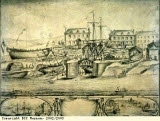
Bristol dock at the height of the slave trade


On a trip to the Bristol ice rink with Helen, a racist gang threatens the two friends. Brandon insists Helen gets her dad to take her home, while he stays to face the gang. Brandon knows this is just his luck...and his 
problem. But Helen and her Dad have not gone home. They arrive just in time to save Brandon from a beating. But this scare makes Brandon clam up; he refuses to acknowledge what has happened and refuses to go to the police, even though he could identify the gang.

While his own story is developing, Brandon tells us the story of Jake Silver. Helen has discovered a perplexing sepia photo among her late grandma's effects, and they find themselves uncovering the story of Jake Silver, an eighteenth century slave brought to Bristol from the West Indies to be a page boy to an evil mistress...We had to make him up, partly, fill in the spaces of his life by imagining it, like doing a jigsaw where a lot of the pieces are blank, tossing ideas between us, trying to work out what it would be like to be Jake. As Brandon learns of the courage Jake showed 200 years ago, he sees how his actions lead to the sort of luck he deserves. He puts his fears to one side – in life, you make your own good luck..

He’s standing on the dockside. People walk round him, eye him up, check if his teeth are sound. He doesn’t exist for them, except as something that might be of use...


Because Brandon likes to be thought of as a joker,  the  writing style is witty, upbeat and easy to read, even for children who are still struggling to read. The action begins quickly and builds into several thrilling peaks. The hard-hitting themes of the story effect children’s lives today, opening  out issues and information that will widen the understanding eight to thirteen year olds of both genders.  


Just My Luck is a modern adventure story, which allows its characters freedom to have exploits in the ‘real world’, to follow a ‘quest’, and to learn about the history of slavery, and
its aftermath, as Helen and Brandon
 grow through the discoveries they make within their story. 


A treasure trove for ten-year-olds that deals with big issues without ever sermonising. Encompassing family history, slavery and modern-day racism this should be a gem for teachers looking for fiction that will bring the curriculum to life while providing a cracking readAli Bacon, author of  In the Blink of an Eye         

Embark on Nina Milton…and you won’t stop reading… Naomi Lewis, Book Review, Sunday Observer 


Buy your copy by clicking here.


This edition of Just My Luck 

is dedicated to every person

who has lost their life 

in the fight for racial justice