Showing posts with label contemporary fiction reviews. Show all posts

Friday, 6 February 2026

Flashlight by Susan Choi: a stellar auhor with a significant and influential voice


The last that ten-year-old Louise remembers of her father, is walking with him on a Japanese beach, looking at the stars. Perhaps they were swept out to sea by a huge wave––she can't recall––but she is found half-drowned, while there is no sign of Serk. He is declared dead and his wife and child go back to the US.


Louisa and her mother were born in America, while Serk emigrated from Japan as a bright young man, and worked in academia in Michigan, until taking a university secondment to Japan with his family. There, the two adults in Louisa's life become mysterious. Serk often takes his daughter with him to visit 'a friend'...an oriental woman who lives near the coast. Anne, her mother, loathes Japan and sleeps most of the day, hardly ever leaving the apartment, and by the time they take a break on the coast, she cannot walk at all. 

Catherine Taylor, reviewing Flashlight in the Financial Times, describes the book as… a rich generational saga that teems with intelligence, curiosity and, in terms of reading, sheer pleasure. Flashlight is told over four generations and sweeps the world; America, Europe, Japan, South Korea, and most importantly North Korea. It moves from after the second world war to the twenty-first century, taking you along on an emotional flight that left me crying out at the end of the book, but also, there is a learning journey. Before the end of chapter one, I'd pulled out my atlas, and my historical atlas, to look at Japan and the Korean peninsular, and checked the history of North Korea online. Thus armed, it all began to make a deeply disturbing, utterly gripping sense, an important story, related with courage and stupendous language control, where flashlights are solid, important objects and a metaphor for lighting up a dark corner of recent history.


Courtesy of Wikipedia 
Choi at the 2019 Texas Book Festival
Beejay Silcox, in the Guardian, says: Choi is one of contemporary literature’s great demolition artists, and her emotional foundations hold. She can build as well as she detonates.  You may feel like that, if you take up this challenge: demolished…detonated. Susan Chio recently talked about the books she loves in The Guardian: I read Bleak House for the first time during the pandemic – it was one of the great reading experiences of my life. I'd already understood this, because the book reads as a deeply Dickensian investigation into the lives of people thrown into turmoil. She also cites Woolf and James as influences, something that emerges in her beautifully constructed, elongated paragraphs. 


Steadily, as Louisa grows from child to teen to middle aged adult, Choi reveals the mysteries she has set up, and as she does this we learn a little-known but shocking aspect of Japanese-Korean history. This might have been clumsily done in another writer’s hands, but Choi already ‘has us’––we are deeply invested in the story of Serk’s malfunctioning family, and however inscrutable he seemed in the early chapters, it is truly shocking to discover just what is happening to him in the later ones. 


One of the labels I use, to help my blog readers navigate my posts, is ‘Stellar Authors’. So this writer joins other ‘Stellar Authors’ such as Henry James, George Eliot, Bram Stoker, Salmon Rushdie and Herman Melville. She deserves her place; as Beejay Silcox reminds us…Flashlight is all kinds of big: capacious of intent and scope and language and swagger. 


That perfectly sums up what you will find yourself diving into if you swim through the waves and into the deep of this book.

Thursday, 8 January 2026

Books to Read While it Snows


If novels set at holiday destinations are the best books to read beside a pool, then surely books describing terrible winters are ideal snowy weather companions...so long as you are sitting snug beside a roaring fire, wrapped in fleeces with a hot chocolate drink on the coffee table.

This is how Robert Macfarlane opens his book, The Old Ways...

Two days short of the winter solstice, the turn of the year's tide. All that cold day, the city and the countryside around felt halted, paused. Five degrees below freezing and the earth battened down. Clouds held snow that would not fall. Out in the suburbs the schools were closed, people homebound, the pavememts rinky and the roads black-iced. The sun ran a shallow arc across the sky. Then just before the dusk the snow came––dropping straight for five hours and settling at a stead inch an hour…At around eight o'clock the snow ceased. An hour later I went for a walk with a flask of whisky to keep me warm…

The Old Ways follows the ancient tracks that crisscross Britain, but maybe it's no coincidence that Macfarlane opens his wanderings in snow. It reminded me of how I love a snowy walk, and will get out as soon as the blizzard stops, bundled into scarf, gloves, hat and extra socks. Four years ago I wrote on this blog;


I whistled my dog into the field beside my garden. It is clothed in snow, and the glow from the moon coated the snowy field in an eerie yellow light. This is our morning ritual, to get out and walk around the 10 acre field together before even a cup of tea. As I crunched through the snow, a thought occurred to me. What's the connection between you, me and everyone else on the planet today?

And now, deep snow is back in West Wales, a place used to drifts, white-outs and gritting lorries, and I'm still walking around the fields and lanes with my dog. The red kites are wheeling in sky, riding the air currents as if for the sheer fun of it, and the sun is golden over the valley.  I can feel my cheeks redden as I walk, and I can't help remembering three novels that made me feel as frosty as I do now. 


The Land in Winter by Andrew Miller, was shortlisted for the 2025 Booker Prize, and I couldn't help drawing closer to the fire as I read the descriptions of the terrible winter of '62/'63. In a small West Country village, two young couples get to know each over the Christmas period. Rita and Bill have taken on a dairy farm and are trying to make a go of it. Eric the GP, and Irene, his pregnant wife don't think they have much in common but when Irene discovers Rita is also having a baby, they become friends.  Eric has a dark secret, and Rita has a past she'd like to keep secret. At a Boxing Day party, everyone becomes far too drunk, while outside the blizzard begins to rage.

The Snow Child by Eowyn Ivey is set in 1920's Alaskan homestead. Jack and Mabel are childless, and drifting apart, under the weight of farmwork and loneliness. Following the pattern of a fairystory,  the couple build a


child out of snow, which strangely melts overnght. They glimpse a young, blonde-haired girl running through the trees, Faina. She hunts with a red fox at her side, surviving alone in the Alaskan wilderness. Jack and Mabel come to love her as their own daughter. But what they eventually learn about Faina will transform all of them.

Angela Carter also has a story called The Snow Child, the shortest tale in The Bloody Chamber. A Count sees snow on the ground while out for a ride with his wife, and wishes for a child ‘as white as snow', leading to an extremely bloody outcome. 

I first read Miss Smilla's Feeling For Snow by Peter Høeg in 1992.  A neighbour's neglected six-year-old boy dies in a tragic accident, and a peculiar intuition tells Miss Smilla it was murder. This was such an unusual, unpredictable and beautifully written crime fiction, set in the snowy winters of  Copenhagen, that I've never forgotten it.

Winter Solstice by Rosamunde Pilcher, has a warm theme of loss and the healing power of love, which will get you toasting your tootsies.

But if you want some that will really give you the chills, don't forget The Shining by Steven King. A classic snowy horror.


Tuesday, 2 September 2025

Stories About Artists; Amazing Novels about Artists and Paintings: Steel, Chevalier, Smith and Hustvedt

What is it about visual artists that attracts those word artists...writers, I mean...to use them so often in their novels?

Stories about artists, both real and fully imagined, abound. 

We've all heard of Girl with the Pearl Earring, which features a real oil painting by Dutch Golden Age painter Johannes Vermeer, but Chevalier's The Lady and the Unicorn is also a great read; about an imagined 15thC artist, Nicolas des Innocents, who created the illustration for a richly embroidered wall tapestry, based on a real tapestry, rediscovered by French historian and archeaologist Merimee, in 1841, in Boussac castle in central France.
Then there's The Goldfinch, which, when I read the book, I imagined Donna Tartt had invented this rather wonderful little oil painting for her scintilating 2014 Pulitzer Prize novel, but is in fact a painting by Reneissance artist Carole Fabritius, which   I talk about here 

I've love all of Ali Smith's novels, but How to Be Both is perhaps as challenging read as you're likely to find. Smith plays with conventional fictional form, letting the reader in on  the poignancy of the story before the characters even start to realise. Smith examines a little of the life of  the 15th-century Italian painter Francesco del Cossa. Meanwhile, George is a teenager who has lost their mother, and tries to bring her back to life by recalling how they saw this  artist's  work.   Smith seems to investigate the symbolism of frescos: many layers, simultaneously.

curtesy of The Women's Prize
Most recently, Lucy Steed has just won the Waterstones Debut Prize for her first novel. She writes about one Edouard Tartuffe, “the Master of Light” an artist who lived in the early 20th Century,  a bit of a hermit and not a very nice man, really. He loves to paint rotting food, which gives his young housekeeper, Ettie, a bit of a headache. In 1920, Joseph Adelaide, an aspiring journalist, arrives at the remote farmhouse in the Provençal village of Saint-Auguste. He takes
comfort in art after being branded by the horror of the first world war, and wants to write an article about the famed oil painter.  Slowly, the young Englishman falls for Ettie, and tries to persuade her to escape her overbearing uncle.

If you're wondering why you haven't heard of Tartuffe, it's because Steed has created him, but he could be real, a cross between many artists of this incedury time. But her depictions of his art feel sensual and authentic and I could almost smell the paint...and the rotting peaches. 

Finally, a book I read some time ago, but have never forgotten. I must read more by this American author; Siri Hustvedt, Her 2003 novel, What I Loved sparkles with intelligence. It begins in the New York art world in the 70s, with art historian Leo Hertzberg and his friend, artist Bill Wechsler, whose artwork Leo has discovered in a SoHo gallery. Hustvedt is strong on the psychological effects of love, grief and hysteria, and her narrative voice pulls you into, and through, the story.

So now I'm looking for more exciting depictions of art and artists through a novelist's eye, although, I don't think, for now, I'm going to find more emotional maturity, than Steed, more passion than Hustvedt, more tense drama than Chevalier, or more brilliant plotting than Tartt.


Friday, 23 May 2025

Discovering Great New Writers–Meet the Womens Prize "Discoveries"


Right now I'm furiously reading The Women's Prize 2025 shortlist; six smashing novels by women published last year.  Here is the lowdown on three of them; 

BIRDING by Rose Ruane. I genuinely could not put this down. Perhaps there was one too many points of view and the end is not fulfilling, but it did grip me.

ALL FOURS. Miranda July is a well-respected US writer. This latests from her is described by the Women's Prize website as 'Part absurd entertainment, part tender reinvention of the sexual, romantic and domestic life of a 45-year-old female... I found the first half of the story huge fun, as the protagonist, in possession of a windfall, leaves her child and husband and drives across the USA for a jolly in New York. Only––she doesn't get further than the next town, where she sort of falls in lust with a guy working in the petrol station, holes up in a downbeat motel and blows the her money by getting the guy's wife to do an interior design job on her little room. She spends the first half of the novel having steamy, non-sex with him. She returns home in Part Two, and, honestly? I'd lost patience with her by then. If this is the New Woman, of the first quarter of the 21stC, then frankly, there's no hope for our speicies.

FUNDAMENTALLY by Nussaibah Younis. This is chuckle funny and that at first didn't sit well with me as it's about trying to help ISIS brides, but as the tension mounted, I could see that it was actually examining the issue in a deeper way. 

THE SAFEKEEP by Yoel Van der Wouden.  The worthy winner of the prize this year.   Holland in the 60's. In the family home, weighed down with duty, a youngish woman, lives alone, until her two siblings and a stranger arrives. This sexy, intensely emotion novel, suddenly reveals the darkest sides of wartime Europe.  Read more about this novel here;

The choice of prizewinner didn’t surprise me; one of aims of the prize is to chose high excellence in writing, but also readable, approachable stories. This allows it to stand apart from other prizes, where winnering novels may be dense, even arcane and seem deliberately impenetrable. I think you can be profound and sibylline without trying to drown your reader in words. 
Some of the winners remain my favourite novels.
Maggie O'Farrel won in 2020 with Hamnet,
one of my favourite winners. 

The Women’s Prize has been running since 1994, annually awarding a female author of any nationality for the best original full-length novel written in English. Kate Mosse founded the prize, and has always responded to the criticism that women and men should compete directly, by saying… ‘It’s not about taking the spotlight away from the brilliant male writers, it’s about adding the women in.’ In 2023 it was announced that a sister prize, the Women's Prize for Non-Fiction, would be awarded for the first time in 2024, with a £30,000 prize.


And now, the Women’s Prize is also sponsoring new female writers with their new enterprise, ‘Discoveries’, which aims to seek out, inspire and support writers from early writing to long-term careers, with writer development programmes, toolkits, free events and online community create pathways.

Over 80% of entrants to the Discoveries development programme said they felt inspired to take steps towards achieving their writing goals and had gained more knowledge on the publishing industry.


This year, alongside those shortlisted for the main prize, six new writers have been chosen as Discoveries, having finished their novels. They are…

Shaiyra Devi, The Persistence of Gravity

Jac Felipez, A Long Ways from Home

Rosie Rowell, Down by the Stryth

Lauren Van Schaik, Seven Sweet Nothings

Muti’ah Badruddeen, A Bowl of River Water

Sophie Black, The Pass


The Women's Prize interviewed each one and I found so much to honour and to concur with each new writer. A lot of them started, as I did, very young. 

Shaiyra Devi says...I began writing fiction as soon I learned to write, filling a notepad with 1-page stories from the age of 5. At 10, I promised myself I’d write a book, and finished Diamonds & Daggers, an adventure fantasy novel, before 13…
Jac Felipez says...I
have been writing, in different ways, my whole life. From the first story my English teacher praised in front of the class to the novel-in progress..
.          Rosie Rowell says...I fell in love with writing from the moment I learned how to read. 

Lauren Van Schaik says...before I could hold a pen I tyrannically dictated stories to my parents.


And their responses to finding out they were shortlisted were amazing;

Muti'ah Badruddeen was...Breathless. I mean that literally. I screamed so much, I became breathless. I have a weak heart, and I don’t think it has stopped racing since I opened the email. I’m usually more on the self contained end of expression but Discoveries has unleashed the inner screamer I never knew...

Shaiyra Devi was...beyond ecstatic, totally over the moon! 

Lauren Van Schaik was...really honoured that the judges see the promise in this project. I’ve had so much fun writing it and can’t wait to share it even more widely.


Can they offer advice? Sophie Black suggests...To not get bogged down in details and research when you really need to just write – you can look at specifics when you’re editing. It worked like a charm because I’m not even 100% decided on my characters’ names – I only know how they feel and how they’d behave. 

What inspired them? For Jac Felipez...visiting the Lubaina Himid retrospective at Tate Modern in 2022...The exhibition prompted me to revisit the 1980s, a decade characterised by uprisings, radical activism, and vibrant artistic expression. Felipez is writing a contemporary story that connects to the 1980s...

For Saiyra Devi it was... The seed for my current novel sprouted in a fiction writing workshop in my final year of college, and it has consumed me ever since...

Rosie Rowell's idea came from TikTok, admitting...doomscrolling finally pays off!... 

  Muti'ah Badruddeen started A Bowl of River Water by writing about her grandmother's life.
...She was an incredible woman...But the more I wrote, the bigger it got away from the details of her life; coming to encompass, instead, the idea of women who, despite dominant narratives about the period and cultural context, fought in their own way to subvert societal norms that infringed on their autonomy and personhood.  

Lauren Van Schaik's story Seven Sweet Nothings was inspired by a true story... polygamist sect leader Warren Jeffs taking his favourite wives to Disney...while he was a federal fugitive. What happens when sheltered wives are removed from the compound and dropped into our world — or rather, the sanitised, perpetually happy theme park pastiche of it?


Reading about their committments to their writing, their love of fiction, and the inspirations behind the stories was very reassuring. You can find more about them at https://womensprize.com/meet-the-2025-discoveries-shortlistees/


Tuesday, 15 April 2025

The Absent Heart by Ali Bacon


I've just finished the most marvellous book. What genre would I put it in? Victorian  fiction? Feminist historical novel? Historical romance? Biographical fiction? None of these bland categories do this wonderful book justice. 

The Absent Heart blends elements of fiction with the real-life events and experiences of historical figures. It's based on the lives of three real people, who were linked––in fact, glued––together; the mercurial Robert Louis Stevenson, the beautiful Frances Sitwell and the introverted literary critic, Sidney Colvin. 

Frances Sitwell was an author and article writer, a woman who earned her own living. In her time she was known as…a spirited and intellectual woman, a remarkable personality … the soul of honour, discretion and sympathy … with rare insight into the developments of life’s problems. But Frances was viewed  by Victorian era’s puritanical and ‘polite’ society as rather 'loose'; she had a circle of male friends, and a partner of 35 years whom she did not marry until she was 63.


She'd known Sidney Colvin since she was struggling to extracate herself from her brutal, abusive husband. He had promised himself to her, but divorce was out of the question, and Sidney had money worries. By the time she met Stevenson, she was separated from her vicar husband and staying with her two young boys at her friend's house. It was there she met the very young Stevenson, a raw but vital talent. Frances introduced him to Colvin, who helped him get his writing established and remained his friend until the end of Stevenson's short life. In fact, it's possible the Sidney Colvin was as in love with the flamboyant young writer as Frances was.

It is clear that RLS fell deeply in love with Frances, but she had already promised herself to Colvin. Even so, they met and corresponded throughout his life. She had asked him to burn her letters to him, but she kept all his to her. They are now housed in the National Library of Scotland.

Ali Bacon took those 100s of letters and poured through them, creating a novel out of previously disregarded possiblilities. She has used creative, poetic liberity to write narrative, dialogue, and characterization, filling in gaps and imagining the inner thoughts and emotions of these three lives. This has allowed her to provide a more intimate and nuanced portrait of the historical figures, allowing readers to gain a deeper understanding of the lives, motivationsof all three, and the impact on the world of Robert Louis Stevenson.  

Many biographies have been written about this extrordinary Scottish man of letters, but The Absent Heart offers a clarity which explains some of the hidden puzzlements the writer's life. However, there are three people in this book and Bacon has illuminated the human experience of all of them, searching behind the facts of history. The work she's achieved here is at the same time a massive academic feat, and a scintilating and absorbing piece of fiction.


Ali Bacon was born and brought up in Scotland, and gained her degree from St Andrews University. She now lives near Bristol, but her writing remains influenced by her Scottish roots. After publishing  In the Blink of an Eye ( listed in the ASLS best Scottish books), she turned her attention to The Absent Heart through a family connection to this bebuiling 19th century three-way relationship. She says, 'My maternal great great uncle, Charles Lowe, knew Robert Louis Stevenson at university.'

That was all the start she needed!

Read my interview with Ali Bacon here; https://kitchentablewriters.blogspot.com/2024/08/an-interview-with-author-ali-bacon.html


Sunday, 9 March 2025

HOW TO WIN THE BOOKER: Creation Lake by Rachel Kushner


A little hobby of mine is to try to read the shortlist of the Booker Prize and the Women's Prize.  It's fun comparng books and pretending for just a moment that I'm a judge. But to save pennies, I use my library a lot, and one novel on my Booker list was very, very, popular; I've only just received it, ages after the Prize Winning Date passed. 

left: Deccan chronicle---British writer Samantha Harvey's space-station novel 'Orbital' wins the Booker Prize for fiction


I'd already chosen my winner, and just for once, that was the actual winner––Samantha Harvey’s Orbital––an intergalactic story set on a space station, but definitely not a sci-fi, rather, it is almost a poem.


Would reading this mega-on-trend book change my mind?

Creation Lake by Rachel Kushner was the fattest (over 400 pages), and, like almost all the shortlist, responded to and interrogated current themes, particualry our varied human response to the climate crisis, but Kushner uses the thriller genre to stake her claim in this catagory. And in places, it really was quite thrilling, and in all places pretty un-put-downable. 

Rachel Kushner

A jobbing agent with the cover name of Sadie takes a contract with a mysterious employer. She is deliciousy free of moral considerations––she'll sleeping around to get a job done and promises us she'll kill anyone who gets in her way.  She is sent to infiltrate Le Moulin, a group of green eco-activists in Guyenne, south-west France, who almost worship an ageing guru called Bruno who lives in cave and believes we should adopt the lifestyle of his favourite of our great ancestors, the Neanderthals. 

Sadie is acerbic in her mocking of these people, especially Bruno. Shame, she suggests, that the Neanderthals didn't have a mobile link, as Bruno so obviously has when sending his epistle-like emails. As she hacks his emails, she becomes drawn in, enticed by his ideas of simplicity.

But her mind's still on the job. A farming co-op is staging a protest against a local scheme to turn local fields into a corn-based monoculture and Le Moulin is planning to help them. Sadie secrets a gun to one of the more thuggish members, hoping the death of a Paris polititian will fullfil her brief.

Anthony Cummins in The Guardian loved this book, describing it as hugely enjoyable…espionage drama pulsating with twisty revelation and drip-fed backstory, dealing with anarchy, agriculture and prehistory, it adds a killer plot and expert pacing to the reach and sophistication of her previous work, as well as vital fun. 

On the other hand, reviewing all the Bookers in the i Paper, Anna Bonnet's enthusiasm is more muted; Creation Lake was the biggest disappointment on the shortlist for me. It isn’t that it’s a bad book, but though I went in to it prepared to have a lot of fun, overly long passages about the Neanderthals somewhat got in the way. However, it has got some brilliantly dark humour, isn’t short on plot, and has some thoughtful things to say about activism and corporate land grabs. I don’t think it should win, but you can see why Kushner is one of the few women often referred to as a Great American Novelist.

Weirdly, I can see both perspectives, having read the book. While reading, I could not put it down; no wonder the library version was so popular. The final 100 pages, which Cummins describes as…pinballing between peril and farce, are amazingly tense: wall-to-wall entertainment, and a real treat...were a delight to read; hilarious and dramatic, just as he suggests. 

But once I'd put the book down, and mused over the length of it, I began to see its flaws. 

The final excitments of the last chapters felt over-plotted and a little too slapstick for me. 

The idea that Sadie was influenced by Bruno as she sails away into a James Bond type deserted tropical sunset, is slightly fogged by the amount of money she's extracted from her employer and her continued  self-interested stance. 

I always feel mean talking about the flaws in other people's novels. What about all those gaping holes in mine? What about the fact I'm never, never, going to be shortlisted for these big prizes? How dare I criticise a Great American Novelist? 

I'm going to let Christina Sanders have the last word; her blog describes Creation Lake as a …nearly excellent book, but...Where is the follow through? I am left feeling there was so much excellently laid build up for so little reward. The dirty kitchen doesn’t get another mention, the entrapped men fade away. Not sure what happens to the guy in the cave, who really could be interesting but this is not his story and if you want a story about Neanderthals among us I suggest you read Seventh Son instead. 

Well, I'm just reading that, so watch this space for the review!

The other Booker shortlist reviews are here;

https://kitchentablewriters.blogspot.com/2024/12/how-to-win-booker-everett-and-wood.html

https://kitchentablewriters.blogspot.com/2024/11/how-to-win-booker-prize-held-by-anne.html

https://kitchentablewriters.blogspot.com/2024/11/how-to-win-booker-safekeep-by-yael-van.html

https://kitchentablewriters.blogspot.com/2024/11/how-to-win-booker-prize-orbital-by.html


Monday, 6 January 2025

Salman Rushdie's Victory City: Stellar Author


Salman Rushdie's Victory City

'Stellar Author'

 an occasional series of posts on 

Kitchen Table Writers

Copyright New Yorker

Salman Rushdie was born in 1947 in what is now Mumbai, India, but is also a British-American citizen. One might say he's a citizen of the world, being a writer whose novels are  allegorical examinations of historical and philosophical issues. He achieves these heights by using magical realism, non-linear narratives and surreal but very believible characters. There is always a dark, yet gentle strain of humor, and a dramatic, exhuberant, unconstrained prose style. Rushdie has never muted what he wants to say about sensitive religious and political subjects, and as a direct result of this, he barely escaped with his life in New York in 2023.

I first encountered him when Midnight's Children came out in 1981 and immediatey won the James Tait Black Memorial Prize  and the Booker Prize. It was also awarded the special Booker of Bookers prize in 1993, and the Best of the Booker in 2008. It was so well recieved, it's been called 
Copyright  Sky News

a watershed in the post-independence development of the Indian English novel,  and in the 80s subsequenty became known as 'post-Rushdie'. The story moves back and forwards in time, but is focused on the children born in India at midnight on the moment of its independence. In it he employs inherited myths, and generates new myths as it traces the story of these children. 

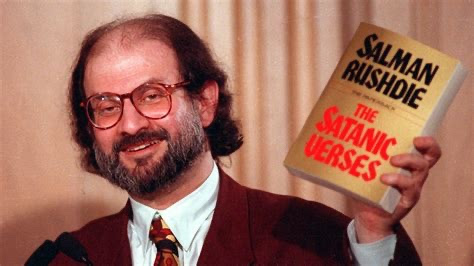
Having loved Midnight's Children, which was his second novel, I couldn't wait to read The Satanic Verses when it came out in 1988. This is the story of two Muslims confused by the temptations of the west. The first returns to his cultural roots. The other, intellectually unable to return to the faith, finally kills himself. I loved it. One of its themes is the way immegrants are treated in the UK and another looks at the very foundations of Islam.  

As I read, it was being burnt. Despite the fact, that to me, a westener, I couldn't see any content that seemed to denounce or critique the faith of Islam, Muslims had many issues with the book, including the story, the title, and some of the names used. In December 1988, around 7,000 Muslims in Bolton held a peaceful protest where they burnt a copy of the book. The Ayatollah Khomeini, leader of Iran, announced a Fatwa was on 14th February 1989.

Could Rushdie have expected this reaction? 

Writers stick out their necks. By the nature of being able, especially via fictional works, to say anything about anything, they constantly fall foul of current morals, ethics and the law. Of course, it’s wise not to be disrespectful, especially without researching and understanding your chosen subject. On the other hand, remaining neutral and inoffensive generally results in bland, insubstantial writing. 

An attempt at a private prosecution to get The Satanic Verses banned was unsuccessful, in fact, the Home Office announced it would not allow any further blasphemy prosecutions. 

Martin Amis, who interviewed Rushdie, suggests… a Fatwa is at once a death sentence and a life sentence. In his own phrase, Rushdie is firmly ‘handcuffed to history’. He is neither a god nor a devil; he is just a writer – comical and protean, ironical and ardent…I bought an evening paper. Its banner headline read: EXECUTE RUSHDIE ORDERS THE AYATOLLAH. Salman had disappeared into the world of block caps. He had vanished into the front page…His uniqueness is the measure of his stoicism. Because no one else – certainly no other writer – could have survived so well…. Amis interviewed Salman in September of the same year, at a Mystery Location…‘When I first heard the news, I thought: I’m a dead man. You know: that’s it. One day. Two days’… (Visiting Mrs Nabokov, Penguin Books 1993  pg 172) 

After a failed assassination attempt  in 1989, Rushdie began came out of hiding and soon became a central figure in debates on free speech and censorship. In 2007 he received a knighthood for services to literature and by then, was in public more and more. 

On 12 August 2022, he was about to start a lecture in New York, when man rushed onto the stage and stabbed him repeatedly, including in the face, neck and abdomen. Rushdie was airlifted to a trauma centre  and underwent surgery. Only one day later, he was taken off the ventilator and was able to speak. He had lost sight in one eye and the use of one hand but survived the murder attempt and was soon writing a memoir about the attack, Knife: Meditations After an Attempted Murder, which hit number one in the Sunday Times Bestsellers List straight away. 

Perhaps the most Rushdiean part of this awful event was the fact he reported remembering a vivid dream, in which he was stabbed in a Roman amphitheatre, only two days before the actual stabbing occurred. The intensity of the dream caused him to consider canceling the event–but he eventually decided on attending.

Since then, just one novel has been released, an amazing, rich and vibrant story called Victory City which was mostly written before the attack. 

The story is  purported  to have been found, hidden in a earthenware pot by a woman called Pampa Kampana, who is reaching the end of her 250 years of life. It begins when she is nine, and watches her mother commit Sati along with hundreds of village women. Immediately after this tragedy, a goddess enters Pampa and she becomes magical, and long-lived.  She takes refuge in a cave with a holy man, and is abused by him, but also educated. 

She is still a young woman when the magic begins. Pampa instructs two of her brothers, Hukka and Bukka, to sow a bag of seeds at the site of their old village.  A city grows, and  people sprout from the earth. Pampa whispers memories into them, so they feel they have a history. The brothers become the first kings. Pampa marries them each in turn, though her daughters are born of her true love, a Portuguese horse trader who names the city Bisnaga.

The city she founds becomes a utopia—a feminist one–Pampa is an avid advocate for gender equality, and wishes her daughters to rein after her husbands’ deaths. This request is met with much conflict and her sons seize control of the kingdom. Pampa and her three daughters are forced to flee into a magical forest where they shelter for several decades. The three daughters eventually grow in separate directions and Pampa returns to Bisnaga. In her absence, she had become a legend, and, as she still looks much the same age, can move about the city freely. Eventually,  she becomes the advisor of the latest monarch, Krishnadevaraya.

After many wars to guard and widen the borders of the kingdom, Krishnadevaraya goes mad and Pampa, caught in one of his rages, is forcefully blinded with an iron-rod. She takes up refuge with a holy man, finally beginning to feel her age which is now over two hundred. The residents of the city become outraged at this betrayal and turn against their king and the kingdom degenerates and is ransacked and destroyed. The novel ends with Pampa burying her written history in a pot and waiting for the Goddess to release her so that she may die.

So what is this allegory about? 
It is possible that he has used an ancient empire, the  Vijayanagara, and to a degree followed major turning points in the history of the empire. But it strikes me we could actually be following major turning points of human history. Even so, there are moments that need careful analysis; for instance the invasion of the pink monkeys in the forests where Pampa and her daughters have settled. Who are the conniving pink monkeys who inveigle their way into the monkey tribes and then take them over? Maybe that is what human history was: the brief illusion of happy victories set in a long continuum of bitter, disillusioning defeats (pg 155).

 And why, when she takes refuge in a cave with a holy man after her mother’s death, is she regularly abused by him? This passage struck me: That's how men were, Pampa Kampana thought. A man philosophized about peace but in his treatment of the helpless girl sleeping in his cave, his deeds were not inlignment with his philospopy. 

Virupaksha Temple, Vijayanagara, Karnataka

In some ways, Pampa could almost be Salman, who has experienced both adoration and opprobrium for his acts of creation. Without doubt, to me, the writer is saying that we humans are both good and evil. In this book we meet oppression, religious zealotry, authoritarianism, divide, patriarchy. But there is also equality, redemption, the power of love, and a demonstration of how humans can be at their most creative when they live in an atmosphere of openness, tolerance, and egalitarianism.


The 'Stellar Author' series of posts on Kitchen Table Writers has looked at several amazing writers, including:

George Eliot

HenryJames

Cormac Mccarthy

Virginia Woolf

A S Byatt

Herman Melville

Boris Pasternak

Just click on the link to read the blogs.