I've been writing since my first story penned at my mother's kitchen table, and helping other writers for almost 20 years.
Do you want to write well? Or get published?
I believe Writing well is the path to being published, and I can show you how to write well.
Join my writing group around my kitchen table and start to enhance your writing...and your writing journey
KITCHEN TABLE WRITERS: NINA MILTON's friendly mentoring and appriasal service
Although the Booker shortlist is revered, and always anticipated, it has, in the past, been sometimes a bit of a let-down, often featuring books that are filled with 21st century angst, that are just too long or obscure or unnecessarily dense. Quite often they offer nothing but a bleakness that surely we can do without. This year, though, I've loved them all and can't wait to tell you what each book is about. So far, in three posts, I've looked at the winner, which has greener-than-green credentials...Orbital by Samantha Harvey, the deepest and most poetic, Held by Anne Michaels, and the raunchiest, The Safekeep byYael Van Der Wouden. In this post I'm going to look at two more before I finally turn my attention to the only 'quite long' novel on the list.
James, by the long-acclaimed American author Percival Everett, who is back on the Booker shortlist after being there two years ago with The Trees, has written what I think is the funniest and most powerful novel on this list.
Stone Yard Devotional, by Australian writer Charlotte Wood, is also a book that made me smile. Maybe Wood didn't want her book to be thought of as 'comic' but it features, quite heavily, an infestation of mice in an isolated community of nuns, which decidedly raises more than one chuckle.
Percival Everett
Before I began James, I did wonder if the world needed yet another retelling of Huckleberry Finn. But James is a hilariously dark, beautifully compassionate yet deeply corrective, perfect for the 21st Century reader. The titular James, as he'd rather be called, is nothing like the 'Yessum' Jim of the original. In fact, he, and his fellow Mississipi slaves only use such language when the white masters are around. In their heads, in the narrative of this book, and when they talk together, their English is perfectly received. This device allows Everett to present James as a fully-rounded character, enabling his voice to be heard properly and giving him the agency to direct his own life, even under threat of the whip.
Here's James teaching his children how to speak to slave owners.
"Let's try some situational translations. You're walking down the street and you see Mrs Holiday's kitchen is on fire. She's standing in her yard, her back to the house, unaware. How do you tell her?"
"Fire, Fire," January said.
"Direct. And that's almost correct," I say.
"The youngest of them, lean and tall five-year-old Rachel, said, "Lawdy, missum. Looky dere."
"Perfect," I said. "Why is that correct?"
Lizzie raised her hand, "Because we must let the whites be the ones who name the trouble."
The reviewer Anna Bonet also loved this book; “Powerful” is an overused adjective when it comes to describing books, but it feels right here. In fact, James is more than that. At times, it is brutal to read – necessarily so, given that slavery is one of its primary subject matters – but it also manages to be light and funny and completely gripping. I could barely put it down.
When he realises he is going to be sold away from his beloved wife and children, he runs, falling in with Huck in much the same way as in the original Mark Twain, but in this story, he's the one who cares for the lad, leads their escape and engineers the happy ending.
Charlotte Wood
Stone Yard Devotional has an unnamed narrator, who constantly surprises us. At the start of the novel she has abandoned her job and husband and, although not religious, decides to spend a short time in a rural Australian nunnery. The convent's routine of bells and service turns out to be just what she needs and she stays; a decision she never fully explains. As she moves through each day as a secular member of a convent, she reveals that she has uncomfortable memories of a girl in her class at school. This woman is now a famous nun, and is about to visit, bringing with her a corps the nuns wish to bury in their grounds.
The story quickly becomes surreal, almost oppressive, as we watch, fascinated, a dance of manners between the narrator, the charismatic Helen and the society of nuns. it takes a long time to get permission to give the corps a Christian burial, but meanwhile we witness the infestations of millions of mice being unceremoniously dumped into a deep hole in the ground.
Orlando Bird, in the Telegraph, says this of the book; Our narrator’s world is one of “dormant” truths waiting to be “released into the open at last”. Yet Stone Yard Devotional is all the more accomplished for resisting neat conclusions – “I don’t know why” is a familiar refrain – and recognising that even the examined life sits only “on the edge of comprehension”. Wood may not be the first artist to embrace uncertainties, mysteries and doubts, but at its best her novel does it beautifully.
It's a good read, but of the two, I will never forget James' journey up and down the Mississippi.
Seven Writing Tips from 7 Respected Authors ...and me.
1. Maggie O’Farrell
‘What I wish I’d known when I was starting out, is that you don’t have to worry about beginnings. Don’t worry too much about knowing what you’re doing at the beginning. You can start in the middle if you want! Just put the words down.’
2. Iris Murdoch
Writing is about practice, and not about luck.
3.Lionel Shriver
‘Write whatever you damned well want. Trying to please ends up pleasing no one, including yourself. And caution is boring. Especially in these touchy times, I suggest getting yourself into trouble. (That won’t be hard.)’
4.Virginia Wolf (from Mr. Bennett and Mrs. Brown, Woolf’s famous essay)
Eavesdrop. Listen to the way people speak, but pay special attention to their silence.
5. Katherine Mansfield
Looking back I imagine I was always writing. Twaddle it was too. But better far write twaddle or anything, anything, than nothing at all.
6.Hilary Mantel
Be ready for anything. Each new story has different demands and may throw up reasons to break these and all other rules. Except number one: you can't give your soul to literature if you're thinking about income tax.
7. Zadie Smith
Work on a computer that is disconnected to the internet.
.
...and me... Imagine your scenes in your head, imagine the dialogues taking place and the setting coming alive. Imagine a character saying to you––"no–I'm not doing exactly what you planned for me, I'm doing this, instead!
The voice youspeak with is unique and can be used to identify you, rather like fingerprints. The voice you write with should also be unique so that your readers will recognise it and grow to love it. A good personal voice helps seduce your reader. It allows them to feel a certain familiarity that brings them back to a particular writer time and time again.
Some people say that ‘voice’ on the page can be defined as ‘the author writing as they would converse’. I think a better definition is that ‘voice’ is ‘the author writing as they would think’. When a writer pours their mind…their thoughts…onto their page, the voice sings out – driven by something that not even the writer fully understands.
Your writing ‘voice’ is as valid as anyone’s, so long it has sufficient flow to hold a reader’s attention. It does not have to be cultured, or even grammatical...clarity, vision and personality count for a lot more. So, don’t be inhibited by other people’s writing style; you have a great style of your own, which, when left to emerge, is unique to you.
The poet Jackie Kay has written about her earlier life, including Red Dust Road (2010), described in review as a fine antidote to the misery memoir, and The Adoption Papers (1991) She says this of voice: I wrote in three different voices: the birth mother, the adoptive mother, and the daughter. It was interesting when I was writing it, talking about inventing yourself, because the daughter’s voice was, in fact, the most difficult to write. Both the mothers were comparatively easy to find a voice for; the daughter I found more difficult – and this was because she was, in a way, trying to tell the factual story. I realised I found that aspect less imaginative and therefore less easy to create – this was a surprising part of the project.
If you are a writer of fiction, you will also need to find the voice of each of your narrators. This might feel a tall order at first, while you are still developing your own writing voice. In fact, it's imperative that you do find your own voice before anything else. Finding your own writing voice is the foundation stone of all good writing. This blogpost deals with helping you develop your own voice. We will return to look at character voices in Part Two.
Exercise: Find your voice
Take a characterless piece of writing to work with. You can write one of your own, or use this example here:
We reached the stile and looked over it. More fields. My legs were tired. The stile was wooden and you had to climb up then down. There was mud on the other side, and cows. I said, 'Let's go back the way we came.'
Such a faceless account gives you scope to reimagine the scene. We've probably all had an experience fairly like this one. Whether you work with this scene, or one you've created, you start by thinking about the dull, lifeless components (a walk, a view, a conversation, a challenge). Allow these to become images and words inside your mind. In other words you…pour your mind…yourr thoughts…onto the page, and let your voice sing out.
Breaking down your writing and divesting it of any individual voice will enable you to see what happens when you introduce your writing personality from scratch. Spend some time now looking at the the difference between the first, dull draft and the second, infused with your voice. What do these reveal about the way your mind works? Is there a certain tone of voice, a detectable style?Did you go for the challenges (for instance, did you focus on getting through the mud, or facing the cows)? Did you concentrate on adding description? Did you focus on dialogue, getting the 'we' chatting?' Was your goal to inspire a reader, make them smile, make them understand, give them reading pleasure?
Try to analyse the changes you made.
The reader over your shoulder
Now’s the time to think more deeply about those ‘influential personas’ that continue to speak internally and accompany the writer. (In fact they accompany everyone, but they’re of most use to writers.)
Robert Graves, author of I Claudius, with his researcher, Alan Hodge, took this idea and ran with. At the start of the 2nd WW, they produced a handbook for writers called The Reader Over Your Shoulder. They began with, “…whenever anyone sits down to write he should imagine a crowd of his prospective readers…looking over his shoulder.” They outlined forty-one principles for writing, devoted to clarity, and grace of expression.
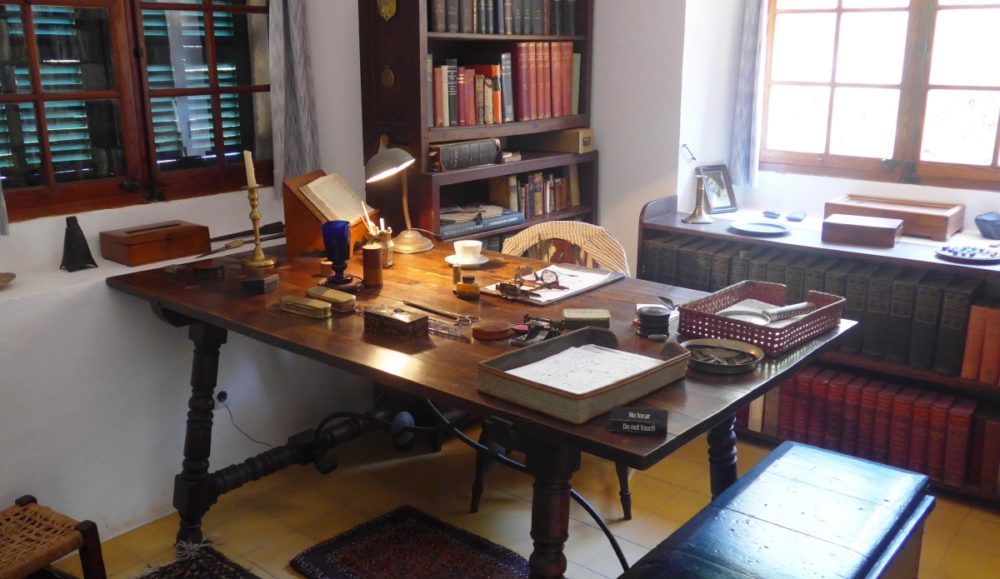
Robert Graves’s desk in his home in Majorca, where he lived from 1929 until his death.
Mikhail Bakhtin, the Russian philosopher and literary theorist, talked about the personas we all internalise as we move from childhood into adulthood – the people we respect, whose own voices remain in our minds. These begin with the authority and love we experience from parents, teachers and older or wiser friends. But they widen as we progress to include other significant influences – your priest, your boss, your financial advisor, a particular politician, even your driving instructor. Their voices may be reassuring, awe-inspiring or heart-warming, but we have these people in our heads and often address our thoughts towards them, creating imagined discourses.
You might feel this phenomenon would get in the way of developing your own voice but, rather than fighting it, allow yourself to address these invisible listeners––or rather, one chosen listener––as you write, as well as think. Using a relevant influence as the reader over your shoulder may encourage aspects of your own voice to grow.
Exercise: Who is over your shoulder?
Take your time over this exercise and work on it in stages:
First, identify just one influential persona who may have an authoritative significance for you. Try not to go for writers; choose someone who influenced your life in the past. Choose a presence that you feel really comfortable with.
Take some time to create a list of the ways in which this voice has influenced (and maybe still influences) your thoughts. What messages come out of any imagined conversations or discourses with this person? Try to isolate the consequences – practical or emotional – that they have on your life.
You may discover that the original persona has developed into someone slightly different over the years they’ve been inside your head, to become a semi-imaginary figure.
Write a series of imaginative sketches that involves discussions between you and this other person. If you like, you can give both of you new names to shift the perspective slightly away from yourself. Imagine both of you taking a walk where you
In your sketches, allow yourself to gain the upper hand in any disagreements. After all, it’s your writing. Even if this persona is actually your old professor, you’re allowed to win the argument!
Let two voices emerge – yours and the voice of the person who will be 'reading over your shoulder'. Read through your work, analysing the two voices and pondering on your own writer’s voice.
Rework the sketches as much as you like, to enhance the discussions or put new points across, to add some action, description or introspection. Feel free to repeat the exercise, especially if you find it helps reinforce your own emerging voice.
Keep practising! Develop your voice through the two exercises above and by writing copiously in the voice that is emerging. Part Two will be with you in a couple of weeks.
Thank you so much Debi, our guest blogger for July.
Do read below about Debi's writing journey in her guest blog post below, which is packed with good advice on how to reduce your tuition costs and still get the support you need as a fledgling writer
Carpe diem – Seize the day – Horace wrote. In fact, the full quote translates as, ”Pluck the day [for it is ripe], trusting as little as possible in tomorrow.” For fledging writers taking their foundling first forage into the wonderful yet mystical world of writing, the path does seem fraught, with companies offering a bewildering array of workshops, advice, and equally eye-watering price-tags to match. So, if like me, you are on a limited budget, where you do you start?
This is simply how I got started; my intention is to encourage all of you who have discovered writing is an all-consuming passion: simply something you have to do because it makes your soul sing. Writing enables you to pour your heart, soul and imagination into the written word. For me, it is a way to communicate ideas, thoughts and insights that I would find hard to vocalise.
It is incredibly liberating.
I rediscovered my passion for writing whilst completing the final year of my Open University languages degree – something I thought beyond my reach due to my CFS/ME. My short story Luna was published in the OU’s Anthology* in 2020. Lockdown provided me with the headspace and opportunity – I had always wanted to write a novel.
Seizing the moment, I enrolled on a Creative Writing course aptly entitled Starting Your Novel with the OCA Open College of the Arts, which gave me the writer’s tool-kit necessary whilst penning the first 10,000 words of my crime novel Abandoned.
I enlisted the services of Nina Milton, my OCA tutor, who offered a peer mentoring and manuscript feedback service at a very reasonable fee. Nina has been instrumental in working with me to get me to the finish line.
Fast forward to Christmas 2023, and 130,000 words later – a complete first draft. I savoured my triumph!
So, how did I get there?
Arvon at The Hurst
A friend’s recommendation of Arvon was extremely fortuitous as a fledging writer. The Arvon Organisation’s https://www.arvon.org/ ethos is to encourage all writers, irrespective of their age and experience of writing, especially those who have just embarked on their writing journey. They occasionally offer fully funded places on their retreats subject to a fairly straightforward application form. I treated this form like a job application and was surprised –– delighted –– to secure a fully funded place on a Tutored retreat at The Hurst in 2022. The week was hugely beneficial, as well as providing network opportunities. Every course does have a number of subsidised places for low income and underrepresented groups (around a 33% discount). I was awarded a subsidised place on their Editing Fiction course, again, at The Hurst. It’s the most accessible by public transport for me. My experience is described on: https://www.arvon.org/my-arvon-week-debi-barry/
My tutors were Angela Clarke and Rory McClean, both published authors. And I loved meeting my fellow writers there. Sharing our hopes and fears made me realise I was not alone. And being offered the headspace to devote to writing was wonderful.
An unforeseen bonus was the fact that Arvon also runs joint initiatives with companies in the Publishing field. I applied for an initial manuscript assessment of the first 15,000 words of my novel through an initiative between Arvon and The Literacy Consultancy under the Arts Council-funded TLC Free Reads Report scheme: https://www.arvon.org/writers-hub/free-reads/
The students help cook the meals
This application form was more involved butdefinitely worth the input. I secured a place!
The feedback I received from Doug Johnstone, an established and well-respected crime writer, was both incredibly detailed and encouraging. Addressing the constructive feedback, I now have the opportunity to implement the suggestions Doug has made to give me the best possible chance of securing an agent or publisher for my novel once submission ready.
I am extremely pragmatic. Securing a publisher or an agent is very difficult but one I feel I have to have a stab at. This is my dream. It may not be yours and rest assured, if it isn’t, that’s fine too.
If you enjoy the company of others, do seek out your local library and see if there are any writing groups set up. I was fortunate I saw an invite that Lynn Griffin, a published author who lives locally, who has set up writing groups at the Trowbridge Library. https://www.facebook.com/ lynngriffinauthor/ I have found a fabulous bunch of like-minded individuals. We meet monthly and share our work.
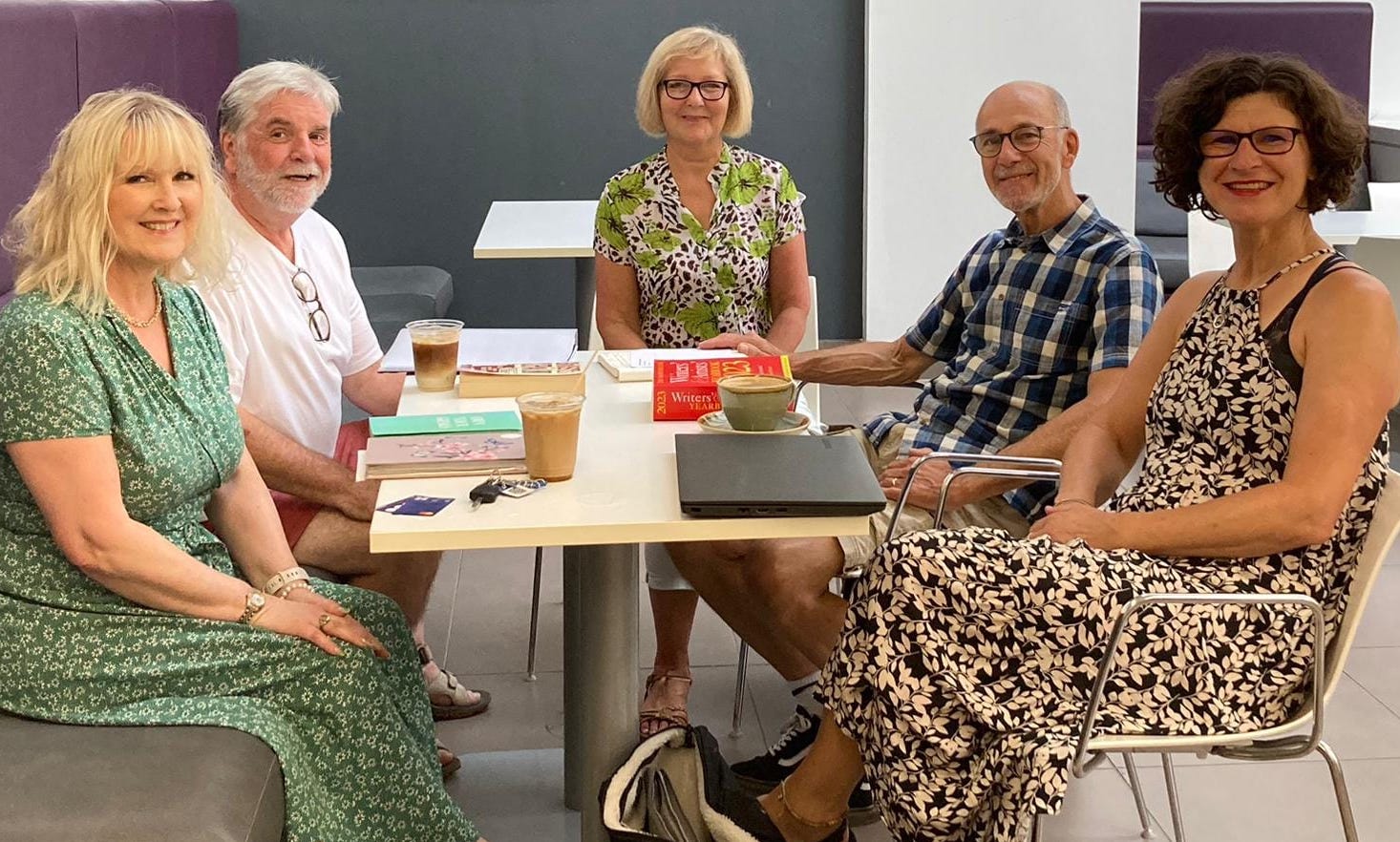
Thanks to Lynn Griffin for getting our writing group under way. So enriching to share our writing journeys with each other. Always come away with loads of ideas Stephen, Claire and Jonathan
My final piece of advice is aimed at all the female writers out there (sorry chaps!) Do consider a subscription to Mslexia, a magazine that supports female writers: https://mslexia.co.uk/ It offers a wealth of resources, writing opportunities and advice. Although I have not yet had any short stories published, I have just secured a bursary to attend their online Novel School (8th-12th July 2024). Armed with my manuscript appraisal and this exciting and challenge week at Novel School ahead of me, I’m still travelling towards that all important holy grail – a submission-ready manuscript.
Have you always wanted to write a novel, create a screenplay, or perfect your poetry? Whatever you’re looking to write, our BA (Hons) Creative Writing degree will give you the tools to achieve it.
Once morning in 1654, in the city of Delft in Holland, there was a "thunderclap". That was the way the people of Delft described the explosion of a factory containing 90,000 pounds of gunpowder. Large sections of the city were devastate, and 100 people died.
Carole Fabritius was among them, and that may be why so few people have heard of this artist, who had been a pupil of Rembrandt, and, before he reached his thirties, was already an acclaimed painter of the Dutch school. He left a sadly small portfolio of work, and it's clear might have gone on to paint so much more, if he had survived the blast.
One of his most beloved works is also one of the most upsetting, from the viewpoint of an animal lover; The Goldfinch. Just 9X13 inches, and possibly as a trompe d'oeil and perhaps a clever part of a window shutter, it is beautifully rendered. A small songbird sits on its perch, staring out at the viewer. Every feather is a perfect rendering. And the little gold chain that prevents the bird from seeking its freedom is lost in shadow, you have to peer closely to see that the goldfinch is a captive. It was sitting in Fabritius's workroom, almost next door to the factory, when the blast destroyed almost everything there, including the artist himself.
Donna Tartt launching The Goldfinch in Amsterdam . Photograph: Bas Czerwinski/AFP/Getty Images
When I read Donna Tartt's third novel in 2014, titled The Goldfinch, I was expecting something grand, something with an explosion at the centre of it, because her previous two novels had been acclaimed and their powerful stories were still in my mind.
She certainly offered an explosion; moments after the story begins, a bomb blows out the New York's Metropolitan Museum. 14 year old Theo Decker is in one section, his mother elsewhere. She is killed by the blast. As Theo tries to extricate himself from the wreckage, a dying man tells him to take the small, framed picture lying in the dust. He thinks to take to his mother for safekeeping and finds his way home; she never arrives. From then on, The Goldfinch, with its imploring theme of captive beauty, is his guilty secret, and a physical connection to his mother. It becomes something he can't bear to be rid of but something he cannot admit he possesses.
How fittingly linked these two stories are. The fiction of a boy who walked out of an explosion with the painting of an artist who died in an explosion. The Goldfinch, painted in the year of Fabricius's death, was one of only about 12 of his paintings to have survived the tragic explosion, and in Tartt's story, it survives again, albeit in a setting it has never traveled to; it's hung in The Haig.
I was reminded of The Goldfinch when I read Laura Cumming's latest book
on art; Thunderclap. Although the focus of this book is Fabritius and his works, she also looks at her own approach to art, as an art critic. She says, 'We see pictures in time and place. We cannot see them otherwise. They are fragments of our lives, moments of existence…' I wonder if that is also true of fiction; certainly, a school of literature theory suggests that works can only be judged though the eyes of the reader, who brings their own emotional smörgåsbord to the interpretation.
Certainly, I began reading The Goldfinch knowing nothing about the painting, or having even heard of Carel Fabritius, but I devoured this long book; it reminded me of Dickens in its complexity and with its whirlwind of amazing characters, and its 'cause and effect' plotting – the dying man who tells Theo to take the painting is guardian to a young girl named Pippa, who was also in the museum when the bomb exploded, and is the only person who Theo feels can understand his heart, as they both lost someone dear in the explosion. Their lives will collide and separate, repeatedly, throughout the book.
And yet, Tartt told The Telegraph, shortly after publishing the book that she hadn't even known about the Delft Thunderclap when she wrote it. She said. 'The the first time I saw it, I connected very strongly with it. This little bird, so brave and so dignified, and then you see that terrible little chain…' She was simply looking for the right painting, that would be small enough to carry and wouldappeal to a child.
The rôle of synchronicity in creating a novel can make one gasp. For, if Tartt didn't know much about Fabritius’ death when she chose the painting, why is her central character called Theo Decker? Because at the time of his death Fabritius was painting the portrait of a church deacon named Simon Decker.
Writing is full of such coincidence, as Tartt admits:
'It all fit together in ways I could never have imagined. When coincidences like that start happening you know the muses are at your side. ”
It's good to know that when such amazing moments occur, the writer should grasp them with both hands.