Showing posts with label Art. Show all posts

Tuesday, 2 September 2025

Stories About Artists; Amazing Novels about Artists and Paintings: Steel, Chevalier, Smith and Hustvedt

What is it about visual artists that attracts those word artists...writers, I mean...to use them so often in their novels?

Stories about artists, both real and fully imagined, abound. 

We've all heard of Girl with the Pearl Earring, which features a real oil painting by Dutch Golden Age painter Johannes Vermeer, but Chevalier's The Lady and the Unicorn is also a great read; about an imagined 15thC artist, Nicolas des Innocents, who created the illustration for a richly embroidered wall tapestry, based on a real tapestry, rediscovered by French historian and archeaologist Merimee, in 1841, in Boussac castle in central France.
Then there's The Goldfinch, which, when I read the book, I imagined Donna Tartt had invented this rather wonderful little oil painting for her scintilating 2014 Pulitzer Prize novel, but is in fact a painting by Reneissance artist Carole Fabritius, which   I talk about here 

I've love all of Ali Smith's novels, but How to Be Both is perhaps as challenging read as you're likely to find. Smith plays with conventional fictional form, letting the reader in on  the poignancy of the story before the characters even start to realise. Smith examines a little of the life of  the 15th-century Italian painter Francesco del Cossa. Meanwhile, George is a teenager who has lost their mother, and tries to bring her back to life by recalling how they saw this  artist's  work.   Smith seems to investigate the symbolism of frescos: many layers, simultaneously.

curtesy of The Women's Prize
Most recently, Lucy Steed has just won the Waterstones Debut Prize for her first novel. She writes about one Edouard Tartuffe, “the Master of Light” an artist who lived in the early 20th Century,  a bit of a hermit and not a very nice man, really. He loves to paint rotting food, which gives his young housekeeper, Ettie, a bit of a headache. In 1920, Joseph Adelaide, an aspiring journalist, arrives at the remote farmhouse in the Provençal village of Saint-Auguste. He takes
comfort in art after being branded by the horror of the first world war, and wants to write an article about the famed oil painter.  Slowly, the young Englishman falls for Ettie, and tries to persuade her to escape her overbearing uncle.

If you're wondering why you haven't heard of Tartuffe, it's because Steed has created him, but he could be real, a cross between many artists of this incedury time. But her depictions of his art feel sensual and authentic and I could almost smell the paint...and the rotting peaches. 

Finally, a book I read some time ago, but have never forgotten. I must read more by this American author; Siri Hustvedt, Her 2003 novel, What I Loved sparkles with intelligence. It begins in the New York art world in the 70s, with art historian Leo Hertzberg and his friend, artist Bill Wechsler, whose artwork Leo has discovered in a SoHo gallery. Hustvedt is strong on the psychological effects of love, grief and hysteria, and her narrative voice pulls you into, and through, the story.

So now I'm looking for more exciting depictions of art and artists through a novelist's eye, although, I don't think, for now, I'm going to find more emotional maturity, than Steed, more passion than Hustvedt, more tense drama than Chevalier, or more brilliant plotting than Tartt.


Saturday, 17 February 2024

The Beautiful Tau Banner of Lady Dai; Duchess of the Han Dynasty


  •  Xin Zhui, (better known as the Lady Dai)
    In 1971 some builders stopped for a smoke as they dug out an air raid shelter on a hill in Hunan, China. They were puzzled; as they dug deeper into the hill, the soil crumbled away as if it had  previously been disturbed. They lit their cigarettes and noticed that the matches burned with a deep blue flame. They might not have known that decomposition of human remains can release highly flammable gasses, but they left the site quickly, and reported their finding. 

    The outside cavity holding the three coffins
    When the archeologists arrived a few months later, they established that this was the resting place of a noble family of the Han dynasty. Two tombs, of the Marquis of Dai, who died in 186 BC,  and  a male relative, who may have been a son or brother, had been disrupted and robbed. But the final tomb, built circa 163 BC, for the Marquis's wife, Xin Zhui, (better known as the Lady Dai), was intact, and the archaeologists discovered  an opulent, spectacular and surprising interior. 
    One of the three inner caskets
  • The tombs were accessed via rectangular vertical shafts dug deep into the earth, a method originating from the bronze age. Lady Dai's funnel-like crypt contained more than 1,000 precious artefacts, including makeup, toiletries, lacquerware, and 162 carved wooden figures which represented her staff of servants. A meal was even laid out to be enjoyed by the 50 year-old duchess in the afterlife. In the central area lay three nesting coffins. Inside many layers of silk was the beautifully preserved mummy, wrapped in her finest robe, her skin still soft to the touch. The fact that she was quite corpulent, from her amazingly rich diet – scorpion soup was apparently a favourite – may have helped the quality of her ancient skin.
    An artefact found in the tomb
  • The outermost coffin was a plain box. Inside were the three nesting coffins painted with  hugely expensive lacquer in black, red, and white. This protected from water damage and bacterial invasion. I cannot imagine how awed the archeologists must have been as they steadily revealed each coffin.
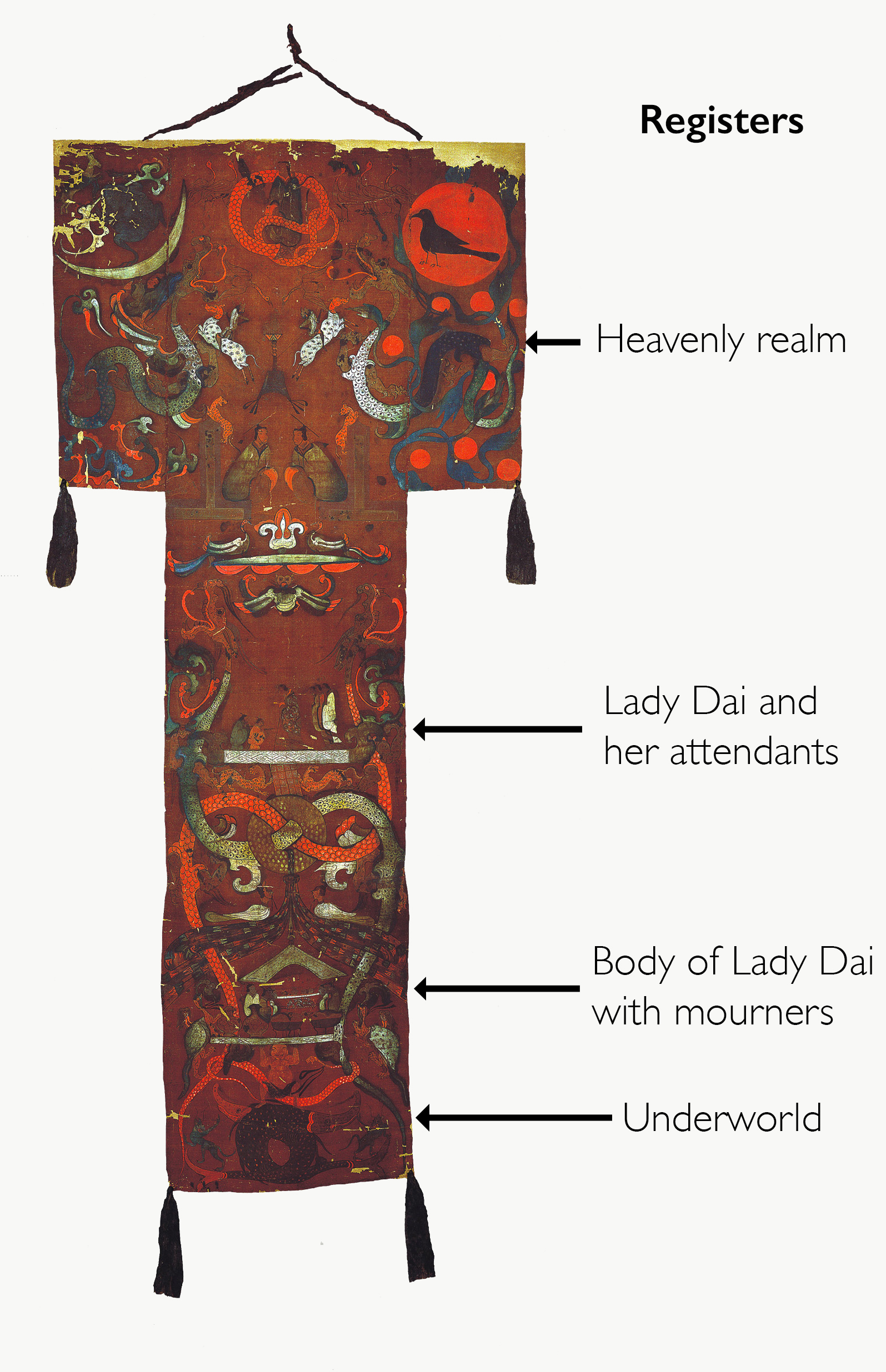
  • But even more magnificent than all of this, was the banner that lay on top of the innermost of the coffins. This almost intact piece of beautifully painted silk would have been part of the procession of the Marquise  to her resting place. And on it were full and intricate instructions for her soul. The banner instructed Xin Zhui's spirit how to reach her paradise
  • This T-shaped silk banner was over six feet long and in excellent condition for 2000-year-old fabric. It is a very early example of pictorial art in China.
  • I first encountered this breathtaking story of life in Ancient China at a lecture given at Lampeter University, in West Wales. Fabric specialist had travelled from across the country to learn more about Lady Dai’s banner, its art and its messages. 
  • The banner is divided into four horizontal sections. In the first, Lady Dai is pictured standing on a platform, leaning on a staff, wearing an embroidered silk robe. Framing the scene are white and pink sinuous dragons, their bodies looping through a 'bi' (a disc with a hole,  representing the sky). This section is remarkable in itself, as it is the earliest example of a painted portrait of a specific individual in China.
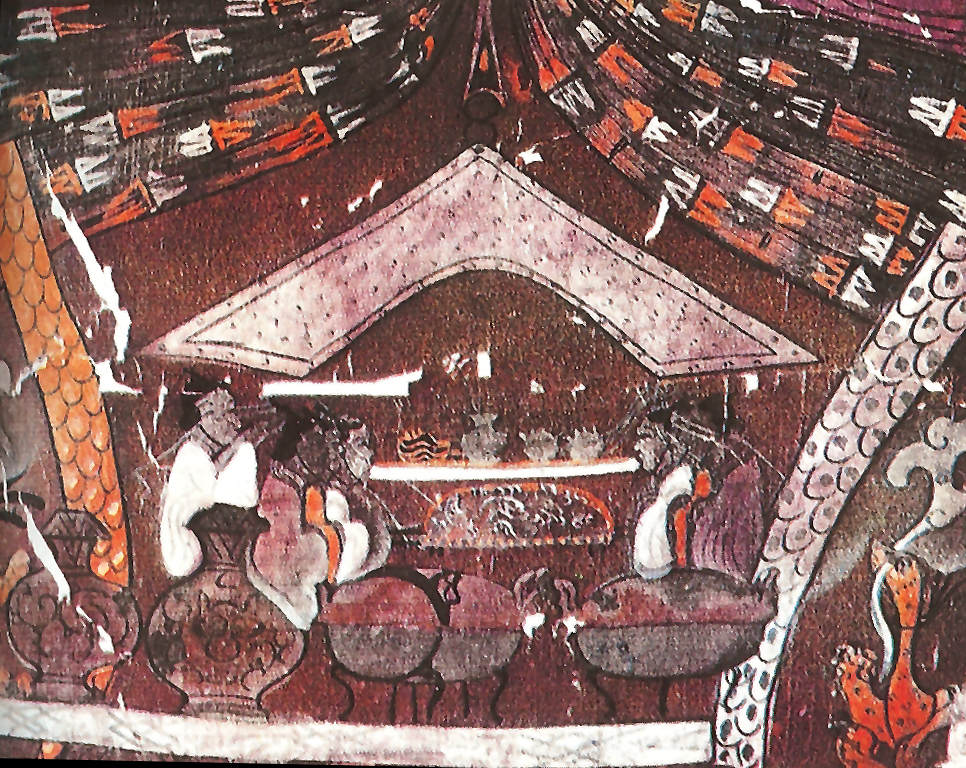
  • In the section below this scene, sacrificial funerary rituals are portrayed in a mourning hall. Tripod containers and vase-shaped vessels for offering food and wine stand in the foreground. In the middle ground, seated mourners line up in two rows.
  •  On a mound in the  between  two rows of mourners there are the patterns on the silk that match the robe Lady Dai wears in the scene above this.
  • Lady Dai’s banner helps the modern world understand the religion she followed two millennia ago, and how artists began to represent depth and space in early Chinese painting. They made efforts to indicate depth through the use of the overlapping bodies of the mourners. They also made objects in the foreground larger, and objects in the background smaller, to create that illusion of space.Diagram of Funeral Banner of Lady Dai (Xin Zhui), 2nd century B.C.E., silk, 205 x 92 x 47.7 cm (Hunan Provincial Museum, Changsha)
  • Above and below the scenes of Lady Dai and the mourning hall, are images of heaven and the underworld. Toward the top, near the cross of the “T,” two men face each other and guard the gate to the heavenly realm. Directly above the two men, at the very top of the banner, is  a deity with a human head and a dragon body.
  • Dragons and other immortal being look down from the sky to a toad standing on a crescent moon flanks the dragon/human deity and  what looks like a three-legged crow within a pink sun. The moon and the sun are emblematic of a supernatural realm above the human world. In the lower register, beneath the mourning hall,  the underworld is painted with a red snake, a pair of blue goats, and an earthly deity, holding up the floor of the mourning hall Two giant black fish cross to form a circle beneath him. The beings in the underworld symbolize water and earth, and they indicate an underground domain below the human world. 
  • Body of Lady Dai with mourners (detail), Funeral banner of Lady Dai (Xin Zhui), 2nd century B.C.E., silk, 205 x 92 x 47.7 cm (Hunan Provincial Museum, Changsha)
  • While other mummies tend to crumble at the slightest movement, Dai is the most well-preserved ancient corpse yet to be discovered. Unlike most of the mummies found in ancient Egypt, her organs were all intact –  there was still blood in her veins—Type A. This allowed pathologists the once-in-a-lifetime opportunity to perform an autopsy on the preserved body, 2,100 years after her death, ultimately giving us a firsthand glimpse at how the richest of the rich lived during the Han Dynast and is arguably the most complete medical profile ever compiled on an ancient individual.
  • Thanks to her luxurious lifestyle, the Marquise had osteoporosis, arteriosclerosis, gallstones, liver disease, diabetes, and high cholesterol. She must have been in pretty constant pain from a fused spinal disc.
  • Immediately after she was exposed to oxygen for the first time in 2,000 years, her body started to break down, which caused some of the visible decay apparent in the photograp of her mummy at the top of this blog.  Her body and belongings were taken into  the care of the Hunan Museum, where she now lies in state.

Thursday, 23 November 2023

Donna Tartt, Carel Fabritius, and The Goldfinch


Once morning in 1654, in the city of Delft in Holland, there was a "thunderclap". That was the way the people of Delft described the  explosion of a  factory containing 90,000 pounds of gunpowder. Large sections of the city were devastate, and 100 people died. 

Carole Fabritius was among them, and that may be why so few people have heard of this artist, who had been a  pupil of Rembrandt, and, before he reached his thirties, was already an  acclaimed painter of the Dutch school. He left a sadly small portfolio of work, and it's clear might have gone on to paint so much more, if he had survived the blast.

One of his most beloved works is also one of the most upsetting, from the viewpoint of an animal lover; The Goldfinch.  Just 9X13 inches, and possibly as a trompe d'oeil and perhaps a clever part of a window shutter, it is beautifully rendered. A small songbird sits on its perch, staring out at the viewer. Every feather is a perfect rendering. And the little gold chain that prevents the bird from seeking its freedom is lost in shadow, you have to peer closely to see that the goldfinch is a captive. It was sitting in Fabritius's workroom, almost next door to the factory, when the blast destroyed almost everything there, including the artist himself.

Donna Tartt launching The Goldfinch in Amsterdam
. Photograph: Bas Czerwinski/AFP/Getty Images
When I read Donna Tartt's third novel in 2014, titled The Goldfinch, I was expecting something grand, something with an explosion at the centre of it, because her previous two novels had been acclaimed and their powerful stories were still in my mind.

She certainly offered an explosion; moments after the story begins, a bomb blows out the New York's Metropolitan Museum. 14 year old Theo Decker is in one section, his mother elsewhere. She is killed by the blast.  As Theo tries to extricate himself from the wreckage, a dying man tells him to take the small, framed picture  lying in the dust. He thinks to  take to his mother for safekeeping and finds his way home; she never arrives. From then on, The Goldfinch, with its imploring theme of captive beauty, is his guilty secret, and a physical connection to his mother. It becomes something he can't bear to be rid of but something he cannot admit he possesses.

How fittingly linked these two stories are. The fiction of a boy who walked out of an explosion with the painting of an artist who died in an explosion.  The Goldfinch, painted in the year of Fabricius's death, was one of only about 12 of his paintings to have survived the tragic explosion, and  in Tartt's story, it survives again, albeit in a setting it has never traveled to; it's hung in The Haig. 

I was reminded of The Goldfinch when I read Laura Cumming's latest book

on art; Thunderclap. Although the focus of this book is Fabritius and his works, she also looks at her own approach to art, as an art critic. She says, 'We see pictures in time and place. We cannot see them otherwise. They are fragments of our lives, moments of existence…' I wonder if that is also true of fiction; certainly, a school of literature theory suggests that works can only be judged though the eyes of the reader, who brings their own emotional smörgåsbord to the interpretation.

Certainly, I began reading The Goldfinch knowing nothing about the painting, or having even heard of Carel Fabritius, but I devoured this long book; it reminded me of Dickens in its complexity and with its whirlwind of amazing characters, and its 'cause and effect' plotting – the dying man who tells Theo to take the painting is guardian to a young girl named Pippa, who was also in the museum when the bomb exploded, and is the only person who Theo feels can understand his heart, as they both lost someone dear in the explosion. Their lives will collide and separate, repeatedly, throughout the book. 

And yet, Tartt told The Telegraph, shortly after publishing the book that she hadn't even known about the Delft Thunderclap when she wrote it.  She said'The the first time I saw it, I connected very strongly with it. This little bird, so brave and so dignified, and then you see that terrible little chain…' She was simply looking for the right painting, that would be small enough to carry and would appeal to a child. 

The rôle of synchronicity in creating a novel can make one gasp. For, if Tartt didn't know much about Fabritius’ death when she chose the painting, why is her central character called Theo Decker? Because at the time of his death Fabritius was painting the portrait of a church deacon named Simon Decker. 

Writing is full of such coincidence, as Tartt admits: 

'It all fit together in ways I could never have imagined. When coincidences like that start happening you know the muses are at your side.

It's good to know that when such amazing moments occur, the writer should grasp them with both hands. 


Tuesday, 17 August 2021

How Art Changes the World

Picasso’s Guernica.

I will never forget the Radio 4 programme on  Picasso’s Guernica. Of course this is an emotionally devastating picture symbolically showing the bombing of the Basque town of Guernica in April 1937, carried out on the behest of Franco by the Nazi German Luftwaffe. The radio programme covered the history of Picasso’s politics (he became a communist in 1944) and the painting techniques in its construction

Guernica pulls you in as you gaze on it. The lack of colour intensifies the drama – it's almost as if we're looking on a confused photograph of carnage. People are screaming in this painting, their necks stretched, their arms raised in defeat. People lie dead; babies lie dead in their mother's arms. And among this carnage, are a bull and a horse. In my last blogpost, I started a new series looking at symbols in writing, and here, both these creatures are present as dominant symbols of what Picasso is telling us. 

As a symbol, bulls  symbolise fertility and stamina, but although it's a powerful beast, it is often unable to defend itself. It's staked in a field by a ring through its nose, or allowed to enter a ring where it will be stabbed to death..Art critics have speculated that Picasso felt many personal parallels with the bull, incorporating it into his work as a symbolic form of self-portrait.The bull is almost totemic in Spanish society, protective of the people and especially the 'Madre'; the mother that is Madrid. However, it has also been interpreted as the fascist state that was attacking the ordinary people of Spain.

The horse has been said to represent the tragedies of war and the suffering it inflicts upon individuals, particularly innocent civilians. In the picture, the horse is screaming in pain and if you look closely you'll see it has been run through with a javelin. People wondered if Picasso was trying to predict the downfall of his nation. There is no doubt that this horse is as least a  distressing sight, as the agony of mothers and children. It has become helpless as it dies its senseless death.

But the thing I took away from this programme on the painting was how ordinary people are affected by it. The contributors said that four and five year olds taken to see it are rendered speechless, that in 1939 working men brought their boots to the Whitchapel Gallery in London where it was displayed, to show their solidarity with Spain. It has gained a monumental status, an anti-war symbol, and embodiment of peace. In 1937, it was widely acclaimed and a  tour helped bring the Spanish Civil War to the world's attention. Sixty year later, Colin Powell stood in front of the UN building to announce the start of hostilities in Iraq, and the tapestry of the picture they have there was covered with a cloth as he spoke. The inhabitants of Guerica wrote to the UN in protest, pointing out the tapestry had been hung to remind all delegates as they entered the building, that their priority was to prevent war. 

This suggests great art is among the finest mediums of communication. In the right place (I think I mean 'available to be seen'),  pieces of great art can be equal in effect, if not having a greater effect, to mass media, social media or advertising. Art does not leave you indifferent. 


In a small survey, people were asked how Banksy’s art makes them feel. The results said: 51% Thoughtful. 24% happy. 22% Rebellious and there is a huge appetite to view his art, which is always brimming with messages. 

Since the M4 was built through the centre of  Port Talbot,  it has become the most polluted area in the UK, and one of the nation’s most deprived town. But just before Christmas 2018, Port Talbot woke up to a very special present. Two sides of a concrete block garage suddenly displayed a painting: a small boy with his tongue out to catch snow that, when viewed from another side, turns out to be ash from an industrial bin. After a brief period of suspense and speculation, Banksy confirmed the work as genuine by posting it on his website in the late afternoon, with the artist commenting: “season’s greetings”. In the frenzy that followed, thousands descended on the small street and the owner of the garage, who used to work at the steelworkss,  went without sleep for two days as he tried to protect the image. He was quoted as saying;  "It's really dusty in Port Talbot. I've lived there for 54 years." From this  terraced street, the  chimney stacks of the steelworks can just be seen above the rooftops, and streets nearby were home to actors Michael Sheen, Richard Burton and Sir Anthony Hopkins before they left for London and  Hollywood. 

Wire fencing was initially placed around the garage wall to stop vandalism, followed by perspex sheets. The artwork was finally sold for a six-figure sum and was displayed in the town.

Leonardo do Vinci is known for so many famous paintings, but this one is not a household name. It is the
 study of a foetus curled up in a womb, drawn in red chalk with traces of black chalk, pen and ink and wash, and has a  note expressing his thoughts attached to it:

"In this child the heart does not beat and it does not breathe because it rests continually in water, and if it breathed it would drown. And breathing is not necessary because it is vivified and nourished by the life and food of the mother... And one and the same soul governs these two bodies, and desires, fears and pains are common to this creature as to all other animated parts. From this it arises that a thing desired by the mother is often found imprinted on those parts of the infant that have the same qualities in the mother at the time of her desire; and a sudden terror kills both mother and child. Therefore one concludes that the same soul governs and nourishes both bodies." 

It is possible that this drawing by Di Vinci made more impact on the world than the Mona Lisa or The Last Supper put together. Da Vinci took his anatomical drawings from real life dissections, which the Church strictly forbade for non-physicians, but he determined to study human anatomy, including the relation between structure and function Often he worked by candlelight in the crypt of a church,  painstakingly dissecting bodies, both of men and women of all ages. Da Vinci described how others “...might be deterred by the fear of living in the night hours in the company of these corpses, quartered and flayed and horrible to see.” His work showed remarkable powers of observation,  perspective, accuracy and clarity, and through this he effectively was pioneering the future sciences of anatomy and forensic medicine. 

By creating a perfect depiction of what happens to the baby inside a woman's body, he challenged moral and artistic convention and changed the way that scientists studied the human body.


Guernica can be seen in the Museo Reina Sofia in Madrid.

Season's Greetings by Banksy can be seen at T'yr Orsef, Parkway, Station Rd, Port Talbot SA13 1UH

Da Vinci's famous embryological drawings of the fetus are held in the Royal Collection at Windsor Castle in England


Monday, 28 September 2020

AN ARTISTIC FUTURE FOR WELSH WOOL


We are once again limited in
 what where we can go, and who we can be with. 
I’ve been spending some happy hours recalling the summer of 2019 (bet you have too...). That was my 'arts and crafts of Wales' summer, when I spent sunny days visiting some of the working mills of West Wales. 

These mills, and the work they're now doing, got me interested in the history of  Welsh tapestry wool. I had conversations with the workers, who told me about their finished products and the sustainability and the carbon footprint of traditional weaving. I chatted to some of the designers about their contemporary artistic endeavours. I had many cups of coffee and quite a few delicious lunches, and took in quite a lot of the lovely countryside and coast.


  The tradition of weaving sheep's wool in            Wales expanded from prehistoric times through the middle ages, relying on the fast-running streams of west Wales, especially around the Teifi, (which runs through the heart of Ceredigion where I live) to provide power. Rural mills,  processing local fleeces, produced the Carthenni double-weave tapestry, which is unique to Wales.


Deeply rooted in Welsh tradition, double weave uses a strong 

2-ply yarn producing a hard-wearing reversible fabric. In past centuries, every mill had its signature design. Two layers of fabric are woven one above the other, interchanging at points forming ‘pockets’, and enabling bold areas of pattern to be created. However, when the Wool Marketing Board came into being in the 1950s, Welsh yarn found itself blended mostly into carpet yarns. The weaving mills began to fail and the iconic Carthenni patterns were almost lost.


National Woollen Museum


I started my discoveries by visiting the National Woollen Museum, 20 minutes from my house. Formally, it was 'Melin Teifi', and produced  shirts and shawls, blankets and bedcovers, woollen stockings and socks, which were sold in the surrounding countryside – and to the rest of the world.  Reopened now after Covid, you can see the sympathetically restored  machines in operation, and follow the process from Fleece to Fabric.


But I also wanted to find the working mills around my way, because recently there has been a renaissance – a new fusion of tradition and modernity – using contemporary marketing techniques to secure a future. However, there is an issue with both attracting apprentices and maintaining the desire for sustainable, artisanal, small scale, locally based goods. 


Melin Tregwynt is a whitewashed mill in a remote wooded valley It's been continually used for nearly 200 years, so the buildings have an industrial feel of oily cogs, dusty air and busy weavers, while the shop’s display style is distinctly high-end high street.


They supply John Lewis and Mulberry and say, Weathering wars, recessions and the passing of time, the looms have continued to work their magic since the 17th century, when local farmers would bring their fleeces to be spun into yarn  and woven into sturdy Welsh wool blankets.'


     The design team take centuries-old Cartheni    and ‘revive and design’ unique pattern ideas. They describe their technique as, '…inspired by our heritage, the archive built up over a hundred years of production and love of colour. Some fabrics in our current collection…are brand new but still inspired buy the landscape and tradition of Wales.' Tegwynt has regenerated the tradition of Patagonian double-weave (where Welsh-speaking immigrant weaves took on a South American flavour). The designers are also influenced by the Welsh landscape, Welsh lace, traditional Welsh quilting  and the ‘sense of spirit of place’.


In the visitor centre, a poster shows dying methods of previous centuries. These generated  muted colours and I noted the mill’s contemporary colour combinations are equally muted – grey and beige,
 lilac, ochre yellow, powder blue, amber and pink. 

Jayne Pierson, who previously worked for McQueen and Westwood, uses the mill’s fabrics to create fashion items which have starred in a Vogue fashion shoot…'I've created something that is a slow, sustainable fashion that is taking something age-old and reinventing it and upcycling it and making it relevant now to a younger consumer. Maybe younger people aren't so familiar with the heritage of Welsh wool - [they can] look at it again and be introduced and turned onto something that is actually very beautiful…'

Solva Mill is only a mile from the splendid Pembrokeshire beach of the same name.

Solva spent quite a lot of cash on restoring the mill wheel to working order, to reinforce their ethical credentials. By using carpet quality Welsh wool, Solva have become specialist weavers of exceptionally long-lasting floor rugs, runners and stair carpets. They feature symbolic designs synonymous with Welsh textiles.


To extend their marketing, the shop stocks locally designed textile art that fits its underlying ethos, including designs by seamstress Emma Iles, who has been inspired by the rugged Solva landscape to develop Seaforth Designs. She is


first inspired by fabric. 'I’d find a piece of soft woven grey herringbone wool with different weft and weaves that would look prefect for a dunlin. But now the collection is evolving. I see oystercatchers in the harbour and decide to add them to the collection, so go on the hunt for charcoal tweeds, and work that way round.' 

Felin Fach is extremely proud of remaining as close to traditional methods as possible. They use a high percentage of wool, alpaca, mohair, linen and silk sourced from local farms or smallholdings. They hand dye  using natural botanical plant extracts such as Madder, Weld, Indigo and Logwood.                      

The fixing agent is Alum, a nontoxic water-soluble


metallic salt and they hand finish using water from springs at the Mill.…
Whilst botanical dye is a more time consuming option there is a beauty and depth of colour to natural dye that becomes more beautiful with age…Our Welsh Tapestry Blankets are woven on traditional looms and created in limited numbers with personal care and attention.

Just a mile from my house, is  Curlew Weavers, a centuries-old family business which originally made its own dyes and used the little river Ceri (my local river, that nuns into the Teifi)  to drive looms. Roger Poulson owns and runs the mill at a profit. When I needed curtains, I went to him, knowing that I'd be hanging real Welsh Carthinni woven wool,  hand-made on machinery that hasn’t much changed over the centuries.                                                                  Roger told me, 'I use an artist’s eye to evolve new designs, choosing colour combinations from available dyes and allowing the ‘weft’  to dictate patterns.'                                                           


My curtain design features three yarns close

on the colour spectrum, and one from the opposite end – gorgeous autumnal oranges and browns, with royal blue. Stand back and the blue subtly turns the entire thing to a golden hue. 

Rodger upgraded his family’s business model radically, focusing on the sustainability of small-space production. 'I offer carding, spinning and weaving for Rare and  Specialist Breeders and organic farmers, while making a range of upholstery fabrics, throws, garments and dyed, spun yarn in skeins.' He supplies the Welsh Office, the QE2 and even Downing Street. 'My products have a small carbon footprintSheep are part of a natural carbon cycle, because wool is a planet-friendly fibre with a long, recyclable lifespan which takes far less water than cotton in the manufacturing process.'


Unable to cope with the vast industrialisation of textile production, the Welsh woollen industry has reinvented its intent and objectives, using the romance of its esteemed past and the revival of hand-made crafts to create a future for the family mills. It now has to concentrate on the next generation skill-set by offering attractive apprenticeships

and keep a close eye on textile trends.


If you would like to know more about this subject, why not start with Wikipedia, Woollen Industry in Wales https://en.wikipedia.org/wiki/Woollen_industry_in_Wales 

The National Woollen Museum is open to you, by rebooking free tickets; https://museum.wales/wool/


Most of these mills are open right now, but check their websites;

Melin Tregwynt,  https://melintregwynt.co.uk

Solva Mill https://www.solvawoollenmill.co.uk/wondersofwool 

Felin Fach https://www.felinfach.com 

 and you can find Emma Iles, Seaforth Designs, here; https://www.seaforthdesigns.com