Showing posts with label Nina's Writing World. Show all posts

Saturday, 30 November 2024

Writing about the Climate Crisis–– A Workshop for Writers

photo: Nina Milton

Habitat loss, marine pollution and climate change issues are blighting the natural world. They are also changing the lives of communities across the globe. There are many writers who wish to write this complex subject, but are often at a loss about where to begin and in which direction to head. 

This WRITERS' WORKSHOP is being held on Friday 24th JANUARY 2025 

online, and available to all writers, whatever your situation. 


Co-ordinated by Nina Milton, this 2 hour workshop is suitable for prose writers interesting in pursuing these subjects.  It won’t pretend to find the all answers, but it will allow us to become a little more aware of the issues around the subject and challenge our responses as writers. 


You may be thinking of writing about the changes or threats to the diversity of the natural world, about the communities effected by changing environments, or about the routes to more sustainable living. You may even be imagining a different future world.


We will discuss  some of the ways this sort of writing has been tackled by both fiction and nonfiction writers, at new and different ways of approaching these issues, and look how this writing will present in the future. 


With discussion and writing exercises with feedback on writing achieved and the chance to peer review each other's work, it is hoped that by the end of the workshop, attendees will feel more confident about approaching this vast subject, and have some new skills to enable this. 


Once you have signed up, you can access the information. on this workshop with links and reading recommendations.


Contact Nina Milton at kitchentablewriters@live.com to find out more details of the workshop.


Costs; £10 PER WRITER: Bursaries are available to help with costs. 


Sunday, 20 October 2024

7 Writing Tips from 7 Respected Authors

Free Number Seven Cliparts, Download Free Number Seven Cliparts png ...  

Seven Writing Tips from 7 Respected Authors ...and me.

1.  Maggie O’Farrell

‘What I wish I’d known when I was starting out, is that you don’t have to worry about beginnings. Don’t worry too much about knowing what you’re doing at the beginning. You can start in the middle if you want! Just put the words down.’

2.  Iris Murdoch 

Writing is about practice, and not about luck.


3. Lionel Shriver 

‘Write whatever you damned well want. Trying to please ends up pleasing no one, including yourself. And caution is boring. Especially in these touchy times, I suggest getting yourself into trouble. (That won’t be hard.)’


4. Virginia Wolf (from Mr. Bennett and Mrs. Brown, Woolf’s famous essay)

Eavesdrop. Listen to the way people speak, but pay special attention to their silence.


5. Katherine Mansfield

Looking back I imagine I was always writing. Twaddle it was too. But better far write twaddle or anything, anything, than nothing at all.

6. Hilary Mantel 

Be ready for anything. Each new story has different demands and may throw up reasons to break these and all other rules. Except number one: you can't give your soul to literature if you're thinking about income tax.

7.  Zadie Smith

Work on a computer that is disconnected to the internet. 

.

...and me...  Imagine your scenes in your head, imagine the dialogues taking place and the setting coming alive. Imagine a character saying to you––"no–I'm not doing exactly what you planned for me, I'm doing this, instead!


Friday, 29 September 2023

Literary Giants of New York and the Algonquin Hotel


When  my daughter, Bex and I were in New York, we were determined to find out more about the literary side of the city, so we went to the Algonquin Hotel to meet Kevin, who knew all about writing and the Big Apple. 

The first thing we saw when we arrived at the Algonquin Hotel, was the cat in the window, snuggled up in a little bed for the world to see. This was Matilda  the Algonquin cat, who has been resident for something like 40 years. Each time a cat dies, a new cat is brought from a refuge. If it is male, it's called Hamlet. If it is female, it's called Matilda. Each puss wanders the hotel at will, but has this special basket in the front window, looking out onto the road. The hotel is located on Times Square,  with Yale, Harvard and the Yacht club headquarters nearby. The hotel façade is imposting and grand, and Matilda gives the place a more welcoming feel.

'I wonder what Algonquin means,' mused my daughter.           I laid down a dollar bet that the hotel name was of First Nations origin. But we were both puzzled – we'd done our homework and knew that the original inhabitants were called The Lenape, who had named the place Manahatta, meaning 'hilly island'.

When Kevin arrived, this was the first question we had for him, and he had the answer; the Algonquin people  lived in the Ottawa Valley for at least 8,000 years before Europeans arrived in North America. But the source of the word Algonquin is unclear. 'It is said to mean  “at the place of spearing fishes and eels from the bow of a canoe”,' he said.

Great – I'd won my bet. I tucked my dollar winnings away as Kevin led us through the hotel foyer, all Art Deco dark wood paneling and golden lighting.  He explained that the hotel had been built in 1902,  was twelve stories tall,  and shaped like an "H". Bex and I agreed that this was the hotel we'd stay at if we were ever to ship up in Manhattan again.

He walked us over to the famous literary round table, set in an alcove behind the reception area. 'This is where all the literati of New York would meet between the first and second world wars,' Keven told us. 'It was known for it's lively, witty, and sophisticated conversations.'

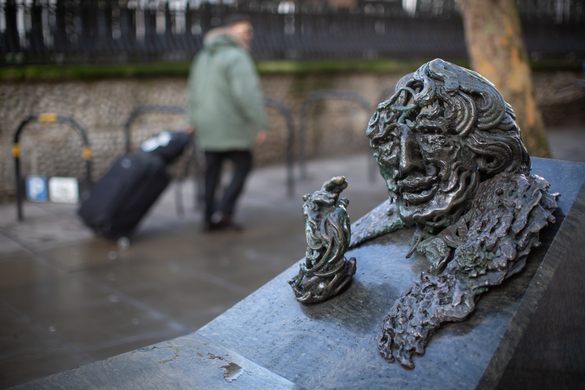
Dorothy Parker

The group included Harpo Marx, Dorothy Parker and Harold Ross and his wife, Jane Grant, who founded The New Yorker. Also members were the actor Peggy Wood, George Kaufman, Margaret Leech Pulitzer and Donald Ogden Stewart who won an Oscar for The Philadelphia Story, Herman J. Mankiewicz, who won an Oscar for co-writing Citizen Kane. The rumour was that people like F Scot Fitzgerald,  Ernest Hemingway and William Faulkner may have also dropped in for lunch; why not, these were wise-cracking wits who enjoyed pranks and word teasers, such Dorothy Parker's wordplay fun with: 'you can lead a horticulture, but you can't make her think…Brevity is the soul of lingerie…If you want to know what God thinks of money, just look at the people he gave it to…'

Above the large round table in the alcove is a painting of the club, showing many of its members. 


Keven took us for a walk around Hell's Kitchen, which is an inner-city 
area that was reputed to be like ‘the kitchens in Hell itself’ according to the NYPD of the prohibition era. There he pointed out where great writers of the time lived. He took us to the homes of James Thurber and Eugene O’Neil and F Scot Fitzgerald and his wife Zelda. A haunt of the young James Baldwin was  his Aunt Barbara's candy shop near Fifth Avenue. She would later provide inspiration for the character of Florence in Baldwin’s first novel, Go Tell It on the Mountain, published in 1952. Colson Whitehead also lives in Manhattan, where he set his masterpiece, The Colossus. This opens with the 'awful truth' about being a Native New Yorker – 'it leaves you ruined for anywhere else.

Most of these writers had written at times for the New Yorker, a magazine I know especially for its amazing short stories and brilliant cover illustrations. We found ourselves in the offices of The New Yorker, the New York magazine featuring journalism, commentary, criticism, essays, fiction and poetry. Although it's been around since 1925, it is still the pinnacle of good journalism, and has published some of the most famous short stories, including Annie Prouix's  'Brokeback Mountain' and Shirley Jackson's 'The Lottery'.

This office was the opposite of the Algonquin; it was plate glass and steel, giving off an atmosphere of being ultra-modern, professional  and efficient. But Bex and I were already longing for Art Deco, and we found ourselves back at the Algonquin, ready to dine very close to (but sadly not on) the round table. 


Tuesday, 12 September 2023

How Authors Plot, and how They Muse


I've just finished a marvellous novel called Still Life, by Sarah Winman. In its  400+ pages, we visit Florence in the Second World War, post-war London, and Florence during the flood of 1966 and Europe at the start of the 20th century.  Moving between these real events are a wide cast of characters, most of them allowing life to take them where it will, and land them wherever it pleases. In The New York Times, the main character, Ulysses Temper is described as  'a searching, wandering protagonist' but it's not just 'Temp' that wanders; the entire story behaves like a river journey. As I reached the final pages, I began to ask, 'what did Winman want to say in this novel?' The Kirkus Review notes this is ''the story of their friendship, though it is also a story of the creation of a family of friends', New York Times suggests, Does Life Imitate Art or Is It the Other Way Around? and the Independent says it is an 'exquisite testament to life, love and art. 

Fair points, the story is all about the art of Florence and 'odd families' especially. But thinking about the characters, I've decided that what Winman especially  wanted to say is: Ordinary People are Really Extraordinary. 

Ulysses is a young soldier in the Allied advance in Italy in 1944 where he works with Evelyn Skinner, a 64-year-old art historian. They form a friendship bond which remain after their paths diverge, But while he's in Florence, Ulysses 'talks down' an elderly gentleman who had decided to take his own life. They go back to the man's lavish but lonely apartment, and again, a bond is formed. Meanwhile in London his soon to be ex-wife, Peg has fallen for a GI called Eddie and gives birth to a daughter she names Alys, but calls 'the kid'. Ulysses is demobbed, and goes back to working at his friend Col's pub, where Claude the blue parrot is a tavern talking point but hated by Col. The  post-war decade moves on, and the novel meanders through many a story, until Ulysses hears that the person who's life he saved has bequeathed him his large apartment. He decides to go back to Florence, and asks his old mate Cress to come with him. Peg, who still yearns for Eddie and is not a good mother to Alys, persuades Temps to  take 'the kid'.  Cress secretes the unhappy Claude  into a bag and off they all go, to live in Italy. They convert some of the inheritance into a thriving pensione. Alys soaks up the Italian life as she grows into a woman and Cress, who was able to communicate with trees in London, can also communicate with trees in Italy.

Throughout the next three decades,  Ulysses continues to love Peg, Peg continues to dream of Eddie, Cress finds Italian love in his golden years, and Alys finds love with another teen girl. Ulysses goes back to creating globes of the world, and in this way, is crazily linked back to Evelyn, who keeps an eye open for her old war friend, but constantly misses him until, one day, they find themselves all together; now a largish group of young and old, English and Italian.

The story, then is a winding route, just like a river. I loved it but immediately thought; 'I don't write like this; I couldn't plot like this'. I'm a bit of a plot junkie; Winman is clearly a 'characterphile'. (I created these terms to describe different 'kinds' of plotter; you can read about them here.) 

When I start a book, I'm usually inspired by landscape, my first point of inspiration. In my Shaman Mystery series a walk, years ago, through the Somerset Levels, sparked my interest in the area, followed by a distant, then closer, then close view of the Hinkley Power Station, which is featured in On the Gallows. Landscapes do it for me, but there are many other starting points.

Louise Doughty makes a similar point in her article, Taking a Line for a Walk (Mslexia No 99).  'My most recent book', she says, 'arrived – like Apple Tree Yard and Platform Seven before it – with a strong visual image'. She then takes that image 'for a walk', asking questions of it, until she has a scene, 'followed by a scene showing what happens next on the journey...until I worked it out, some 100,000 words later.'

This is a great way to write a novel if you are a 'characterphile'. If however you are a 'plot junkie' the idea might fill you with horror! What, no chapter by chapter outline, no timeline, to plot points to lead you on? I'm a plot junkie, but I'm quite tempted to have a go at this meandering method, the next time such an image, or landscape, enters my mind. Or, as happened this time to Doughty, a line comes to you, out of the blue. The same questions can be asked of this line or phrase or sentence, the same walk take, until, chapter upon chapter, you find an answer. 

Doughty talks about how the 'synapses in your brain are prompted to join up by something'. She doesn't go on to say what that 'something' is, but I would suggest we go back to the Ancient Greeks, who personified the inspirations that arise from intuition, or 'synapses' if you like, as Muses. The nine daughters of Zeus and Mnemosyne, or Memory, the Muses prompt those they visit to remember what they have forgotten. Muses with a special affinity for writers are: 

Calliope, the Muse of epic poetry

courtesy of Wikipedia
Clio, the Muse of history

Euterpe, the Muse of lyric poetry

Melpomene, the Muse of tragedy

Erato, the Muse of love poetry

Polyhymnia, the Muse of sacred poetry, and

Thalia, the Muse of comedy

Sadly, there isn't a Muse for  short stories, as these weren't around in ancient Greece. Their stories were narrated orally, or dramatically, and poetry was used in both forms, especially as it helps with memory...Mnemosyne…when retelling a story!

Like Doughty, one should never sit around and  wait for a muse to visit, in the hope she'll just 'show up'. She should be seduced to come to you. Doughty had gone to Amsterdam, 'wandering around the city for a week...with an empty notebook...' in the hope that she would 'encounter my next book'.  She was seducing her Muse, and finally, was obliged. 'What do you do when you're in the tase of creativity that I might as well call 'pre-technique', where all your struggles for plot construction or character development are useless because you don't have the foggiest idea what you book is about?' Suddenly a line came to Doughty. The opening line to a story she didn't yet know. The Muse had descended. She could begin. 

It seems a bit extreme to visit a different country in order to find your Muse, but you should be on the alert at all times. When your muse pops in every so often to drop a story idea on you, sit up and pay attention.

When you have a story idea, write it down in a journal or notebook. You can't write every story right away, so put it in the pickling juice and go on. Also remember the wonderful 'Muse-filled'  Miscellany File, or Commonplace Book, which I talk about here. Read, look through your ideas from time to time, crossing out the ones that have lost their muster. Also cross out the ones that seem too cumbersome. Keep the simple ideas and the ones that give you chills in your spine. Maintain this practice and you'll find that you always have a few good story ideas in the queue. 


Saturday, 8 January 2022

Getting Your Writing Published PART FOUR – Writing Competitions.


Nina at the Wells Literary Festival

One of the most memorable moments in my writing career, was walking up onto the stage to give a talk at the Wells Literary Festival. I'd been a previous winner of their short story competition and I'd been asked back to talk about my experience. This might not be the first thing you consider, when thinking about the benefits of entering competitions, but  it was a huge event on my calendar. 

I mentioned entering competitions right back at the start of this series of 'getting published' because it's one of the very best ways of making agents and editors sit up and take notice of a new writer, especially one who has just finished their first novel. They are a little more likely to read a few more pages of your submitted chapters if they know someone else liked your writing too. 

It is getting harder and harder to publish short stories. The small-press magazines are over-submitted (and sadly, not well read), and most weekly women's magazines have stopped including a short story. For over ten years I regularly had a story in women’s magazines - especially Bella who seemed happy for me to write dramatically about family issues, or sustaining relationships, rather than starting them (Bauer paid very well; I sent my daughter through her half scholarship on my Bella earnings), but now I aim my short stories at the anthology market, which is partly fuelled by competitions, and I recommend you do too, because agents and indie publishers do keep their eye on the winning contributions. 

Competitions are good for individual writers. They can help you work out how effective your writing is, in comparison to the work of others. They can help you push to finish things, and to polish them well. Winning can be quickly effective, gaining you kudos on your writing CV that might help get you a position on an MA course, or even introduce you to an agent. There are competitions for all disciplines and genres, especially short fiction, flash fiction, novel writing, scriptwriting, poetry and writing for young people. 

There are tricks and keys that open the door to getting into competition shortlists. Stories with originality that stand out in some way often do very well. Although ‘quieter’, beautifully written stories can win competitions, stories with a ‘tingle factor’ are bound to attract the judges' attention, especially after ploughing through hundreds, even thousands of similar, often derivative entries. 

Jo Verity, who won the Richard and Judy prize, says this..'I’d been writing for about 2 years. I happened to be off work with food poisoning – whiling away the time watching the Richard & Judy Show. It was the last chance to enter their short story competition (this was before the Richard & Judy Bookclub started) and I happened to have a story ready to go. I posted it off and forgot all about it. A couple of months later I got a call to say that my story was in the final 15 (from 17,000 entries) and could I go up to London the following week when the winner would be announced live on air. It was very exciting. Martina Cole, Suzi Feay and Tony Parsons were the judges. I was flabbergasted when they picked my story as the winner especially as I’d sent the same story out to a couple of competitions and it had done nothing.'

The prize was to have the story published in The Independent on Sunday, under the title Rapid Eye Movement.  The story relates the experience of a depressed young woman who gives up her job and cuts herself off from her family to perfect ‘lucid dreaming’. By the end, she’s spending most of her life in her dream world. 

One of my students came up with a 'tingle factor' story and successfully submitted it, to her absolute delight; Read her blogpost on her experience of entering a competition… here. Like  Jo Verity, my student had also had this story rejected in another competition. So bear in mind, when you don't win, time and again, that the choice of winner is both arbitrary and subjective. Judges are like the rest of us––they have their likes and dislikes. So long as you are sure you've proofread you work carefully, and that the story holds up under scrutiny, do submit it again. 

Prize winners all.

What is that scrutiny? Crucial to a winning short story are convincing characters, a strong and appealing core theme and an ability to provoke empathy or inspiration. Aim for coherent progression, rigorous construction and a satisfying conclusion. Many a fine story lacks ‘closure’, leaving the reader with untidy loose ends or an unresolved mystery. The author A S Byatt, suggests that: 'a good short story knows its ending before it is begun, it is always working towards its end…A good short story establishes its own rhythm at its very beginning, and the reader has a sense of the rhythm reaching ahead, towards the end…'

Read about AM Byatt in this Kitchen Table blogpost 

Make sure every word counts because word count is perhaps  more importance than anything else. Every competition has its rules and you must stick within them. Do not send out your 2,500 word story to a competition if the remit is 'less than 2,000 words'.

It's also best to keep to the short story maxim of 'few characters, little time and a satisfying resolve'. However, many a fine short story has successfully handled a bevy of characters, an extended timeline, or an ending that lacks closure. It might appear, at first glance, to be a collection of vivid but disjointed impressions. But the story still has to be rigorous in its construction; it must be a whole.

Most poetry writers start their publishing career by submitting their individual poems to poetry competitions. Your local library is as good a place to check these out as searching online. When submitting poems, try reading the previous winners’ entries, which give you an idea of which types of poems the judges enjoy. Be sure to read all the qualifications properly, checking for specific writing styles, points of view, settings, and especially length. Naturally, polish your work before submitting Use proper formatting within the title and description areas, and don’t use crazy fonts which will just annoy the readers.Start with smaller and lesser-known poetry competitions first, especially if finance is an issue, where you may have a better chance of being noticed.  If you are submitting your poem by snail mail, be sure to read over the poem after you print it and make any necessary changes.


Finding competitions across the disciplines is not difficult. They are all over the internet, and in every writing magazine. They advertise because most intend to make a profit, hence the entry fee. This often feels excessive, but it covers costs, pays the judges and often allows the prizes to glitter. 

There is nothing wrong with going for those glittering prizes, but the opposition is stiff, so don’t be put off by smaller prizes or contests that offer nothing more than the possibility of being published (especially in print). This always looks good on a growing CV.

Keep persevering…this can often be the best way to succeed. And –– by the way –– good luck!

Sunday, 31 October 2021

Getting your Writing Published' PART ONE – are the facts all fiction?

Are the facts about publishing all fiction?
 

Kitchen Table Writers hasn't blogged about the publishing world for a while – instead, subject matter has ranged from Asian goddesses, to symbolism, to  recent books to art, to sacred walking, So it's probably time to get back to one of the basic subjects people ask me about; HOW DO I GET PUBLISHED?

 Most writers would like to see themselves in print. In recent years, gaining a publishing contract has not got any easier, but new writers are still being spotted and taken on by major publishing houses. It happens almost every week in the UK – it has just happened to a friend on mine – but you may not hear about such successes unless the advance is large enough to make news headlines.

Another happy first-time author. 

If you’ve not ever sent out work to a publisher, I'm actually going to first say; well done! The more experience you can get under your belt before you send off your work, the better. A good point to remember is that once you’ve had work rejected, it’s pointless sending it out again without further work, and it may prove useless to send it back to the same publisher, even after you’ve improved it. The only reason you might do this, is if a covering letter (or email) has suggested it. So before you decide to start looking for publication, ask yourself if you work is ready. This is often an area of research that writers hoping to see themselves in print skip over. They’ll spend time, even money, on approaching publishers, or investigating self-publishing, but they omit the hard work of presenting their work as publishable.

a recent anthology
 with my work featured. 


A lot of writers start by submitting shorter, individual works. There is a cache of small press publications who want shorter material, many of which have been in the literary magazine market for a long time, Ambit has been going for forty years and London Magazine was founded in 1732. Some publish in one discipline or genre…Envoi concentrates on poetry, longstanding Interzone takes horror and Chester based Flash only publishes flash fiction. Some are more eclectic; Granta will take art-work, essays, reviews, poetry, short stories and occasionally extracts. Certain magazines have grown out of university literature departments, for instance Short Fiction from Plymouth and Cake from Lancaster. Some publications, such as The Poetry Review, are extremely well thought of, while every week a new online publisher comes along…and almost every week, one fails and is never seen again. 


Literary and small press magazines can be unearthed online. Try Splice or any other website that offers a list of publishers. The The Writers’ and Artists’ Yearbook or Bloomsbury’s Writers’ & Artists’Yearbooks always include both newspapers and magazines in their listings, as does Mslexia's comprehensive paperback The Indie Press Guide, now in its third edition. A book physically by your side, which tells you where to send your poems, short stories or articles, is a useful thing to have, and although Mslexia is focused at women writers, they'll sell their wares to anyone. Traditionally, writing magazines in the UK not only compile regular lists of current competitions, but also updated lists of small press publishers. These included Mslexia, but Writing Magazine, and Writers’ Forum also do this.


Before submitting to literary or small press magazines, check their submission rules and stick to them. Do not send six poems (just because they’re short) when the maximum asked for is four. Send tidy copy. Check up on your presentation, and the criteria for submitting to that organisation, and follow to the letter. You should also send a covering letter, introducing yourself. If you’re sending by post, enclose a stamped addressed envelope, and when sending by email, check you’ve included your details, especially your phone number.
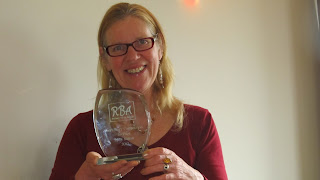
Winning the Rubery Prize

You may have written many short stories, especially if you're working through a writing course, degree or go regularly to short story workshops. You might feel you have enough for a slim volume; a collection of your work. Beware, though.This is Ailsa Cox, who's writing manuals are well-loved, writing in the latest edition of Writing Short Stories : A Routledge Writer's Guide:

“But things are changing in the UK. A report commissioned by the English and Scottish Arts Councils in 2002 confirmed that British writers were unlikely to have a collection accepted by a mainstream publisher unless they were already well known as novelists. Its recommendation for a major literary prize to raise public awareness resulted in the founding of the National Short Story Prize (now the BBC National Short Story Award) in 2005. This was followed by other prizes, including the Edge Hill prize for a published collection, The Sunday Times EFG Short Story Award and a new short-story category linked to the Costa book awards. This revival in the fortunes of the short story is undoubtedly connected – as in the USA – to the rise of university-based creative writing

 programmes."


.”


Competitions are often easier to get placed in than magazines. I'm just having a short story presented in an online competition magazine. the SaveAs competition, judged by the University of Kent, short-listed one of my stories recently. But why bother, if what you want is to get that novel published? 


Being able to say you're in accepted magazines, or that you've been placed several times for your short fiction can make all the difference when you're searching for an editor or an agent. So don't turn your nose up at this option.


But first, perhaps we should look at the choice most writers need to make – getting on the books of a good agent, or going straight for the great contract with an established publisher. Which is it to be?


It’s often said that it’s harder to find an agent than it is a publisher, but a good agent hugely increases your chance of selling your work. Good agents believe in their writers, and that alone can be a valuable boost to morale. 


Some publishing houses state clearly that each manuscript must arrive via a literary agency, but even those who do not state this are often swayed by the agent’s ability to sell the work they advocate. Agents not only know which publishers to approach and argue the best deal for their clients, but also handle the legal and financial side of publication and can advise on promotion of the published work. They charge around 15 per cent of all fees, but there aren’t usually any up-front payments to make. Most published authors use an agent, sometimes obtaining one after they’ve struck a publishing deal.


Some agents do ask for an up-front payment before taking on a new client. Although legally entitled to do this, do be wary of such contracts. Most agents will want you to work on your manuscript, in affect, appraising it for you.  It seems reasonable to assume that if you send your work to an agent and pay for appraisal, they may undertake to handle it if they like what they read. Whether you’ve paid for their opinion, or whether they send it gratis after reading your work, what often encourages an agency to take you on their books is your response to any initial assessment. They want to see that you are flexible, can take criticism, and can think around writing problems. They’ll read the rewritten version before they take you on, and may still turn you away at that point.


After I’d completed my MA in creative writing, I had an almost finished book in my hands. I rewrote, edited and proof-read it. I sent off a synopsis, three chapters and a covering letter to an agent. They asked to see the full manuscript. Within eight weeks, they’d returned it, along with a positive, supportive letter, which said they had liked my writing voice, my characterisation and my skill with plotting, and would be pleased to see anything further that suited their list. So, that was a 'no', then. 


But within a year, I had a completed good draft of my first crime thriller, In the Moors, and chose to send it to that same agent. We met in London, and I was given a good deal of work to complete on the book before my agent was able to tell me I'd been offered a contract. However, taking their suggestions for the rewrite under my belt resulted in that agent being able to sell my book to the right publisher. And, of course, it was a better book – the first in the Shaman Mystery Series.


Because it's such a big decision to send out a manuscript, it is advisable to get a second opinion on it, before you do so. You can 'buy' that opinion, using a appraising firm, mentor, or 'book doctor'. or, as stated above, an actual literary agency. Some of these services are eye-wateringly costly, and all of them charge a fee. 


I have mentored many new novelists over the years of being a writing tutor and assessor, and blogger. I charge, but I don't charge silly money. I think of it as 'an exchange of energies', because what I'm usually doing is giving that writer more work to do!!  However, you must bear in mind that all book doctors are giving you is their opinions The next along the line might say really different things about the same material. Which might lead you to conclude that sending to a variety of agents could have the same (but far cheaper) effect. 


One person you probably don't want to ask about your book is your nearest and dearest. Unless they are also a writer, publisher or agent, of course! Their response will be far too subjective and possibly down-right wrong.


I would recommend, rather than a one-off appraisal of your book, you try a writing course, or intensive workshop over a week or more, or a degree like the one I'm part of – the Open College of the Arts BAhons in Creative Writing. This isn't a cheaper option, but you get a lot more bang for you buck than using a writing doctor.


a great gang of writers who share they work
...and their woes.

There is a cheaper alternative, although it takes more time and a lot of effort. Join a good writing club, society or online group. Read your work aloud or send it to be read and critiqued; this is definitely an exchange of energies and you may learn as much about your book by critiquing others as you will from the comments you receive.


In the next blogpost we'll take this perennial question of HOW DO I GET PUBLISHED further, by looking at the publishing houses and their editors – and how to get their attention.


In the meantime, if you want to ask a question, or make a comment, or tell a story about your publishing experience, don't forget the comments box below this post.


The best of luck with your writing!


Wednesday, 13 October 2021

Symbolism in Literature – The Snake

Brittanica.com

Across the world of fiction and world literature you can find the snake. It has probably more symbolic references than almost any other creature, from representing an insidious threat (the "snake in the grass"), to the idea of fertility or a creative life force. As snakes shed their skin through sloughing, they have becomes symbols of rebirth and transformation, even immortality. They're associated with the underworld and the abode of the dead because they spend so much time in pits or hiding under rocks – or in the UK under corrugated iron laid down for that purpose.

Ouroborus 

Two of the most known. symbols ares the ouroboros and the caduceus. 

In ancient myth, a snake devouring its own tail, known as Ouroboros, was a symbol of eternity. The snake’s ability to slough or shed its own skin 

The Rod of Aclepious

The caduceus, the staff of the messenger Hermes in classical Greek myth has two intertwined serpents. This staff was carried by Hermes (or his Roman counterpart, Mercury): the messenger of the gods. The two staffs are often confused, but the herald’s staff borne by Hermes/Mercury had two serpents, rather than one, with their heads facing each other. This  has been wrongly used as a medical symbol for a little over one hundred years. It has often been mistaken for the Rod of Asclepius, a visually similar symbol belonging to the god of healing and medicine.

The Caduceus

The caduceus only has one winding snake. while the Asclepius has two.

In stories the world over, as well as in modern literature, the snake often raises its head.


In the Epic of Gilgamesh, a 4,000-year-old story which also features a flood narrative, Gilgamesh attempts to seize a plant that might confer immortality, only for a snake to steal the plant away. This feels similar to the biblical  story although the creature who confronted Eve was only ever described as a serpent in Genesis – it is Milton, in Paradise Lost who first uses the term 'snake' to denote the evil of Satan. After he has tempted Eve  God punishes him by making him crawl in the dust.

 Fold above fold a surging Maze his Head            

 Crested aloft, and Carbuncle his Eyes;

With burnisht Neck of verdant Gold, erect 

Amidst his circling Spires.


In 
Good Omens, by  Terry Pratchett and Neil Gaiman, we meet  Crawley the satanic snake hilariously transformed into a burned-out rock star tasked with ushering in the apocalypse. Except Crawly—or Crowley, as he rechristens himself—isn't so keen on putting an end to his favorite earthly delights just yet. 

One of my favourite poems, D. H. Lawrence's ‘Snake’, was written while he was living on the island of Sicily, in the beautiful resort, Taormina, on the east side of the island:

The voice of my education said to me

He must be killed,

For in Sicily the black, black snakes are innocent, the gold are venomous.

And voices in me said, if you were a man

You would take a stick and break him now, and finish him off...

Lawrence stages a masculine battle,  two males facing off against one another. He ruminates on killing  the snake so that he will be safe, while accepting its power and individuality. This creates an inner drama.You can read the entire poem here

One of the most famous snakes in fiction has to be Kaa, the Indian python from Rudyard Kipling’s The Jungle Book. In he 1967 Disney film  Kaa is a villain, while in Kipling’s original book he defeats the Bandar-log monkeys and frees Mowgli, so showing that ambiguous symbolism, being both saviour and danger.


In The Poisonwood Bible, by Barbara Kingsolver, zealous Baptist Nathan Price takes his family to the Belgian Congo where he works as a missionary. Snakes appear, seemingly mysteriously, in gardens, and one morning the family find a curled-up green mamba and, as it slithers off, hear a shriek from Ruth May, the youngest of the four Price sisters. She has been bitten on the shoulder and dies as they watch. Read more of my thoughts on this fabulously rich novel here 


American poet Emily Dickinson (1830-86) wrote with passion about the snake; 

A narrow Fellow in the Grass                            

Occasionally rides –

You may have met him – did you not

His notice sudden is –

The Grass divides as with a Comb –

A spotted shaft is seen –

And then it closes at your feet

And opens further on 

I use snake symbology strongly in my second Shaman Mystery, On the Gallows. Sabbie first encounters an anaconda in a journey she takes for one client. But she meets this spiritual snake in an ice house, a long way from its home:

'Time and place can change. Home may change.'

I frowned. I didn’t want to forget a single word of what Anaconda was saying; I was sure it had meanings only Drea would understand. 

'Do homes change for the better?' I asked.

'Duty and purpose can change.'

'What is your duty and purpose?'

'First; do no harm. Next; protect your kin. Last; keep your secret.'

'What is your secret?'

Anaconda didn’t like this. He clearly felt I’d been presumptive to ask. For the first time I saw malevolence flicker in the small eyes. I heard the girl give a trembling sigh, as if even her breath shivered with cold. I tried to dodge past Anaconda, but he intercepted my move and I collided with him. His scales felt dry on my bare arms. My feet slid from under me and I fell on the ice, hard as concrete but much colder. It burned through my dress.

His tongue flicked. His head lunged at me. The razor-sharp points of his tongue plunged into my belly. I heard my throat scream in the world of my therapy room. My hands covered my stomach. There was no blood. This was a spirit wound from a serpent without a poisonous bite. Anacondas, I remembered, crushed their prey. I tried to slide away from him, wriggling like a snake does, struggling to gain a grip, but I was shivering so much my hands and feet refused to co-operate. I could hardly feel my body now. The bite wasn’t poisonous, but it had sent me spiralling into hypothermia.


The snake theme continues through the On the Gallows (Unraveled Visions in the US). Towards the climax, I make use of a reference to another fictional snake, the Mara, from Dr Who, when Sabbie interviews the woman who discovered a body on the cooling station at Hinkley Point Power Station;
The Mara, as it manifested itself in Kinda
...' I was cold, very cold and frightened and mad with myself for being so utterly stupid. I could hardly dial. I think I sort of lost it. Because behind me was a dead girl on the gallows and in front of me was the power station. I know I was screaming by then, on and on. Got myself right freaked out until I couldn’t move at all, like we did as kids, imagining Hinkley Point was the Dark Places of the Inside, where the Mara lived; we loved to scare each other with that Dr Who stuff, say the power station could transmit telepathically, and that the Mara was manifesting as one of us, we’d point to one of the gang and run screaming from them, the pure hatred and greed of Mara and that. It all came back to me. I was stuck there remembering that the Mara manifested into its snake form and could destroy me. Like her. I’d got it in my head that was what had happened to her.'     She stopped, and wiped her mouth. 'Madness. How your mind plays tricks.'
    'What did you say?'
    'That I went quite mad, really. Screamed so hard, I couldn’t use my voice for days, after–'
     'No – not that. The thing about Hinkley. What did you say about a snake?'
    'Oh, I was just frantic, totally back to when we were kids. We loved scaring each other. We knew about nuclear power, but we didn’t if you get me. We made things up. Even the signs are scary…DO NOT ENTER…to us, that mean, enter at your peril. It was Rick who started saying the power station was the Dark Places of the Inside. Said he could hear purring, but it wasn’t a cat, it was the Mara, who was, I dunno, this snake; a representation of all evil from another planet. It was what was on Dr Who at the time.'
    'The power station is…'
    'I’d half lost my mind, Sabbie, be fair.'
    'Yeah, I understand.'
     I did not understand at all.  Like I’d explained to Rey, the spirit world is full of twists and tangles...

Perhaps you have used snakes as symbols in your own writing. Or have been particularly affected by their reference in your reading. Do tell me about your experiences with snakes, by posting a comment below.

You can listen to Paradise Lost on BBC Radio 4 right now, with the great Ian McKellan as Milton, and Simon Russell Beale as the snake (Satan). It's live on Sunday afternoons and available on Sounds; click here to find out more

To read more blogposts about symbolism in literature, click here