Showing posts with label How They Got Published – Stories of Writing Success.. Show all posts

Friday, 23 May 2025

Discovering Great New Writers–Meet the Womens Prize "Discoveries"


Right now I'm furiously reading The Women's Prize 2025 shortlist; six smashing novels by women published last year.  Here is the lowdown on three of them; 

BIRDING by Rose Ruane. I genuinely could not put this down. Perhaps there was one too many points of view and the end is not fulfilling, but it did grip me.

ALL FOURS. Miranda July is a well-respected US writer. This latests from her is described by the Women's Prize website as 'Part absurd entertainment, part tender reinvention of the sexual, romantic and domestic life of a 45-year-old female... I found the first half of the story huge fun, as the protagonist, in possession of a windfall, leaves her child and husband and drives across the USA for a jolly in New York. Only––she doesn't get further than the next town, where she sort of falls in lust with a guy working in the petrol station, holes up in a downbeat motel and blows the her money by getting the guy's wife to do an interior design job on her little room. She spends the first half of the novel having steamy, non-sex with him. She returns home in Part Two, and, honestly? I'd lost patience with her by then. If this is the New Woman, of the first quarter of the 21stC, then frankly, there's no hope for our speicies.

FUNDAMENTALLY by Nussaibah Younis. This is chuckle funny and that at first didn't sit well with me as it's about trying to help ISIS brides, but as the tension mounted, I could see that it was actually examining the issue in a deeper way. 

THE SAFEKEEP by Yoel Van der Wouden.  The worthy winner of the prize this year.   Holland in the 60's. In the family home, weighed down with duty, a youngish woman, lives alone, until her two siblings and a stranger arrives. This sexy, intensely emotion novel, suddenly reveals the darkest sides of wartime Europe.  Read more about this novel here;

The choice of prizewinner didn’t surprise me; one of aims of the prize is to chose high excellence in writing, but also readable, approachable stories. This allows it to stand apart from other prizes, where winnering novels may be dense, even arcane and seem deliberately impenetrable. I think you can be profound and sibylline without trying to drown your reader in words. 
Some of the winners remain my favourite novels.
Maggie O'Farrel won in 2020 with Hamnet,
one of my favourite winners. 

The Women’s Prize has been running since 1994, annually awarding a female author of any nationality for the best original full-length novel written in English. Kate Mosse founded the prize, and has always responded to the criticism that women and men should compete directly, by saying… ‘It’s not about taking the spotlight away from the brilliant male writers, it’s about adding the women in.’ In 2023 it was announced that a sister prize, the Women's Prize for Non-Fiction, would be awarded for the first time in 2024, with a £30,000 prize.


And now, the Women’s Prize is also sponsoring new female writers with their new enterprise, ‘Discoveries’, which aims to seek out, inspire and support writers from early writing to long-term careers, with writer development programmes, toolkits, free events and online community create pathways.

Over 80% of entrants to the Discoveries development programme said they felt inspired to take steps towards achieving their writing goals and had gained more knowledge on the publishing industry.


This year, alongside those shortlisted for the main prize, six new writers have been chosen as Discoveries, having finished their novels. They are…

Shaiyra Devi, The Persistence of Gravity

Jac Felipez, A Long Ways from Home

Rosie Rowell, Down by the Stryth

Lauren Van Schaik, Seven Sweet Nothings

Muti’ah Badruddeen, A Bowl of River Water

Sophie Black, The Pass


The Women's Prize interviewed each one and I found so much to honour and to concur with each new writer. A lot of them started, as I did, very young. 

Shaiyra Devi says...I began writing fiction as soon I learned to write, filling a notepad with 1-page stories from the age of 5. At 10, I promised myself I’d write a book, and finished Diamonds & Daggers, an adventure fantasy novel, before 13…
Jac Felipez says...I
have been writing, in different ways, my whole life. From the first story my English teacher praised in front of the class to the novel-in progress..
.          Rosie Rowell says...I fell in love with writing from the moment I learned how to read. 

Lauren Van Schaik says...before I could hold a pen I tyrannically dictated stories to my parents.


And their responses to finding out they were shortlisted were amazing;

Muti'ah Badruddeen was...Breathless. I mean that literally. I screamed so much, I became breathless. I have a weak heart, and I don’t think it has stopped racing since I opened the email. I’m usually more on the self contained end of expression but Discoveries has unleashed the inner screamer I never knew...

Shaiyra Devi was...beyond ecstatic, totally over the moon

Lauren Van Schaik was...really honoured that the judges see the promise in this project. I’ve had so much fun writing it and can’t wait to share it even more widely.


Can they offer advice? Sophie Black suggests...To not get bogged down in details and research when you really need to just write – you can look at specifics when you’re editing. It worked like a charm because I’m not even 100% decided on my characters’ names – I only know how they feel and how they’d behave. 

What inspired them? For Jac Felipez...visiting the Lubaina Himid retrospective at Tate Modern in 2022...The exhibition prompted me to revisit the 1980s, a decade characterised by uprisings, radical activism, and vibrant artistic expression. Felipez is writing a contemporary story that connects to the 1980s...

For Saiyra Devi it was... The seed for my current novel sprouted in a fiction writing workshop in my final year of college, and it has consumed me ever since...

Rosie Rowell's idea came from TikTok, admitting...doomscrolling finally pays off!... 

  Muti'ah Badruddeen started A Bowl of River Water by writing about her grandmother's life.
...She was an incredible woman...But the more I wrote, the bigger it got away from the details of her life; coming to encompass, instead, the idea of women who, despite dominant narratives about the period and cultural context, fought in their own way to subvert societal norms that infringed on their autonomy and personhood.  

Lauren Van Schaik's story Seven Sweet Nothings was inspired by a true story... polygamist sect leader Warren Jeffs taking his favourite wives to Disney...while he was a federal fugitive. What happens when sheltered wives are removed from the compound and dropped into our world — or rather, the sanitised, perpetually happy theme park pastiche of it?


Reading about their committments to their writing, their love of fiction, and the inspirations behind the stories was very reassuring. You can find more about them at https://womensprize.com/meet-the-2025-discoveries-shortlistees/


Sunday, 24 November 2024

How to Win the Booker: THE SAFEKEEP by Yael van Der Wouden


The Safekeep by Yael Van Der Wouden

In her website Yael Van Der Wouden introduces herself as A great smalltalker... available as a +1 for your cousin's wedding. Woulden also keeps a blog, Dear David: An Advice Column, in which Sir David Attenborough speaks about the natural world in answer to writers' problems. It's funny and clever in a similar way that The Safekeep is funny and clever. And yet her 2018 essay, On (Not) Reading Anne Frank  suggests that The Safekeep is also a darkened polemic on the Dutch position after the 2nd WW.


In her Booker interview, she explains the moment that this book came into her mind, starting with… a fascination with how the Dutch narrativise national histories; my obsession with homes and the fantasy of owning a home; wanting to explore desire as the flipside of repulsion. The way it happened was like this: I was in the car on the way back from a funeral, looking out over flat Dutch fields, and somewhere between grief and a need to escape the idea bloomed, of a house, a woman and a stranger.


A house, a youngish woman, her two siblings and a stranger. 


It is Holland in the 60's and Isabel lives alone in the family home, weighed down with duty left by her dead parents, avoiding contact with humans, hating most of the people she knows: Louis, who will be gifted the house once he marries (and he’s in no hurry to stop moving through pretty girls like his latest, Eva):  and Hendrick, who lives with Sebastian, a person Isabel particularly turns her face from in shame


Author Yael Van Der Wouden.


This book did not win the Booker Prize. So maybe you won’t want your book to be––suddenly and surprisingly-–this sexy, with intense emotion and fiery physicality… Isabel could see herself from the dresser mirror: face red, mouth like a violence


Wouden admits––erotica is about the knife’s edge of voyeurism and participation. As a reader, you want to feel like you are present, but if you are too present then I think the text tries to envelope you, tries to comfort, and I think good erotic writing makes you a little uncomfortable.


You might not want your novel to be in the 1st person perspective of a repressed, unlikeable woman such as Isabel, without being able to show that vulnerability that hides behind such a front. And, in 1st person, how can the story reveal what happened almost 20 years previously? Two-thirds of the way through, after the central explosion of love and lust, we reach The Diary. Diaries don’t often work in modern novels, but this one, stolen by Isabel after a caustic row with her lover, reveals the darkest sides of wartime Europe.


Think about taking an extended symbol throughout the book, as Wouden does. In the opening lines, Isobel finds  broken pottery in the garden. It's a shard from the china plates her mother loved, and which she now keeps locked away. She knows one has never broken, but if that is so, how could this shard be in the garden? The answer dogs her throughout the novel, and it is not until we read the diary that we know the shocking answer. 


You might like to be in Wouden's position,however, of having her debut novel snapped up by Penguin after a bidding war. 


What did the English reviewers say about this debut? The Observer says that the author weaves this story of historical reckoning (or its avoidance) with an account of Isabel's individual and sexual awakening,

The Guardian's reviewer said The book's powerful final act provides an already weighty emotional situation with an extra layer of historical heft.


Reviewer Anne Bonnet loved it; The Safekeep is simmering and sexy, but it is also a Trojan horse of a novel. Not much is, rightly, given away in the synopsis and it is only in the last third that you realise you have been reading a very different book…


Perhaps for me, the ending wasn’t quite perfect. But that might be because whatever way the final moments of such a twisted the story might go, I’ll have wanted it to go in the other direction. Happier? Darker? I’ll let you read it and make up your own minds.

Thursday, 21 November 2024

How to Win the Booker Prize: ORBITAL by Samantha Harvey

2024 Booker Prize winner Samantha Harvey holding a copy of her book "Orbital" and the trophy
photograph: epa

Orbital unfolds over a single day in the life of six astronauts and cosmonauts aboard the International Space Station. Samantha Harvey allows us to marvel at Earth’s splendour through the thoughts, memories and work of the people on board. She allows them to pose the question: What is life without Earth? What is Earth without humanity?

Orbital is Samantha Harvey’s fifth novel. On the 12th of November 2014, she stood amongst applause to receive the Booker trophy. Her acceptance speech began with a joke; ‘I was told we weren’t allowed to swear in our speech, so there goes mine’. She dedicated her prize to everybody who ‘speaks for and not against the Earth…and the dignity of other humans, other life; and all the people who speak for and call for peace.


If you would like your novel to win the Booker, you could start by picking apart what makes a winner. Why did the judges almost unanimously decide on Orbital?

Firstly, it's original. it is the first Booker Prize-winning book set in space. It has a natty little chart that describes the voyage of the SSI over one Earth day at the front of the book. It has chapters that align with the rising of the sun every 90 minutes. 

But there are some specifics that are probably key components each time. The judges recognised this book's beauty and ambition, saying: 'It reflects Harvey’s extraordinary intensity of attention to the precious and precarious world we share'.  They were 'determined to find a book that moved us, a book that had capaciousness and resonance, that we are compelled to share'. 

Surprisingly, it is very short. This is a novella. It is so much shorter than some winners, that you could fit four Orbitals into some of them.  The Luminaries by Eleanor Catton won in 2013, at 832 pages, compared to the 239 pages of Orbital. But judge Kit  De Waal said that Orbital is 'the right length of book for what it’s trying to achieve'.

I loved this book. Its descriptions of the Earth from the ISS are stunning, lyrical and memorable, and yet sparse; we can never quite get enough of them, which is the best way to write descriptions, after all. There are only six characters, plus the people they carry in their heads. We don't get to know them very well, but rather as they all get to know each other, in that intimate, yes sporadic way we get to know our work colleagues for instance, sometimes sharing something truly important about their lives and lots of minor, day-to-day things, while probably not knowing much, say, about their family or the layout of their homes. But what we do see is what they also witness; the marvellous beauty of the Earth as they witness a sunrise every 90 minutes and follow the progression and devastation of a super tornado of life-threatening proportions as it assaults and wrecks south-east Asia. They are passing on the information, but feel powerless to help.

The odd 'other' perspective is also allowed in, so that we can travel back to the 'Big Bang' or meet the laboratory mice who are learning to fly. And then there is  Diego Velázquez’s Las Meninas, which is with the crew as a postcard. They talk deeply about the unique illusion of reality created in this painting. Welcome,” Shaun’s wife has written on the postcard, “to the labyrinth of mirrors that is human life.”

Having finished the book and laid it down with a satisfied sigh, I turned to the reviewers to see what they had thought. Most had read this book before it had been shortlisted, and most, like me, found it such an absorbing, educative read. 

Anne Bonner, in INEWS says...With the modern world being as it is, it is not a surprise that a story set in space is a strong Booker contender.  At times it feels a bit like you’re reading an essay meditating on human existence as opposed to a novel. You also have the sense of observing these characters as though they’re floating in a snow globe: as beautiful as it is, something is stopping you from connecting with them.

The Economist did find flaws, and I can to a degree sympathise with the line they took: A slim, slightly worthy novel in which everything and nothing happens Yes, it is a tiny bit worthy, and nothing does much happen in it. So one thing you might try,  if you follow Harvey's model of winning the Booker, is create an epic poem in prose form.  

But who knows? With another night's sleep, the judges might have made a different decision. There are always 6 shortlisted novels for the Booker Prize, and I will review each of the 2024 books in turn and continue to think about...HOW TO WIND THE BOOKER PRIZE. 

You can read more about Las Mininas here.

Thursday, 15 August 2024

An Interview with Author Ali Bacon


I met Ali Bacon when she joined Bristol Women's Writers and began her her first contemporary novel, A Kettle of Fish, set in Scotland. She followed this with In the Blink of an Eye which reimagines the life of an early Edinburgh photographer and was listed in the ASLS best Scottish books of 2018. Her writing is still strongly influenced by her Scottish roots and Linen Press has just shaped up The Absent Heart. I interviewed her about her continued success and her ability to keep writing over many years.

What is your forthcoming novel about?
The Absent Heart is about Robert Louis Stevenson’s relationship with his muse Frances Sitwell. 

Could you outline the story for us, without giving anything away? 

Frances Sitwell is relying on faithful but diffident Sidney Colvin to help her escape an abusive marriage when she meets the young Robert Louis Stevenson. Colvin becomes his mentor while she allows Louis to pour out his heart to her in letters. When Stevenson dies and those letters come to light, she is accused by Colvin of having been his friend’s mistress as well as his muse. As her ill-fated attempts at discretion come back to haunt her, she risks losing her reputation, her forthcoming marriage and her long-standing friendship with Stevenson’s wife.


That sounds absorbing and compelling! 

Yes, the book unpicks a complex Victorian love triangle while exploring themes of love, desire, romance and bromance. 


This is your second novel with Linen Press and both have included historic detail. What drives you to write novels about real people who had some fame in their time?


First of all, I had no real intention to write historical fiction which I thought would be way too hard (research research!) but while writing my very first (contemporary) novel A Kettle of Fish, I stumbled across the story of early photographers Hill and Adamson. I found their story, especially that of David Octavius Hill, utterly compelling and wanted to bring it to a wider audience. I even considered non-fiction, but as a novelist at heart, a novel is what I had to write. In the end, In the Blink of an Eye was a big challenge but also highly satisfying, so I thought I should have another go!


What made you choose your current heroine?

Our family always had a sentimental attachment to Robert Louis Stevenson (one of my ancestors knew him) and when I heard a radio drama in which he played a part, I considered him as a subject, but of course there is very little about him that hasn’t been explored, and I preferred to write what is in effect an ‘untold story’ about one of those thousands of women whom history has neglected up to now. Frances (Fanny) Sitwell appears in every R.L.S. biography but is mostly dismissed as a brief episode in his early life. In fact, they remained in touch, and in my eyes their early encounter reverberated throughout their lives and their other relationships. As the victim of an abusive marriage, Frances Sitwell is also a fascinating subject in terms of how she negotiated the difficulties and restrictions imposed by Victorian society. 

How have your Scottish roots influenced your writing?

Although I look back on my childhood with great happiness, when I first started writing (in the early 2000s) I didn’t see this as a particular source of inspiration.  It was only after a holiday to my home county of Fife that I realised my deep attachment to the places I frequented as a child and decided I should celebrate them in A Kettle of Fish. It was a happy coincidence that the characters in In the Blink of an Eye also had strong connections to Fife, albeit in a different age. It was a delight to revisit (mentally and physically!) my home town of Dunfermline and also St Andrews, where I spent four wonderful years. I think my instinct was also to convey not just the places but the voices I recalled from my youth. The Absent Heart, apart from the character of RLS himself, is actually my least Scottish novel so far!  However, it probably helped that I have a personal connection (through my sister) to the location in Suffolk where R.L.S. and Fanny Sitwell first met.
Frances Sitwell

What’s your favourite part of the writing process?

If I’m honest, apart from brief periods of the first draft when I feel I am in the zone, I really enjoy editing – taking those rough sentences and smoothing them out, removing the cliches or sloppy bits of writing ( we all do it!) and cutting out needless verbiage.  I firmly believe that however good the story, this process makes a massive difference to the end product. The reader won’t be consciously aware, but getting small things right is what makes reading a pleasure.  


Least favourite?
I do struggle with getting the plot in shape – or structural editing as it’s usually known. As a ‘pantser’  I write without a lot of detailed planning, so I always have to rewrite and restructure. You could call it reverse engineering! I don’t mind the rewriting, just the anguished moments in which I have to work out what the final shape is going to be. 


Tell us more about Linen Press, and when is publication day? 

Linen Press is a small indie publisher for quality fiction ‘by women, for women’. Since the demise of Virago I believe they are the only exclusively female publisher. I met director Lynn Michel some years ago and was absolutely delighted when she accepted In the Blink of an Eye especially as Avril Joy, one of my favourite writers, (check her out!)  is on their list. It was a single book deal so her accepting The Absent Heart was not a foregone conclusion. In fact Lynn did ask for some tweaks and changes of emphasis with which I was happy to comply as I trust her publisher’s instinct. Now we are down to our favourite task of close editing in which small changes are suggested and discussed. See above! We’re working towards publication in the early spring and I’m already exploring people, places and events who might help promote it. 


You've won short story prizes in the past, are you working on these now?

I have a historical short story in the forthcoming Linen Press anthology Skeins.


Anything longer in the pipeline?

I have an idea for a novel set in the 1970s, but so far it’s just an idea!


How can people keep in touch with you? 

I’m on Facebook, Twitter (@AliBacon) and Instagram (@alibwriter) but for sneak previews of the book and bonus material, readers can sign up to my Absent Heart newsletter which will run up to publication day and beyond. There’s a link on my website https://alibacon.com or use this one http://eepurl.com/iTCrNc


Don’t forget Ali’s other books are also available.

In the Blink of an Eye (ebook or paperback) from Linen Press Books. https://www.linen-press.com/shop/in-the-blink-of-an-eye/

or Amazon UK https://www.amazon.co.uk/Blink-Eye-Ali-Bacon/dp/0993599729

A Kettle of Fish, (Kindle or paperback) https://www.amazon.co.uk/Kettle-Fish-Ali-Bacon/dp/1781768625/.(Both are also available from WOB)

Read about Ali here; https://www.linen-press.com/authors/ali-bacon/


Thank you so much Ali Bacon and huge good luck with your new book!


Sunday, 7 July 2024

Carpe diem - Seize the day – how one writer is gaining their dream


Thank you so much Debi, our guest blogger for July.

Do read below about Debi's writing journey in her guest blog post below, which is packed with good advice on how to reduce your tuition costs and still get the support you need as a fledgling writer 


Carpe diem – Seize the day – Horace wrote. In fact, the full quote translates as, ”Pluck the day [for it is ripe], trusting as little as possible in tomorrow.”  For fledging writers taking their foundling first forage into the wonderful yet mystical world of writing, the path does seem fraught, with companies offering a bewildering array of workshops, advice, and equally eye-watering price-tags to match. So, if like me, you are on a limited budget, where you do you start?  

This is simply how I got started; my intention is to encourage all of you who have discovered writing is an all-consuming passion: simply something you have to do because it makes your soul sing.  Writing enables you to pour your heart, soul and imagination into the written word. For me, it is a way to communicate ideas, thoughts and insights that I would find hard to vocalise.  

It is incredibly liberating.

I rediscovered my passion for writing whilst completing the final year of my Open University languages degree – something I thought beyond my reach due to my CFS/ME. My short story Luna was published in the OU’s Anthology* in 2020.  Lockdown provided me with the headspace and opportunity – I had always wanted to write a novel.  

Seizing the moment, I enrolled on a Creative Writing course aptly entitled Starting Your Novel with the OCA Open College of the Arts, which gave me the writer’s tool-kit necessary whilst penning the first 10,000 words of my crime novel Abandoned.

I enlisted the services of Nina Milton, my OCA tutor, who offered a peer mentoring and manuscript feedback service at a very reasonable fee.  Nina has been instrumental in working with me to get me to the finish line. 

 Fast forward to Christmas 2023, and 130,000 words later – a complete first draft.  I savoured my triumph!

So, how did I get there? 

Arvon at The Hurst
A friend’s recommendation of Arvon was extremely fortuitous as a fledging writer.  The Arvon Organisation’s https://www.arvon.org/ ethos is to encourage all writers, irrespective of their age and experience of writing, especially those who have just embarked on their writing journey.  They occasionally offer fully funded places on their retreats subject to a fairly straightforward application form.  I treated  this form like a job application and was surprised –– delighted –– to secure a fully funded place  on a Tutored retreat at The Hurst in 2022.  The week was hugely beneficial, as well as providing network opportunities. Every course does have a number of subsidised places for low income and underrepresented groups (around a 33% discount). I was awarded a subsidised place on their Editing Fiction course, again, at The Hurst. It’s the most accessible by public transport for me. My experience is described on: https://www.arvon.org/my-arvon-week-debi-barry/

My tutors were Angela Clarke and Rory McClean, both published authors. And I loved meeting my fellow writers there. Sharing our hopes and fears made me realise I was not alone. And being offered the headspace to devote to writing was wonderful. 

An unforeseen bonus was the fact that Arvon also runs joint initiatives with companies in the Publishing field.  I applied for an initial manuscript assessment of the first 15,000 words of my novel through an initiative between Arvon and The Literacy Consultancy under the Arts Council-funded TLC Free Reads Report scheme:  https://www.arvon.org/writers-hub/free-reads/

The students help cook the meals

This application form was more involved butdefinitely worth the input. I secured a place! 

The feedback I received from Doug Johnstone, an established and well-respected crime writer, was both incredibly detailed and encouraging.  Addressing the constructive feedback, I now have the opportunity to implement the suggestions Doug has made to give me the best possible chance of securing an agent or publisher for my novel once submission ready. 

I am extremely pragmatic.  Securing a publisher or an agent is very difficult but one I feel I have to have a stab at.  This is my dream.  It may not be yours and rest assured, if it isn’t, that’s fine too. 

If you enjoy the company of others, do seek out your local library and see if there are any writing groups set up.  I was fortunate I saw an invite that Lynn Griffin, a published author who lives locally, who has set up writing groups at the Trowbridge Library. https://www.facebook.com/ lynngriffinauthor/  I have found a fabulous bunch of like-minded individuals.  We meet monthly and share our work.  


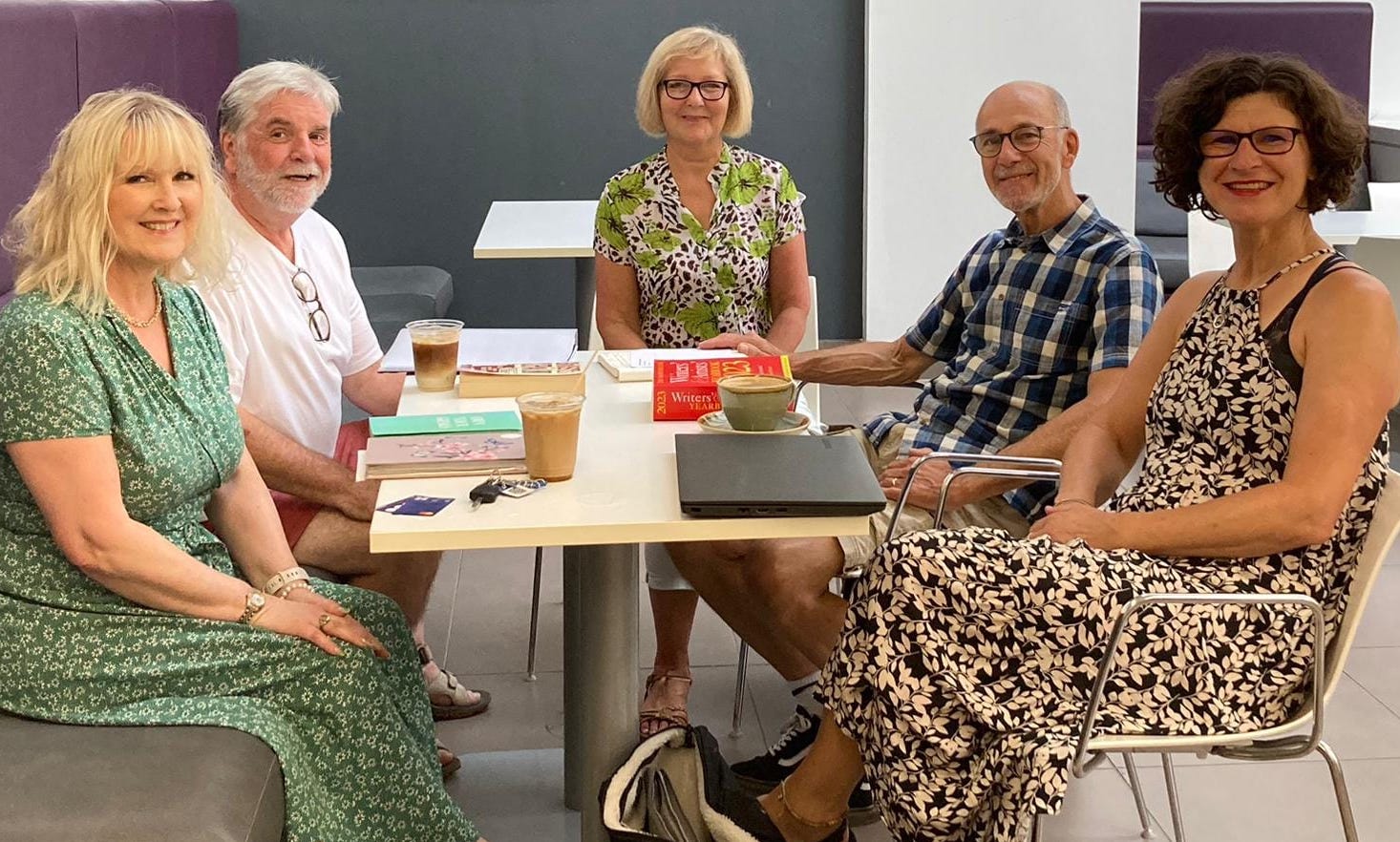
Thanks to Lynn Griffin for getting our writing group under way. So enriching to share our writing journeys with each other. Always come away with loads of ideas Stephen, Claire and Jonathan 


My final piece of advice is aimed at all the female writers out there (sorry chaps!)  Do consider a subscription to Mslexia, a magazine that supports female writers: https://mslexia.co.uk/ It offers a wealth of resources, writing opportunities and advice.  Although I have not yet had any short stories published, I have just secured a bursary to attend their online Novel School (8th-12th July 2024).  Armed with my manuscript appraisal and this exciting and challenge week at Novel School ahead of me, I’m still travelling towards that all important holy grail – a submission-ready manuscript.  


Carpe diem! 

Debi

@deborahbarry_


Learn more about 

Nina Milton's Mentoring Services ––

click here to learn more about my friendly services for writers


A Creative Writing degree with the OCA

Have you always wanted to write a novel, create a screenplay, or perfect your poetry? Whatever you’re looking to write, our BA (Hons) Creative Writing degree will give you the tools to achieve it.