I've been writing since my first story penned at my mother's kitchen table. I write fiction for both children and adults including the four-book crime series, The Shaman Mysteries Series, published by Midnight Ink (Llewelyn Worldwide) I’m a prize-winning short story writer, have an MA in Creative Writing, and tutor and write for the Open College of the Arts.
KITCHEN TABLE WRITERS Mentoring and Notepad Programme NINA MILTON's friendly mentoring service
Friday, 10 July 2026
Books You Love: an Interactive Look at Now! Novels
Russian Dolls: Haunting Novels (that never make perfect sense)
Jennifer Egan's A Visit from The Goon Squad is very clever, as is the more recent Booker short-listed All that is Man Is by David Szalay, (Vintage 2016) a beautiful examination of the male mind and the seven+ ages of man. Both are worth a read, but their stories don't nestle, they move along, linking together in various ways. So what about Italo Calvino's If On A Winter's Night A Traveller, a gloriously surreal story about the hunt for a mysterious book? Mostly categorised under the post-modern definition of metafiction because the story plays with self-awareness and the writing conventions of authorship. Certainly, the story is complex and layered. It begins with a reader (the reader...), opening Italo Calvino's latest novel, If On A Winter's Night A Traveller, only to have the story cut short. Turns out it was a defective copy, with another book's pages inside. As the reader tries to find out what book the defective pages belong to, he meets Ludmilla, a fellow reader who also received a defective book. Calvino's novel broke ground and created a storm in fiction, but I don't think it qualifies for the Russian Doll structure – but then, it doesn't need to do anything it doesn't want to do – it's a marvellous read.
Cloud Atlas,(Sceptre, 2004) by David Mitchell, begins with a rollicking story of Victorian exploration and missionary zeal. It consists of six interlocking, stylistically distinct novellas spanning 500 years and begins in 1850 with extracts fromThe Pacific Journal of Adam Ewing. T
he narrative breaks off suddenly on page 39 at the half-way point with no warning, and we’re in the1930s, where a new character arrives solely via his intimate letters to a certain Sixsmith, and onwards, into the future and the centre of the novel, a four further tales later, to find connections and learn outcomes. Mitchell has a delight in creating puzzles in his novels and Cloud Atlas bends time, structure and genre. Mitchell trusts us to keep reading although each narrative is unfinished, using links such as birthmarks and documents, to complete each individual story and the novel itself. This builds up a satisfying narrative structure that shifts across genres and styles, and the distinct voices of many protagonists… I do recommend the book, but I haven’t seen the film, so I’m not entirely sure how these Russian dolls are slotted together for cinema. David Mitchell tells the tale of how he was skyping with Hollywood executives at his home in Ireland. "I kept a pretty straight face while I was skyping and then I ran downstairs and told my wife, 'Hanks has said yes! Can you believe it?' I did Maori victory dances around the house." Mitchell never imagined his book could be adapted for the screen, and neither can I, loving the narrative and the voice on the page too much. Halfway through the book, the goatherd stumbles across the ruins of a defunct civilisation and reaches the novel's climax, after which each story is resolved one by one.This kind of structure is reminiscent of A Thousand and One Nights, where Scheherazad tells a story, then breaks off and begins again at a later time…to save her own life, of course…but the structure of Cloud Atlas is more complex, perhaps best described as ‘reflecting mirrors’. It well suited not only Mitchell’s characters and plots, but one of his reoccurring premises, the circular and rippling nature of history.This was, for a novelist in his mid-30s, an astoundingly accomplished performance. But I don't think it's a Russian Doll, although you can disagree with me if you like. So if I’m not talking about any of these different, and equally complicated stories, what am I on about? Do I even know myself?
There is a Russian Doll plot in the almost impossible House of Leaves by Mark Z Daneilewski, and you can try gently pulling the next Babushka out of the bigger one right to the end of Philip K Dick’s novel The Man in the High Castle, where every character interacts with a book that seems to tell an alternative story parallel to their own.
Margaret Atwood's novel The Blind Assassin is a novel-within-a-novel within a novel. Iris, now an old woman, recounts how she and her sister Laura grew up motherless in Ontario. Within this story we encounter excerpts from a novel attributed to Laura but published by Iris. Embedded in this novel is a science fiction story, Blind Assassin. As Atwood unfolds The Blind Assassin we learn pivotal events of Iris and Laura's lives in the ‘40s, and understand that the novel-within-a-novel is inspired by real events. Before the end, Iris dies, leaving her granddaughter to discover the twists of truth in an unpublished autobiography. Another novel that use this shape became a great cult hit across the world in the noughties.
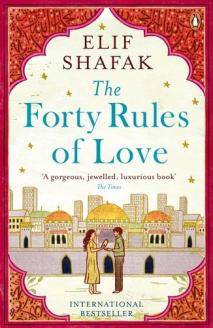
Which brings to Elif Shafak’s The Forty Rules of Love. This is a most loved author; people literally can't wait for her next book. They are always complex. The Forty Rules of Love is a complicated, multilayered and deliciously flawed story set both now and in the thirteenth century, and across several countries. The story starts with Ella, an unhappily married 40-something, whose first assignment with a literary agency is to read Sweet Blasphemy, a novel written Aziz Zahara. Like Ella, I became mesmerized by the tale of a whirling dervish known as Shams of Tabriz and his relationship with a Persian poet called Rumi, Ella is also taken with Shams’ rules, which offer insight into an ancient philosophy based on the unity of all people and religions, creating a further layer. Both Shams and Rumi were real people, living in Persia 800 years ago. Ella feels driven to contact the writer of the book she's appraising, and discovers that he strangely mirrors Shams in looks and philosophy. He tells her his story, she tells him hers, that the connection sets her free.Wednesday, 27 May 2026
How to Write Like Homer
A man wrote a story–the first ever story written on papyrus.
His name was purported to be Homer, the Blind Poet, writing in the language of the very ancient Greeks. It's possible that he was previously a storyteller, a profession well thought of in those times–before television, books to curl up with, or even Greek plays.
But he was different; he wrote down the stories he told. Because of that, we can enjoy the Iliad and the Odyssey to this day. Although they were epic poetry, an account of a true event, when translated into a prose form, they read like novels.
![]() |
| The chariot ramp from the Skaian Gate |
I've just returned from Turkey, and I was anxious to see Troy, the city where the action in the Iliad took place, around 3,200 years ago. I'd already read the Iliad, but I bought a new copy, translated by classicist Emily Wilson with a poet's eye. As I read, I recognised how Homer was following all the techniques, devices, rules and guidelines for creative writing, that, as a tutor, I advise to my students to study.
But no one had written a book before!! So from where had he got his writerly skills?
My first good guess is that, although not many stories were written down (the earlier ones were written on cuneiform; clay tablets), what Homer was mostly drawing on for technique were the skills of the storyteller.
It's a tough life, being a storyteller, a performance poet, or even getting up at a local writing slam to strut your stuff. The Greek storytellers needed to keep their audience gripped while they emptied the amphorae of wine.
![]() |
| Bronze Age vessels discovered at Troy |
From the very first page of the Iliad–actually, from the very first line–I can see those skills in action. Homer knows the all the writing tricks. Most of his techniques relate directly with creative writing today.
So, for today's writers, here's my Top Ten Homer Writing Tips:
1 Start with a crackerjack of a first line
2 Jump into your story
3 Focus on your protagonist while establishing your main theme
4 Set up an antagonist that will make the reader bristle with anger
5 Give your characters failings as well as good points
6 Use imagery that takes the reader to the event
7 Show, don't tell both action and emotional responses
8 As you move towards the end, bring your protagonist to a low point
9 Finally, your main character achieves the thing they've dreamed of
10 Parallel your first action with your last, for a neat dénouement
![]() |
| The red of poppies replace the blood spilt long ago |
Let's look at these in a bit more detail.
1 Start with a Crackerjack of a first line...in my copy, these are, Goddess, sing of the cataclysmic wrath of great Achilles. So we know what style...what 'personal voice'...the writer is going to use. This is lyrical, beautiful, worthy of the gods. And we know who the story is about, and what's up with him.
2 Jump into your story...The Iliad famously starts in medias res. Much later on in the story, Homer will seed in some of the background to the war, but now he focuses on our desperate need to know what has made Achilles furious.
3 Focus on your main character while establishing your main theme...why is Achilles burning up with rage? Homer answers this by introducing his nemesis...Agamemnon, and by taking us directly into the action of the story, battle by battle.
4 Set up an antagonist that will make the reader livid....Agamemnon is the high king and field marshal of the gathered Greek troops. But he's mean and greedy and selfish. He takes Achilles' slave woman as his own...because he can. Achilles hates him for almost the whole story.
5 Give your main character failings as well as good points...Okay, Achilles is a guy with anger management problems, and he's a terrible sulker. His priorities are all wrong; his goal is to die a hero. But he's strong, fearless, focused in battle. And a faithful lover. He cries really easily!
6 Use imagery that takes the reader to the event...In the Iliad, rather than simply giving all the facts to the reader, Homer hides them in simile and metaphor. This helps the reader understand the storyline via familiar objects, as well as making the text more vivid.
Here's a moment when Hector's army reaches the Greek ships, ready to set them alight: Hector pushed ahead, as when the torrential rain dislodges the foundations of a stone, and from up high upon the rocky clifftop the river, swollen with the rainstorm, thrusts the shameless stone, which skips and leaps and flies–the woods resound around it, and it runs unstoppably on down and down, until it reaches level ground and spins no more, for all its eagerness to keep on moving–such was the threat that Hector posed. This extended description fits the voice of the poet...although it might be a little long for modern tastes you can imagine Homer's audience enwrapped in the symbolic illustration it paints.
7 Show, don't tell action and emotional responses...As well as using simile a lot, Homer is not afraid of showing us what's going on, using animated, realistic action. Here's a bit from the same battle. Teucer has just killed a Trojan spearman; Teucer darted up to strip the corpse, and Hector hurled his spear at him, but Teucer, as he sprnted, saw the bronze hurtling towards him, so he ducked–it missed him narrowly but struck Amphimachus...
Although the Iliad is mostly about men fighting with sharp weapons, there are tender parts. Here's Hector, bidding farewell to his wife before returning to battle; Then noble Hector reached towards his son, the baby wailed and wiggled back to snuggle in his well-groomed nurse's lap and dress. The child was scared by how his father looked, shocked at the terrifying horsehair plume that nodded at the top part of his helmet. His loving father and his mother laughed. Hector immediately took off his helmet and put it on the ground. It glittered brightly. Then glorious Hector kissed his darling son and took him in his arms to rock and cuddle...
8 Bring the main character down to a very low point towards the end...Achilles deeply loves his friend and lover Patroclus. So when (spoiler alert!) Patroclus goes into battle in Achilles' armour, and is killed by the Trojan general Hector, his world spins apart. His shirt is wet with tears and he cannot eat or sleep.
9 Finally, your main character achieves the thing they've dreamed of...At first, it was Achille's dream to be a hero, remembered forever. But when Patroclus dies, all he burns to do is kill Hector. And we all know how that turns out, having watched the film Troy.
10 Mirror your opening actions with your last. In the opening pages, we learn that Chryses, a Trojan priest of Apollo, has risked coming into the Greek camp. He begs Agamemnon to let him take his daughter (who is now Agamemnon's slave trophy), home. Agamemnon hands her back to her father then snatches Achilles' slave woman, Briseis, a priestess of Apollo herself, as replacement.
One of the final scenes in the Iliad shows Priam, king of Troy, old and weary from grief, slipping into the Greek camp to beg for the return of his son's body, the great Hector, slain, and abused, by Achilles. These two huge emotional moments bookend the story, but Priam's story is even more heart-rending than Chryses', allowing the Greek audience to have a moment of empathy with the enemy side.
It takes around 30 minutes to read a single book (chapter) aloud and there are 24 books in the Iliad. Besides reading aloud isn't equivalent to telling aloud. Storytelling performances are full of gestures, actions, and facial expressions; full of humour and drama. So the Iliad, in its told form, was not just an evening's entertainment, but probably a regular spot for each episode at a favourite watering hole.
We will never know why Homer, whoever he was, decided to write these epic storytelling poems down, but I wonder if it wasn't just the latest thing at the time. Remember how everyone wanted Jane Eyre and Lucky Jim on their Kindles a decade or so ago? Homer might have thought..."this new papyrus stuff from Egypt...why not write down these stories?" It probably didn't feel like a revolutionary thought, but actually it was. For generations before him––for five hundred years, in fact––the handing on of told story was enough to keep the history of the Trojan war active and alive, but finally it was recorded for all the epochs to come.
The Iliad is a brief moment from a long war, in which the twist in the tale is that the hero is sulky and absent from battle, while the man destined to die a beloved hero is on the enemy's side. But Homer wrote many stories, about the Great Trojan War–eight in all. Sadly, apart from the Iliad–great battle story, and the Odyssey–great sea voyage of mystery and magic, we have lost the rest, apart from summaries and tiny papyrus fragments. These include the Cypria, the story of the first 9 years of the war, and the Iliou Persis, which details the sacking of Troy. It's possible that the last known copies became charred fragments when the Library of Alexandria burnt to the ground.
![]() |
| The view from Troy to the Aegean |
I love the allure and glamour of these ancient books, and the idea that some of the story is absolute fact. Of course storytellers embroider...that's the creative bit of writing...but as I wander up the the very pinnacle of Troy, and looked over the plain on which the armies fought, I can see the Aegean, where the black ships of the Greeks had been anchored. I felt all the players, standing just behind me; the soldiers in their gleaming bronze and the women in their trailing dresses,. They were both real people and the vivid characters in a book I love to read.
Friday, 6 February 2026
Flashlight by Susan Choi: a stellar auhor with a significant and influential voice
The last that ten-year-old Louise remembers of her father, is walking with him on a Japanese beach, looking at the stars. Perhaps they were swept out to sea by a huge wave––she can't recall––but she is found half-drowned, while there is no sign of Serk. He is declared dead and his wife and child go back to the US.
Louisa and her mother were born in America, while Serk emigrated from Japan as a bright young man, and worked in academia in Michigan, until taking a university secondment to Japan with his family. There, the two adults in Louisa's life become mysterious. Serk often takes his daughter with him to visit 'a friend'...an oriental woman who lives near the coast. Anne, her mother, loathes Japan and sleeps most of the day, hardly ever leaving the apartment, and by the time they take a break on the coast, she cannot walk at all.
Catherine Taylor, reviewing Flashlight in the Financial Times, describes the book as… a rich generational saga that teems with intelligence, curiosity and, in terms of reading, sheer pleasure. Flashlight is told over four generations and sweeps the world; America, Europe, Japan, South Korea, and most importantly North Korea. It moves from after the second world war to the twenty-first century, taking you along on an emotional flight that left me crying out at the end of the book, but also, there is a learning journey. Before the end of chapter one, I'd pulled out my atlas, and my historical atlas, to look at Japan and the Korean peninsular, and checked the history of North Korea online. Thus armed, it all began to make a deeply disturbing, utterly gripping sense, an important story, related with courage and stupendous language control, where flashlights are solid, important objects and a metaphor for lighting up a dark corner of recent history.
| Courtesy of Wikipedia Choi at the 2019 Texas Book Festival |
One of the labels I use, to help my blog readers navigate my posts, is ‘Stellar Authors’. So this writer joins other ‘Stellar Authors’ such as Henry James, George Eliot, Bram Stoker, Salmon Rushdie and Herman Melville. She deserves her place; as Beejay Silcox reminds us…Flashlight is all kinds of big: capacious of intent and scope and language and swagger.
That perfectly sums up what you will find yourself diving into if you swim through the waves and into the deep of this book.
Tuesday, 13 January 2026
What is Exposition? Is it Different to 'Show, don't Tell'?
Is there a difference between exposition and telling?
Exposition is a literary device used to introduce background information about characters, settings, and events in a story. It provides necessary context for readers to understand the plot. I always think that exposition explains story, providing background and back-story, establishing the setting and introducing characters.
"Show, don't tell" is a writing technique that encourages authors to convey emotions and actions through sensory details and character behaviour rather than through straightforward exposition. This method allows readers to experience the story more vividly. Key aspects include: sensory details: describing what characters see, hear, smell, taste, and feel; character actions; illustrating emotions through actions rather than stating them outright, and dialogue: Using conversations to reveal character traits and emotions without explicit explanations.
When used to poor effect, exposition is the ‘tell’ of show, don’t tell. Overused, or wrongly used, exposition can ravage a good story in the making. It becomes particularly redundant when the writer allows the actions to be held up by ‘telling’, rather than ‘showing’ ––that is, the creation of scenes that drop the reader into the character’s lives with action and dialogue. It can also take the shine away when it appears in dialogue or interior monologue, or through epistolary form, such as newspaper articles or emails.
You can broadly (but not absolutely) think that;
exposition = tell
scenes = show
In a scene the character is present in every sense – literally – of the word – their five senses are operating there and then, and their sixth sense – the way they experience the world – is operating too. To show this happening pulls the reader in.
Treat exposition warily. Depending on ‘tell’ to lay out your story is almost always unwise. However, exposition isn’t all bad. Although readers mostly think about exposition as the boring chunks of narrative that open a story to tell them what’s already happened (especially in 19th C literature), it can also describe, elucidate, clarify, interpret or summarise story, because;
- There would be too many scenes (or too big a flashback)
- a link needs to be made (i.e. between space or time)
- the author must convey information quickly (this is often when it’s useful in dialogue)
- The narrator wants to guide readers through some story stages.
Dramatise your exposition
If it can be useful, how do we prevent exposition becoming dull? If the background information, such as the historical elements, or ‘world building elements, is getting ‘told’ in chunks of exposition on the page, then take a breath, and rewrite, because such contextual stage-setting is best ‘shown’ as the story builds.
This is particularly true if you have needed to closely research information for your story. Bear in the front of your mind that, although it was interesting to learn, and although it took you blood sweat and tears, it is not what the reader wants to know about…not via exposition, anyway. They long for character conflicts and the sparks that fly from relationships.
In my novel In the Moors, available on Kindle and paperback, I needed to explain what had happened to Sabbie's hens overnight. I could have just used exposition...the fox got in and killed most of the birds...but that's as dull as ditchwater, when I can use 'show':
At the henhouse door I dropped my empty basket and cried out in raw distress. Slaughter lay at my feet. Saffron, the biggest of my hens, was gone, and Pettitgrain, my favourite, lay in the run, dead from a clean bite to the neck.The henhouse smelt of gore. Sickness swelled in my stomach, an expansion of loathing for the fox, no doubt now slumbering, replete. My brave cockerel, Cocky Bastard, who must have defended his harem to the last, lay on his side twitching steadily. I picked him up. His body was bloodied and broken. His eyes stared deep into mine. Quickly I broke his neck. The three remaining birds huddled in a corner making low, tense cluckings, as if they were discussing their traumatic night in hushed whispers...
The info dump
The information dump is a phrase used colloquially by scriptwriters, but it’s also something that can be an issue for writers of novels and short stories. An info dump is a type of exposition, commonly a gambit used when the writer wants the reader to know something that the characters already know, but also used to overcome other information issues. I've covered this issue in this blogpost
Part of the redrafting process is to check for unnecessary exposition, and liven it up by transforming it into 'show'. Have a look at one of your pieces of work, to check if you can get rid of any and help your story shine!
Thursday, 8 January 2026
Books to Read While it Snows
If novels set at holiday destinations are the best books to read beside a pool, then surely books describing terrible winters are ideal snowy weather companions...so long as you are sitting snug beside a roaring fire, wrapped in fleeces with a hot chocolate drink on the coffee table.
This is how Robert Macfarlane opens his book, The Old Ways...
Two days short of the winter solstice, the turn of the year's tide. All that cold day, the city and the countryside around felt halted, paused. Five degrees below freezing and the earth battened down. Clouds held snow that would not fall. Out in the suburbs the schools were closed, people homebound, the pavememts rinky and the roads black-iced. The sun ran a shallow arc across the sky. Then just before the dusk the snow came––dropping straight for five hours and settling at a stead inch an hour…At around eight o'clock the snow ceased. An hour later I went for a walk with a flask of whisky to keep me warm…
The Old Ways follows the ancient tracks that crisscross Britain, but maybe it's no coincidence that Macfarlane opens his wanderings in snow. It reminded me of how I love a snowy walk, and will get out as soon as the blizzard stops, bundled into scarf, gloves, hat and extra socks. Four years ago I wrote on this blog;
I whistled my dog into the field beside my garden. It is clothed in snow, and the glow from the moon coated the snowy field in an eerie yellow light. This is our morning ritual, to get out and walk around the 10 acre field together before even a cup of tea. As I crunched through the snow, a thought occurred to me. What's the connection between you, me and everyone else on the planet today?
And now, deep snow is back in West Wales, a place used to drifts, white-outs and gritting lorries, and I'm still walking around the fields and lanes with my dog. The red kites are wheeling in sky, riding the air currents as if for the sheer fun of it, and the sun is golden over the valley. I can feel my cheeks redden as I walk, and I can't help remembering three novels that made me feel as frosty as I do now.
The Land in Winter by Andrew Miller, was shortlisted for the 2025 Booker Prize, and I couldn't help drawing closer to the fire as I read the descriptions of the terrible winter of '62/'63. In a small West Country village, two young couples get to know each over the Christmas period. Rita and Bill have taken on a dairy farm and are trying to make a go of it. Eric the GP, and Irene, his pregnant wife don't think they have much in common but when Irene discovers Rita is also having a baby, they become friends. Eric has a dark secret, and Rita has a past she'd like to keep secret. At a Boxing Day party, everyone becomes far too drunk, while outside the blizzard begins to rage.
The Snow Child by Eowyn Ivey is set in 1920's Alaskan homestead. Jack and Mabel are childless, and drifting apart, under the weight of farmwork and loneliness. Following the pattern of a fairystory, the couple build a
child out of snow, which strangely melts overnght. They glimpse a young, blonde-haired girl running through the trees, Faina. She hunts with a red fox at her side, surviving alone in the Alaskan wilderness. Jack and Mabel come to love her as their own daughter. But what they eventually learn about Faina will transform all of them.
Angela Carter also has a story called The Snow Child, the shortest tale in The Bloody Chamber. A Count sees snow on the ground while out for a ride with his wife, and wishes for a child ‘as white as snow', leading to an extremely bloody outcome.
I first read Miss Smilla's Feeling For Snow by Peter Høeg in 1992. A neighbour's neglected six-year-old boy dies in a tragic accident, and a peculiar intuition tells Miss Smilla it was murder. This was such an unusual, unpredictable and beautifully written crime fiction, set in the snowy winters of Copenhagen, that I've never forgotten it.Winter Solstice by Rosamunde Pilcher, has a warm theme of loss and the healing power of love, which will get you toasting your tootsies.
But if you want some that will really give you the chills, don't forget The Shining by Steven King. A classic snowy horror.