Thanks to past links with Russia, I’ve got several of these gaudily painted Babushkas that nestle one inside the other, and I watched my children play with them when very small – the thrill of breaking them apart and the comforting certainty that they would all fit together perfectly in the end. That may be that’s why I’m intrigued by their literary equivalent. Readers of fiction have perennially loved the ‘Russian Doll’ structure, Nested Plots offering tales within tales within tales.
How many nests does a story need before it can qualify for my classic Russian Doll shape? It must have onion-like layers; after all, there are never just two Russian dolls...there's always more and more, getting smaller and smaller. So I’m not talking specifically about Mise en abyme, the French term for a ‘frame’. This literary device, with one story narrated or imbedded around a further story, includes Henry James’ The Turn of the Screw, where a party losing its sparkle turns into a ghost story told by a fire. And I'm excluding books that build a single story in a complex way, for instance by use of fractured perspective or flash-back. And – sorry, disagree if you might – I don't believe that stringing a set of shorter stories together count as ‘Russian Dolls’.
 Jennifer Egan's A Visit from The Goon Squad is very clever, as is the more recent Booker short-listed All that is Man Is by David Szalay, (Vintage 2016) a beautiful examination of the male mind and the seven+ ages of man. Both are worth a read, but their stories don't nestle, they move along, linking together in various ways.
So what about Italo Calvino's If On A Winter's Night A Traveller, a gloriously surreal story about the hunt for a mysterious book? Mostly categorised under the post-modern definition of metafiction because the story plays with self-awareness and the writing conventions of authorship. Certainly, the story is complex and layered. It begins with a reader (the reader...), opening Italo Calvino's latest novel, If On A Winter's Night A Traveller, only to have the story cut short. Turns out it was a defective copy, with another book's pages inside. As the reader tries to find out what book the defective pages belong to, he meets Ludmilla, a fellow reader who also received a defective book. Calvino's novel broke ground and created a storm in fiction, but I don't think it qualifies for the Russian Doll structure – but then, it doesn't need to do anything it doesn't want to do – it's a marvellous read.
Cloud Atlas,(Sceptre, 2004) by David Mitchell, begins with a rollicking story of Victorian exploration and missionary zeal. It consists of six interlocking, stylistically distinct novellas spanning 500 years and begins in 1850 with extracts fromThe Pacific Journal of Adam Ewing. T he narrative breaks off suddenly on page 39 at the half-way point with no warning, and we’re in the1930s, where a new character arrives solely via his intimate letters to a certain Sixsmith, and onwards, into the future and the centre of the novel, a four further tales later, to find connections and learn outcomes. Mitchell has a delight in creating puzzles in his novels and Cloud Atlas bends time, structure and genre. Mitchell trusts us to keep reading although each narrative is unfinished, using links such as birthmarks and documents, to complete each individual story and the novel itself. This builds up a satisfying narrative structure that shifts across genres and styles, and the distinct voices of many protagonists… I do recommend the book, but I haven’t seen the film, so I’m not entirely sure how these Russian dolls are slotted together for cinema. David Mitchell tells the tale of how he was skyping with Hollywood executives at his home in Ireland. "I kept a pretty straight face while I was skyping and then I ran downstairs and told my wife, 'Hanks has said yes! Can you believe it?' I did Maori victory dances around the house." Mitchell never imagined his book could be adapted for the screen, and neither can I, loving the narrative and the voice on the page too much. Halfway through the book, the goatherd stumbles across the ruins of a defunct civilisation and reaches the novel's climax, after which each story is resolved one by one.
I snowed a hid cave by Mauka waterfall an’ to here it was I took us for what’d be Meronym’s final night on Big Isle if ev’rythin’ worked as planned. I’d hoped Wolt or Kobbery or ‘mother goatherd may o’ scaped an’ be hidin’ there but, nay, it was empty, just some blanket and what we goatherds stashed for sleepin’… pg 317
This kind of structure is reminiscent of A Thousand and One Nights, where Scheherazad tells a story, then breaks off and begins again at a later time…to save her own life, of course…but the structure of Cloud Atlas is more complex, perhaps best described as ‘reflecting mirrors’. It well suited not only Mitchell’s characters and plots, but one of his reoccurring premises, the circular and rippling nature of history.This was, for a novelist in his mid-30s, an astoundingly accomplished performance. But I don't think it's a Russian Doll, although you can disagree with me if you like. So if I’m not talking about any of these different, and equally complicated stories, what am I on about? Do I even know myself?I’m searching for ways in which multiple narratives might nest within each other. The intent, or story, is then peeled away by layers. Short stories can employ in this format, and certain kinds of memoir are perfect for this slow revealing of their core.
There is a Russian Doll plot in the almost impossible House of Leaves by Mark Z Daneilewski, and you can try gently pulling the next Babushka out of the bigger one right to the end of Philip K Dick’s novel The Man in the High Castle, where every character interacts with a book that seems to tell an alternative story parallel to their own.
 Margaret Atwood's novel The Blind Assassin is a novel-within-a-novel within a novel. Iris, now an old woman, recounts how she and her sister Laura grew up motherless in Ontario. Within this story we encounter excerpts from a novel attributed to Laura but published by Iris. Embedded in this novel is a science fiction story, Blind Assassin. As Atwood unfolds The Blind Assassin we learn pivotal events of Iris and Laura's lives in the ‘40s, and understand that the novel-within-a-novel is inspired by real events. Before the end, Iris dies, leaving her granddaughter to discover the twists of truth in an unpublished autobiography. Another novel that use this shape became a great cult hit across the world in the noughties.
Published in 2006, Diane Setterfield’s first novel The Thirteenth Tale handles the Russian Doll structure masterfully. The themes of the book; truth, secrets and the making of myths, weave their way through the stories like a golden thread. Margaret Lea is a biographer, who works in her father’s rather arcane bookshop. She is summoned to write the life story of Vida Winter, an author who is infamous for weaving a fiction out of her own past every time she is interviewed about a new novel. She tells Margaret that, now she is dying, she really does want to tell her true life story, a darkly gothic tale that echoes unsettlingly in Margaret’s own past.
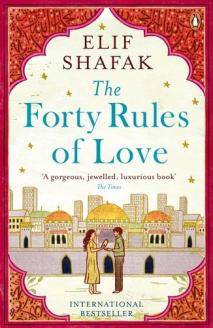
 Which brings to Elif Shafak’s The Forty Rules of Love. This is a most loved author; people literally can't wait for her next book. They are always complex. The Forty Rules of Love is a complicated, multilayered and deliciously flawed story set both now and in the thirteenth century, and across several countries. The story starts with Ella, an unhappily married 40-something, whose first assignment with a literary agency is to read Sweet Blasphemy, a novel written Aziz Zahara. Like Ella, I became mesmerized by the tale of a whirling dervish known as Shams of Tabriz and his relationship with a Persian poet called Rumi, Ella is also taken with Shams’ rules, which offer insight into an ancient philosophy based on the unity of all people and religions, creating a further layer. Both Shams and Rumi were real people, living in Persia 800 years ago. Ella feels driven to contact the writer of the book she's appraising, and discovers that he strangely mirrors Shams in looks and philosophy. He tells her his story, she tells him hers, that the connection sets her free.
I’ve described the classic Russian Doll tale as both deliciously flawed and nesting imperfectly. This, for me is a crucial part of the structure, and the major reason such books often take on cult status, and become loved across the globe, as did The Shadow of the Wind by Carlos Ruiz Zafón (translated into English by Lucia Graves and first published in English in 2001 by Penguin Books). This begins with a young boy being asked to choose any book from the Library of Secrets. The novel he takes away haunts his childhood, and as he grows into adult he begins his search for the author. The investigation leads to the telling of many tales, including his own and that of his small, Spanish town. Finally, he confronts the truth, which turns out to be more dramatic than the original childhood book.. We recognise in them our own, complex, horribly layered lives, of which we are trying, but mostly failing, to make sense.
Sometimes, it’s reassuring to read fiction that is tightly plotted – in which every strand is tied by the end. But it can be equally illuminating and heartening to know that other people’s lives are disparate, random and full of stories that don’t quite end or make perfect sense.
I’d be interested to hear what other readers and writers think about this; do leave a comment about your favourite Russian Doll novel or tell me if you disagree with either my interpretations above or my theory of the Russian Doll structure. And if you’re in the middle of writing a Russian Doll story, do tell us about it; if you have the strength!