Tuesday, 14 January 2020

This Is the American Earth – Ansel Adams and Conservation Photography

This Is the American Earth – 
Ansel Adams and Conservation Photography


http://vault.sierraclub.org/history/ansel-adams/
This Is the American Earth (1960) was a conservation project between the American landscape photographer Ansel Adams (1902-1984) and photography curator Nancy Newhall (1908-1974). It it a book of 44 photographs (mostly by Adams) of wild America, especially the Yosemite National Park in California’s Sierra Nevada, with accompanying text by Newall. The book sprung out of an exhibition of the same name held by the Sierra Club, an environmental organisation still active in America today. Its website commends Adams as…a visionary figure in nature photography and wilderness preservation.…an environmental folk hero and a symbol of the American West (Sierra Club 2018).
From the thirties to his death in 1984, Ansel Adams was a renown landscape photographer. His work, especially Monolith, remains regarded as one of greatest masterpieces of American art In 1927, Adams clambered though 4,000 feet of deep snow to reach ‘the Diving Board as light failed. Adams had a moment of inspiration. By using a red filter, he turned the sky black against the snow, creating Monolith. However, the stunning shot may not have the simple stroke of luck Schama would have us believe. Heath Johnson (2002), agrees that after publishing Monolith, Adams would become ‘renowned as a dedicated and fastidious technician’. It’s possible he climbed as light failed with a red filter ready in his pocket. 


 http://anseladams.com  
Adams’ choice of title for this photo intently offers the detonations of size and power, while conjuring up resonant connotations…the monuments of ancient man, the pillars of classical times and the sky-scraping east-coast American architecture of the time. There are also cultural connotations within this name of kinship and connection. None of this would resonate if the photo had simply been called, ‘Face of the Half Dome’.The driving black lines of Monolith takes the eye over the rock surface towards the white line of light along the upper edge, The dark sky above and the brilliance of snow, compounds the variety of black and grey. The dome dominates, even governs, the landscape. It’s a giant’s chair, with the sitter just out of sight, guarding all it surveys. On another level the rock seems to offer itself to the land below, a sort of watching sacrifice.

Ansel Adams was born in San Francisco in 1902 and began taking photographs as a kid with a Kodak Brownie on family trips to the Yosemite National Park, sustaining a 60 year career as a fine art and commercial photographer, teacher, author and environmentalist. He died at the age of 82 leaving an enormous legacy for conservation photography.


http://vault.sierraclub.org/history/ansel-adams/
Alan Ross describes how Adams developed techniques of the time; etching, Bromoil Process, soft focus and silver based darkroom techniques and his ‘Zone System’, a technique for transferring light into formally measured densities, encouraging choices about light and tone, shadow detail and light-metre values. The truth is, in the five+ years I worked with him in the darkroom, I never saw Ansel make a straight print. An ideal Zone System negative, if there is one, might actually look boring as a straight print. But the information is there to achieve what was visualized the moment the shutter was released…

I recently watched one the Civilisations a series from the BBC with Simon Schama, who explained the way Adams relied on ‘visualisation’…not what his eye, but the inner lens of his imagination, could see (2018). The idea of seeing the picture before taking it, reminds me of the methods of other visual artists, and indeed creative writers, who talk about imagining their work before commencing it, and indeed on the idea of tracing an image from a camera obscure. Adams spoke about this technique on camera: My basic approach begins with a visualisation of the final photo before exposure is made. When you visualise a photograph, it’s not only matter of seeing it in the mind’s eye, but a matter  of feeling it, feeling the various qualities you wish to obtain in the print.  


 https://theautry.org/exhibitions/revolutionary-vision-group-f64-and-richard-misrach-photographs-bank-america-collection


This passion for wilderness preservation began on a trip to New Mexico in 1941, which yielded one of Adams most famous images, Moonrise Over Hernendez. It’s possible that these two halves – the aesthetic value and the persuasive ability of his work – is the synergy that makes Adams so honoured and enduring as a photographer. Certainly, by the sixties, Adams was generating books, including This Is the American Earth, that were concerned largely with the goal of raising awareness for the campaign to preserve the natural landscape. These influenced its growth as a movement in the US (Encyclopaedia  Britannica 2018).


The art work in This Is the American Earth was acclaimed when first presented to the public in exhibition, but the accompanying text by Newhall was too ahead of its time. E.S Deevey (a zoologist from Yale University) reviewing after publication in 1960, having described the plates as ‘a pure aesthetic delight’ writes…The message is grafted on in the form of text by Nancy Newhall…what comes through to me is not Conservation, but Conservationism. By this I mean a tendency to effusive overstatement that make some conservationists sound like member of a cult…Fortunately, any purchaser who can get past the book’s repellent title will probably not even notice the text, and the pictures are magnificent (Deevey 1960). 

Work by Joe Cornish Exhibition Archive http://www.joecornishgallery.co.uk/exhibition-archives-i43


This delight in pictures, not the text, makes two points. The first is that Adams never sacrificed artistic value to make an environmental point; What Adams ‘ pictures show us is…not with the description of object—the rocks, trees, and water that are the nominal parts of his pictures—but with the description of the light that they modulate, the light that justifies their relationship  to each other…(Robert Turnage, 2016). 


Moonlight shines on a majestic Sierra Juniper Peter Essick/National Geographic


The second is the well documented possibility that writing cannot express nearly as well, what a picture can tell us visually. Adam’s work touches nerves within the viewer, influencing photographers like Michael Frye, who works in the Yosomite Nation Park, produce environmental photographic art-work, and acclaimed photographer Peter Essick: I had been inspired by the work of Ansel Adams…he had been a big influence on my work at National Geographic (Keart, 2018).

I was inspired, not as a photographer, but someone who has felt strongly about saving all aspects of the environment for many years. As we get closer to an uncrossable chasm ourselves, remembering that some people took care with what nature offers us is something I like to do.

watch view a clip of Picture Paradising’ (2018) Civilisations  here.

A video of Adams here
Read more about Ansel Adams here


Thursday, 21 November 2019

We're the Woolflings...Virginia Woolf's devotees

I’m in a room of people, all chattering like mad. There are feathers in the hair of the women and our Charlston dresses shimmer like mad in the candlelight. We're all fringes and Art Deco jewellery.  The men are more sober...at least on the outside. Inwardly, we're  seething with  intellect, emotion and sexuality. Everyone is secretly cheating with someone they're not married to. And as we exchange sparkling conversation about all the most important issues of the era, above us floats an ethereal presence, In the best traditions of Bloomsbury they're gender fluid...a 'he', a 'they' and sometimes a 'she', is whispering in our ears that they are three hundred years old and counting.

Where on earth am I? Is it the early 1930s, and I'm partying with the Bloomsbury set, joining in with their most decadent and amusing members?

Or...actually…I am somewhere on the Gower in Wales, where a set of 21st century friends meet regularly to celebrate story and myth?

Last time I was there, we were immersed in the novel Jonathan Strange and Mr Norrell, which you can read about here; this time we're celebrating the writing, and the life, of Virginia Woolf. This is a gathering of Woolf fanatics. We're the Woolflings, we tell ourselves, as we move round the room playing our parts and sipping our drinks. 

From her teens Woolf regularly sank into a distressed state which we now think may have been bi-polar disorder, because when Virginia was in party mood, her conversation shimmered and she was full of life and fun, but when she was low she became very ill, often delirious, with 'vile imaginations' that threatened her sanity. She’d hear the birds outside her bedroom window sing in ancient Greek, and had strongly suicide thoughts. Her illness may have begun at the age of 13 when her beloved mother died. Her half sister Stella, who took over being a mother to her, died not long after. In her famous diary she said it was impossible to write of. A few years later, her father died, followed by her beloved brother Thoby. She wrote Jacob’s Room  in memory of him, an emotion which you feel, turning her grief into a spiritual shape. In the novel, Jacob moves from childhood to his early death in battle, and we’re left with the emptiness of Jacob’s room to show the profound emptiness of loss.


We’d been discussing her work all weekend, dipping into A Writer's Diary which is a Woolfling's constant companion. This journal. which she kept from 1918 to three weeks beforee her death, included entries on her writing, books she was reading and her unfolding private world - the anguish, the triumph, the creative vision.

We mostly concentrated on four of her many books, starting with The Lighthouse. This is set in a country house similar to the one ther father kept. He was the writer and thinker Leslie Stephen and he'd take his entire family down to the rather disheveled Talland House on the rugged Cornwall coast every summer.  Woolf’s book is a clear reconstruction of those times, removed to the Isle of Sky where, through the lives of the Ramsay family, she investigates human relationships. Talland must have been a respite for Virginia, but most things that are constant in our lives  have to end eventually, and the novel finishes with the return of the grown children and their father to the house, after their mother's death. None of the siblings want to be there, and it's too late for them to be the least excited about trip to the eponimous lighthouse.

In 1917 the Woolfs bought a printing press, which I've already written about  in this blogpost about the Hogarth Press Virginia was slowly recovering from a breakdown and Leonard hoped the intensely manual  occupation would give her something to occupy her mind when she wasn’t writing. Despite the long hours, she found it exhilarating, as she wrote to her sister Vanessa:
Reading from Mrs Dalloway
“After 2 hours work at the press, Leonard heaved a terrific sigh and said ‘I wish to God we’d never bought the cursed thing!’ To my relief, though not surprise, he added, ‘Because I shall never do anything else.’ You can’t think how exciting, soothing, ennobling and satisfying it is. And so far we’ve only done the dullest and most difficult part – setting up notice.’”
Although Woolf's books were printed on this press, it would be wrong to think of it as ‘self publishing’. She received rave reviews for Mrs Dalloway, which might be thought of as the epitome of Virginia’s modernist style. It’s often the first book people will read of hers, and certainly it was my entry into her world, when I bought a finely-bound volume in the early eighties. The plot is  simple and only takes place over one day. Clarissa Dalloway is throwing a party, while war veteran Septimius suffers severe PTS; hallucinations and haunting memories. Her first title for this book was The Hours; taken by Michael Cunningham for his novel that follows another Clarissa's day through New York while also detailing the last hours of Woolf’s life. 

By the time she was writing the magically realistic Orlando, Virginia had met Vita, and taken her for her muse. Orlando follows an English nobleman who lives for three centuries and mysteriously becomes a woman during that time. Woolf received critical praise for the groundbreaking work, as well as a newfound level of popularity – most people agree it is her most accessible and witty story.
Vita

The final book we explored was The Waves, my personal favourite. The voice of this novel is like listening to the waves break on a shore...I can still feel her prose shusshing in my ears. Despite there being almost no story at all, I think it's a thrilling novel. We watch six friends grapple with the death of a mutal friend, Percival. Woolf does this by revealing their inner soliloquies. This is Virginia Woolf’s theory of how fiction works for her, an amazing, poetic dreamscape.  
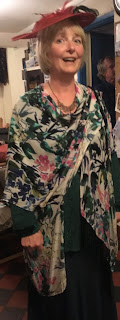
'Violet'
But now, after a weekend of study, reading, dramatising and interpretating, we're allowed to loosen our (bow) ties and let our (shingled) hair down. At the  party, we greet each other with air kisses and whoops as the ‘four Vs’ and their male partners arrive in their finery.
First to pour a drink is Virginia herself,  accompatined by the ever loving and caring Leonard Woolf. And here's her sister Vanessa Bell, but there's no Clive Bell in sight. She's accompantied by her lover and gay friend Duncan Grant, who is an artist, like her. By now, Vita Sackville-West has arrived with her long-suffering husband, Harold  Nicolson. Vita was also a novelist, writing books that are still enjoyable (see this blogpost), but is most famously known as a gardener. With her hubby she transformed the derelict gardens at Sissinghurst Castle into something so wonderful it's an attraction to this day. Finally,  the enigmatic Violet Keppel comes in, sulking somewhat. She is Vita’s true love and was her lover before and after the little fling with Virginia. She’s on the arm of her fiancé Major Trefusis, who she will eventually marry after many gay affairs, still suffering a deep depression. 

Finally, Orlando is here, in all zir glory. Man, woman, young, ageless. Nothing thicker than a knife's blade separates happiness from melancholy, zie whispers to the others...All extremes of feeling are allied with madness. We can all hear zir, even though we can't see zim clearly... we write, not with the fingers, but with the whole person. The nerve which controls the pen winds itself about every fibre of our being, threads the heart, pierces the liver.  Is not writing poetry a secret transaction, a voice answering a voice?

The atmosphere in the candlelit room is electric. While Orlando floats above us, Vanessa is trying to find out just how things are with her sister, whom she cares for deeply, while discussing her art with Duncan and, more importantly, trying to pursued him to give her a child…despite being a wonderful artists she was also a born mother and finally they did have a child together.

Meanwhile Violet is griping and glowering at everyone. Temporarily at least, Vita has gone off with her new amour, Virginia. It’s possible they only spent one weekend together, and no one knows if the relationship was consummated, but Violet isn’t happy and poor Major Trefusis is getting it in the ear. 

As for Virginia…she’s high tonight. Her conversation is witty, avant-garde and irreverent to the point of bawdiness. She's talking about life...I have a deeply hidden and inarticulate desire for something beyond the daily life...and feminism...as a woman, I have no country. As a woman I want no country. As a woman my country is the whole world... and books...Second hand books are wild books, homeless books; they have come together in vast flocks of variegated feather.
She’s using language to create; ‘some kind of whole made of shivering fragments that capture the flight of the mind.’ 

Virginia might have been mentally desperate  at times, but there's no doubt she was cherished and loved by her husband. Leonard was always by her side, watching for signs of depression, keeping things quiet and calm, providing her with a balanced diet, and that most important of essentials...A Room of One's Own. As the Second World War continued, and she finished Betweenn the Acts, her last book, Leonard  saw how she was sinking into deepening despair as their London home was destroyed in the Blitz. She was also terrified that if England was invaded by Germany, Leonard, who was Jewish, would be in particular danger. On the 28th March 1941, Virginia Woolf filled her overcoat pocket with stones, walked into the River Ouse and was swept away. She was a strong swimmer, so the stones made her determination clear. Although she'd had enough of her life, her books remain as a testiment to her. They are filled with such understanding of life and death, such wonder, and such a clear acount of the human condition. Let's let her have the last words as we party on her behalf on into the night...So long as you write what you wish to write, that is all that matters; and whether it matters for ages or only for hours, nobody can say.


Hello to her

Thursday, 16 May 2019

Picasso: My Experience

Picasso: My Experience

Part Six of Kitchen Table Writer's Look at Art


People are always asking me what my favourite genre of novel to read is, and who is my favourite author, but no one ever asks me the same question about art. Perhaps I just don't move in those circles, where elevated conversation gently buzzes through rooms of martini-holding guests (which is how I sort of visualise arty parties). But if anyone actually did, I'd answer without hesitation…
Picasso. 

The famous photo of Picasso shading Franciose
 Pablo Picasso and Françoise Gilot with Picasso’s nephew on the Côte d’Azur in 1951. Photograph: Robert Capa/Magnum


I first encountered Picasso in my twenties, when I bought the book written by Francoise Gilot; My Life with Picasso. Gilot became Picasso's lover and the mother two to of his children.  Gilot was at that point trying to establish herself as an artist when she met the older man. She is now 94, and was recently interviewed by the Guardian; read the article .

La Joie de Vivre, 1946
Since reading her biography, which was as much about their art as their love affair, I've  zoned in on the great man's work wherever I am, from travelling to London in the eightes for touring exhibitions of his work, to discovering that Antibes, in the South of France had its own picasso gallary. In 1946 Picasso spent a  year in Antibes using the 2nd floor of the Chateau Grimaldi as his workshop, and at the end of that year gave around seventy works to the city,  The gallery is now inside that magnificent chateau. I wandered around the artwork until I was face-to-face with the most enormous painting that struck a cord. This is linked to Francoise Gilot, because when he painted it, he was about to become a father again with her child in hid sixties, so he probably did feel full of the joys of life, This comes through in this painting, in fact it shouts it out. I could have stayed in front of it forever, because it is amazingly detailed and there is so much to see, interpret and understand. 


Françoise herself is depicted as the central dancing nymph accompanied by a faun and centaur playing flutes and two small goats who are dancing with her in their goat-like way. The colours are muted and restricted to yellow, blue and neutrals, and I stood there thinking how it made me feel free and re-energised. 


Three Musicians 1921
https://www.pablopicasso.org/three-musicians.jsp
Since that time, I've visited the Museum of Modern Art in New York, where Picasso's The Three  Musician is on display. Like  La Joie de Vivre, it’s a massive painting more than 2 metres wide that swallows all your attention. Picasso was experimenting at the time with cutting out and repositioning images in paper. The  three brightly coloured figures are set against a dark background, which could be a stage as they might represent the masked figures in a type of Italian popular theatre, and it’s easy to spot Pierrot and Harlequin. The third figure is hard to make out. He is a singing monk, intriguingly concentrated into a small, grey rectangle. Using cut out paper clearly aided Picasso in his development of cubism, which, as far as my small artistic brain can work out, is when the artist tries to represent many sides of a 3-D object in 2-D, using geometric shapes to distort what we're seing and make us look again. This picture takes us backwards in art history time, to 1907 and the other famous Picasso at MoMA;  Les Demoiselles d’Avignon. The name is a reference to a street in Barcelona famed for its brothels. This is traditionally seen as Picasso's pivotal first step towards the new Cubist style, establishing him as the leader of avant-garde art in Paris, and marking a radical break from traditional composition. 


https://en.wikipedia.org/wiki/Les_Demoiselles_d%27Avignon
As I took in the pink, naked figures with their grotesque faces, and the incongruous bowl of fruit, which seems to be slipping down a slanting tabletop at the bottom of the composition, I  recalled a TV programme on Picasso I'd seen, which explained that the compressed, splintered, flattened and jagged naked women were inspired both by Iberian sculpture and African masks I was also struck by the connection between the powerfully muscular Art Deco bodies I'd been seeing all over New York during our tour and the ladies in Les Demoiselles d'Avignon, who are equally well-built and muscular.

More recently, I’ve become fascinated by a series of paintings I've never seen, but certainly will, next time I'm in Barcelona. In his final years, Picasso combined all the styles he'd invented and embraced all his life, and his paintings became even larger and full of colour. He also began to re-examine and re-appropriate (this is, copy, with changes to make the work your own) the old masters. In 1957, he created a series of 58 paintings in little over two weeks, all from a seventeenth century oil painting by Diego Velázquez; Las Meninas. This has even more massive dimensions than Les Demoiselles and is hung in Madrid. Picasso’s works – also called Las Meninas –  are preserved at the Museu Picasso in Barcelona – well worth a visit. 


    Click here to read more about the
 painting and see who all these people are 


Although I've never seen Diego Velázquez’s painting in the flesh, I downloaded it as a screen saver, and it excited, even thrilled me. I found that I could unravel things about it just by looking for longer and longer, and that I was taken off on tangents… psychological, philosophical and practical. But when I then read more about the picture, I had to review some of my conclusions and seek further unravelling of its mysteries. This simply added to the delight of discovery.  


The first puzzle is the name given to the painting. Clearly, the central figure in Velázquez’s original is the Infanta Margaret Theresa, a five-year-old stunner in a costly white dress. The 'Meninas' are her handmaidens, ladies in waiting of high status, dressed quite similarly, a little older than her, and extremely attentive. Noticeably, they have dark, ‘Spanish’ hair, while the Infanta has golden curls. 


At first I thought Margaret’s expression was that of a little girl who loves attention. I thought she’d turned her face to the light, believing it  enhanced her beauty. But on closer inspection, I could see her eyes are looking in the opposite direction – at Velázquez's canvas. Is that because the artist is painting her? If so, why is she behind him? Or is there someone else, outside the picture, who is posing for it? Is Margaret looking at a picture of her parents? Because they are there too, in the mirrored image behind Margaret. Are we watching the court watching the painting develop, and seeing it for ourselves in a mirror? If so, what does this mean?  I wondered if by looking at this painting, I'm putting myself in the shoes of the King of Spain. If that’s true, I don’t think the king understood. Velázquez remained his favourite all through his reign.

Each figure adds to the mystery and enchantment. On the right are two dwarfs, perhaps employed to entertain the princess One has laid a foot on the dog. Is he saying “at least I have power over one creature in this court” or is he just boyishly trying to inflict pain on the animal? Above the princess are the royal chaperone and a bodyguard while at the back, in a bright, open doorway, someone looks in. This might be the Queen's Chamberlain. To the left is the artist himself, concentrating on a massive canvas. A link between Velázquez and Picasso is that they both put themselves into their paintings.

All this discovery about Velázquez’s painting had come out of learning about Picasso's tribute. I'd been listening to a programme about Picasso’s Guernica
Click on link to find out more about this painting
on Radio Four, of course, which explained that  in the fifties, Picasso often created works relevant to the political situation in Franco’s Spain. This enabled him to make very specific satirical comments about the fascist government without getting into too much trouble. 
His Las Meninas is harder to unravel than Guernica, but, as with other Picasso’s works, it’s even harder to look away. I discovered they also fascinate and frustrate art historians.
click link for more information

The Infanta is a picture of childhood innocence. Picasso painted her over and over again: Alone, in body and as a bust, the Infanta appears in 14 of the series interpretations. In the work to the left, she does retain that sweet, chubby-cheeked look, but Picasso subverts and alters the original throughout the series. In some she seems to have a sourer look, worldly wise and rather disenchanted. In both representations, she’s wearing a mantilla, unlike the original, which makes me think Picasso wanted to make her seem traditionally Spanish. The colour of her dress and hair also change in each representation and in some her head is out of proportion. To quote art histories, it's possible Picasso twisted Infanta Margarita’s face in order to show how difficult it was for the young princess to balance her contradictory feelings and emotions between traditional etiquette and controlled behavior on the one hand and playfulness.

click link for  further pictures
Some art historians suggest that Picasso painted re-appropriations late in his life because he finally felt equal to the great masters, also to prove he had not left his best years behind. In the art world, it is quite common for a great master to be reviled in later stages of their lives, and this was happening to Picasso.


So how are these pictures a commentary on contemporary events in Spain, observed by Picasso from his exile in France? Look at the ceiling bosses. They have become grotesque hooks for the suspension of torture victims. In some pictures, the painter becomes a figure from the Inquisition while in one of them a maid has Franco’s moustache.

In the middle of these 58 paintings, Picasso also painted pigeons, white creatures, resonant of innocence and purity. It was as if he was searching for
perfect innocence amid the desperation of Spain at that time.

I found this quote from Picasso on the Guggenheim website, about this series…
little by little, I would paint my Meninas which would appear detestable to the professional copyist; they wouldn’t be the ones he would believe he had seen in Velázquez’s canvas, but they would be “my” Meninas. 

I like the way that sums up what you see when you look at the canvases, or at least, their representations online.