Friday, 8 January 2021

Beneath the Tor out in Kindle!


At last! The three books in the Shaman Mystery Mystery series are out in both Kindle and paperback editions. The third in the series,  Beneath the Tor, is now available from Amazon. The Kindle edition is only 99p and if you're with Kindle Unlimited, it's free to download. 

Now I'll be able to concentrate on seeing the fourth in the series through production and into both Kindle and paperback editions. Through the Floodgate, should be released in the early spring of 2021. 

The original idea of the Shaman Mystery Series, came to me one day, in the guise of Sabbbie Dare. She arrived, fully-formed and said;  'I'm a young therapist, a shaman, and sometimes I do get very strange people walking into my therapy room. Honestly, I could write a book about some of them...'

And so the idea for the first in the series, In the Moors,

was born.


I'm not at all like Sabbie; I can't add up, I doubt I could solve a murder mystery, and I'm not quite the 'cock-eye' optimist that she is. I'm far, far, shyer than Sabbie, who says it just like it is, and is unafraid of catching people off-guard. Sabbie is a very curious person and as she says herself..."you know what that did to the cat."


But like Sabbie, I follow a pagan path which takes me close to the earth and into the deep recesses of my mind. Shamanic techniques help me in my life - in fact they changed my life - although, unlike Sabbie, I’ve never set up a therapeutic practice...I’m too busy writing!  


Beneath the Tor had its seeds in my visits, over the years, to the town of Glastonbury. I have become firm friends with many of the people who not only live there, but use it as a sacred and spiritual base for their work. But I also can't help but think that there is a dark side to the town. Naturally, one has to made a living if one offers spiritual therapies, but in the past, I have met those who are not all they're letting on, and some who have been making a profit without really knowing what damage they might do.


Nevertheless, there are good points to the town. The sacred and the pagan do exist side-by-side, with the beauty of the Abbey and the lovely church central to the community, and the mysteries of the Chalice Well and Tor deep in its psyche. I wanted to include both these sides to Glastonbury, and celebrate it, as well as set a thrilling crime mystery there.


To get this book right, I spoke to a lot of people and read a lot of books. I should thank the generosity of Nicholas Mann, whose wide breathe of knowledge on Glastonbury was my foundation stone, especially his book The Isle of Avalon:
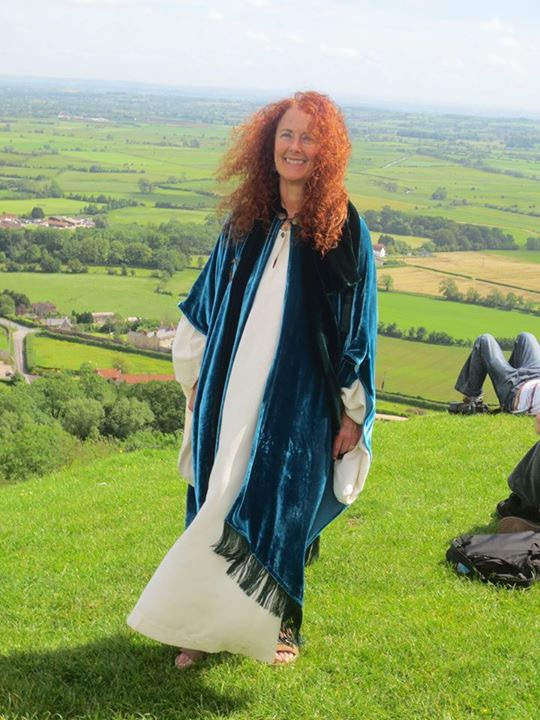
Mara Freeman on Glastonbury Tor

Sacred Mysteries of Arthur and Glastonbury
, published by Green Magic, and Glastonbury Tor: A Guide to the History and Legends. Also
 by my side as I wrote was Grail Alchemy, Initiation in the Celtic Mystery Tradition  by Mara Freeman, an authority on the mysteries surrounding the Isle of Avalon. She had just finished writing  at the time I was completing Beneath the Tor. It's an inspirational book I recommend here. Of the series, Mara says…"A real page-turner, In the Moors cost me several hours of sleep because it was so un-put-downable! An engaging heroine, a landscape at once so real and so menacing, and an intriguing mystery had me enthralled into the wee hours!” 


Some of you may remember the launch of Beneath the Tor at the The Avalon Room in Glastonbury. 50 people gathered and it was a blast; everyone had a great time, there was standing room only, and as one attendee said on facebook…Ronald Hutton...Arthur ‘ZZ Birmingham’ on guitar...and chocolates!


While Arthur wowed us with the blues, Ronald Hutton, professor of history at Bristol University and a world authority on paganism, gave a talk on the history of shamanism, concentrating on how it arrived in the West and was taken up and made obtainable by the great exponents in this country and the US especially. He then very cleverly (well, he is clever!) explained how my books tapped this seam, explaining how readers nowadays like two particular genres of novel; crime fiction and fantastic fiction. By entering Sabbie Dare’s two worlds…as a 30 year old woman faced with dilemmas, worries and, sometimes, danger in the 'apparent world' – and her amazing journeys into the spirit world as a shaman, I had successfully blended the two. Thank you, Ronald, and thank you, too, for your kind review of the book...." Milton 
has become a mistress of plot-weaving, and above all, she pulls off the trick of setting the totally fantastic amid the totally everyday and making the two fit together with pace and excitement."


So, I hear you cry, what is the third Shaman Mystery about? Well, let's have a taster; 


…A handful of dancers were still going strong. Alys was among them, turboed up like a child who’d had too much ice cream, hollering and whooping, I could hear her from the far side of the summit.

    I saw her dance.

    I saw her drop.

    She fell to the ground without a stumble or a cry.

    She fell awkwardly, one leg trapped under the other, her head thrown back.

    I stared for long seconds, waiting for her to rise.

    Alys didn’t get up. She didn’t move at all 


One Midsummer Eve on Glastonbury Tor, beautiful Alys Hollingberry dies suddenly after dancing through the night. After receiving sinister, anonymous emails about Alys, her grieving husband Brice approaches therapeutic shaman, Sabbie Dare. She turns to the spirit world for guidance but receives only conflicting and enigmatic answers. Meanwhile she follows the links from Alys to a killer who attacks in public yet seems to disappear at will. She must find the murderer before someone she knows becomes the next victim.


You can get a copy of Beneath the Tor HERE!


Friday, 1 January 2021

2021– Here We All Come!

When I walked out of my door  this morning, it was hardly light; the sun still is rising at around 8.15 in West Wales. The moon was well up above the western horizon. Although technically in its 'waning gibbous' phase, it is still pretty full to the naked eye and the phenomenon of seeing the bright full moon and the first glimmers of rising sun was inspiring.


Seeing these two great celestial bodies together, reminded me of a passage in the 2nd Shaman Mystery;
 
The full moon hung low in the west, glowing like a Christmas bauble, outflanking the real baubles in every shop window. It was bitter cold in my garden as the moon sank on its steady course. Six of us stood on my lawn, holding hands through our gloves, our faces raised to watch the moon set. Magically, this full moon would drop below the horizon just after the winter solstice sun would rise above it. We’d set up a pagan circle under the dying moon, in almost the same way as I set up my therapy room. We cleansed it with a besom broom and smoking incense, and a sprinkling of Glastonbury water. I took my wand of yew and cast a circle which would enclose us and keep us safe. We called in the powers of the four directions; north, east, south, west and the central powers that come from a place and time so sacred, it existed before any place or any time. The centre of our circle was marked by a lantern (didn’t think a candle would last the event), which let out enough light for us to see where we walked while the sun rose. It was already getting lighter in the garden; dawn was arriving long before we would see the sun rise over the rooftops. But we could see into the west, where the moon’s last light was fading as dawn broke. I thought about the way the solstice sun would hang in the its southern-most latitude for three or four days, where its path from horizon to horizon was so short it offered nothing more than a glimmer of warmth and a few hours of light, making the night interminable. Once those three solstice days were through, the sun would begin to move northwards. It would grow warmer, week by week, And every day, the sun would rise earlier and set later.  

I whistled my dog into the field beside my garden. It is clothed in snow, and the glow from the moon coated the snowy field in an eerie yellow light. This is our morning ritual, to get out and walk around the 10 acre field together before even a cup of tea.

As I crunched through the snow, a thought occurred to me. What's the connection between you, me and everyone else on the planet today?

Probably you can guess.

"We're all heading into a new year. 2021, the 'coming of age' year of this century and the year above almost all remembered years where everyone is voicing one thought";

 LET'S HOPE IT'S BETTER THAN LAST YEAR!

2020 was a pretty dismal year in so very many ways. The pandemic raised its head very early on  and has dominated every news headline, every action, and almost every thought process since the spring. It's not over, but thanks the the intensely hard work and brilliant minds behind several vaccines, there is now light...light that is echoed by the sun's steady progress from deepest, darkest midwinter into a new spring.

The darkness of the winter morning, and the soft glow of the moon and the growing sparkle of the rising sun on the snow. cannot help but remind me of the way the covid pandemic has offered little glimmers of light. The way, despite being locked down and often isolated in their homes, people have risen above themselves in remarkable ways. Some have focused on keeping their physical health together, achieving longer runs, further walks, better yoga postures. Others have had to cope with difficulties in  mental health A lot of us spend time reconnecting with themselves, perhaps concentrating on a renewed appreciation of the little things. Some wonderful souls have raised millions of pounds, but for others, the thing they are most grateful for. is the fact that they are still here in this world. Perhaps we learn, when things are taken away from us, how to appreciated.

My husband has concentrated on learning the hardest language in the world (we both think); Welsh.  Puzzle magazines and 'learn an instrument' videos have had a great time of it in this crisis. I've baked myself into a floury mess, even trying my hand at sourdough with limited success. I have a friend who has walked miles (within the daily limits) and learnt to  photograph wildlife as he ambled along, People have  taken on new pets,  redecorated or rediscovered painting as a hobby, I've seen a lot  old garments up-cycled  into new ones. All over the UK, people have crafted up a storm. Tom Daley crotched a pair of personalised swimming trunks (and a cardigan for his son)!  Katherine Jenkins sang into her phone and gave Facebook viewers a weekly dose of music for free. while other celebrities used their kudos to raise funds or ginger-up government action. I think we've all learned something about ourselves in the past year. I've heard this from so many people. New understanding of the slow and mindful processes has permeated this process, for when we slow things down, we see them in new and more intricate ways.

Lockdown has allowed a lot of writers a huge chance to write. In the next few days, the 3rd Shaman Mystery, Beneath the Tor, will be once again available in Kindle as well as paperback.  

Meanwhile, I've been putting the finishing touches to the 4th Shaman MysteryThrough the Floodgatewhich is now in production. This story is set in another period of deviations; the tragic floods of 2014. The Somerset Levels, which devotees of the Shamanic Mystery Series will know is where our hero, Sabbie Dare, lives, was deep underwater during that winter. This sparked my imagination and Through the Floodgate. was born, took shape, and now, I believe is the most relevant and thrilling book of all the series.

I'll be letting you know about these  events in the coming days and weeks. 

Meanwhile, of course I wrote on. I have almost finished my latest book for young adults. There will be more news about that soon, too.

All of that hasn't stopped 2020 being a grim time, I know. Death has stalked us even as we stayed in our houses. Not all who died did so of the new virus. Around the world there has been natural disasters, manmade disasters, police and state brutality We need to learn from all of this as we move into 2021. We could all do with getting back to normal,  visiting friends, heading off to a concert, browsing a library, having family round. 

So I'd like to know...

What have my readers been up to, since the start of 2020? What have you started  doing,  learnt about yourself, achieved through hard work or luck? And what do you wish for this promiseful year?

I'd love to know; leave a comment below.  In the meantime, I can only wish you

A most blessed, peaceful and hopeful 

new year, 

with wishes that you will get just the right level of excitement in 

2021


Thursday, 3 December 2020

Walking the Dunloe Gap


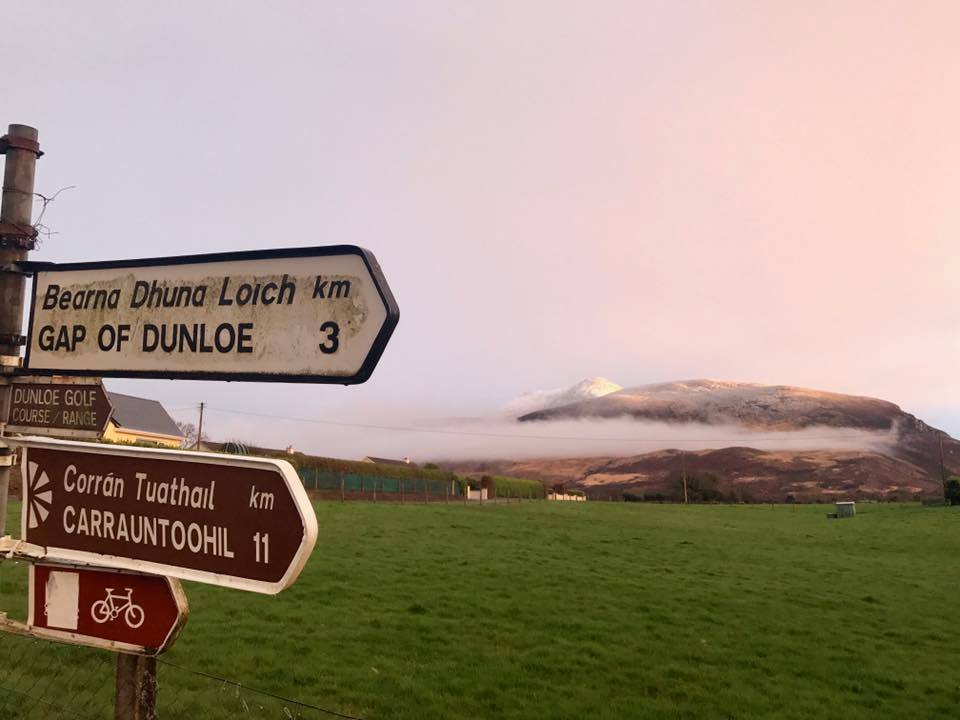
The Gap of Dunloe

By the time we got to the riding stables at the top of the Gap of  Dunloe, Maggie and I had a single pair of gloves between us. She wore the right one, I wore the left (our writing hands) and kept the other hands deep in anorak pockets against the March chill. We were seventeen, and on a hitching holiday across Southern Ireland (as the Republic of Ireland was called then). We'd stayed in Youth Hostels where the wind had blown through ill-fitting windows and hitched our way to Bantry Bay via Waterford and Cork, taking lifts from lorry drivers, garrulous primary school teachers and a farmer who told us to 'get in the back with the pig', and now we were in Kerry, hoping to see the famous lakes. We were looking at the sign which said… Pony and Trap Through the Gap; Five Shillings

'This might be our quaintest ride yet,' I said to Maggie. She nodded, but we were both wrong, even stranger vehicular contraptions awaited us. 

. 'Fancy the ride between the highest mountains in Ireland?' A man with a blue paisley scarf to keep his neck from the cold was waiving his hand expansively. 'McGillycuddy Reeks to your left and Purple Mountain to your right; Killarney’s got the highest peaks in all of Ireland.

'We're trying to get the the Youth Hostel,' we replied. I don't think we really understood the significance of the Gap of Dunloe', its wealth of legends, its sheer beauty, but by the time the man had hitched his horse to his trap, we were beginning to get the idea. 'Dun Loe; from the Irish "Dún Lóich", the fort of Lóich, an ancient Tribal chief.'

Very soon, we were behind him, sheltered from the wind in the cosy trap, but with a magnificent view as our tan horse trotted down the metalled road. 'We're passing Kate Kearney’s Cottage soon,' the man called out. 'Famous in her time. Would you like to stop there?'

I fancy our driver had an 'arrangement' with the cottage, nowadays a pub and a place where most people start their journey. He pulled his horse in, and we got out and bought a postcard. Kate Kerney was a great beauty in the days before the 1840s famine, but she was famous for her 'Mountain Dew', a poitín distilled from potatoes.

'It was said to be fierce and wild, the trap driver told us,  'requiring not less than seven times its own quantity of water to tame and subdue it.'

'Was it moonshine,' we asked, enthralled. 

'Illegal even in those days, and probably lethal, too.'  

He started up the horse and we travelled on into the gap. You'll see a lot of derelict cottages,' he said. 'From the hungry forties. Have you heard of those times?' 

Maggie and I fell silent, taken up by how the waters of a small lake reflected  the mountain tops on either side of the gap. 'They are blue,' Maggie said.

'They're further off than you'd think. The great glaciers formed this gap during Ireland's last ice. He pointed away from the road. 'See the massive boulders scattered about the valley? That's what the glacier left. And this is Auger Lake, the first of the five corrie lakes that feed out of the River Loe.'

We reached a wonky bridge than spanned river. 'You can throw a coin in if you want,' said the driver. 'This is a wishing bridge.' 

He watched us, as we got down and leaned over the wall, staring at the way the water foamed and gushed over the rocky bed. Then we searched our pockets for the lowest denomination of coin we could find. We were taking this holiday on a shoestring, but a lucky wish on the River Loe was something we had to do. Finally, I found a penny; the old kind, of course, with King George's head on it. I spinned it in and wished that I would come back some day and do this all again. 

As we set off again, the driver said, 'For an extra five shillings, I'll take you all the way to Lord Brandon’s Cottage, where you can get a boat across the Killarney lakes.' 

But we knew we couldn't afford that. And we'd seen the lakes on horseback the previous day. 'We need to get to the youth hostel,' I repeated. 

'I can't take you that far. But if we make a sprint of it, we should catch up with the farm cart that passes Moll’s Gap at four in the afternoon.'

 Sure enough, as we reached the bottom of the valley and joined the road, a horse-drawn cart was easing its way towards us. Our driver hailed it and the old carthorse came to a welcome halt.

'I can take you past the entrance to the hostel, as it's on my way,' the farmer told us. 'Can you get up on top my load?' 

To our teenage delight, we scrambled up the wheels of the cart and found ourselves sitting among a heap of turnips. They smelled of the earth (and were covered in it) and the tanginess of swede. We waved good bye to the trap driver and the lovely tan pony, and continued our journey by turnip cart.

Thirty-five years later, Jim and I returned to Ireland, to stay with my cousin who lived in Kerry. I really wanted to show them the Gap of Dunloe. So we picked up a very similar pony trap from  Kate Kearney’s Cottage and went down through the gap once more, taking the full 8 mile trip to Lord Brandon’s Cottage, which turned out to be where the poor man was on house arrest for many years. We climbed down into what seemed a very rickety motorised wooden boat called the Hollie Belle. Our boatman was named Donal and promised us he knew everything  about the lakes. He set up a patter of information as the outboard motor sprang into life. We countered across the three lakes of Killarney, under the stone bridges, through the old weir which is shallow and fast, and difficult to navigate, past islands where goats chewed thoughtfully and ruined houses rose up behind. We sailed close to a cliff side to see an eagle soaring above us. 

'We're, about to arrive at Ross Castle,' Donal began, 'And so I'll tell you the legend of   O’Donoghue Mor, who build the castle in 15th century. They say he still exists in a deep slumber under the waters of Lough Leane, and on the first morning of May every seven years he rises from the lake on his magnificent white horse and circles the lake. Anyone catching a glimpse of him is said to be assured of good fortune for the rest of their lives.' He grinned. 'But I'm here most May the firsts, and I can't say I've been lucky yet.'

We laid out our picnic in the castle grounds and then drowsed for a bit before we set out to walk the shorter route around Lough Leane. As we walked, my cousin and husband chatted, and I fell into a dream of a song. By the time we got back to the castle,  I was desperate for a pen and paper to write down my new song...The Kerry Colours

I wove the Kerry colours into my mother’s hat

And we went up to the mossy bank where the hurling lads were sat.

We took our ease,

By the lake-side trees

Drinking Spanish wine and mead,

And the sun it passed into the west,

But no one took much heed.


Chorus

Those days are long behind me now,

The people far apart,

But the kiss is warm upon my brow

And the smile’s still in my heart.


With whitethorn all around us, its blossoms smelt of love,

The great lake sparkled down below our ferny, dappled grove.

The girls all led,

On a bracken bed

Singing songs that were so fair,

While the boys all laughed and nudged their arms, 

Making garlands for our hair.


The night-time came, the darkness grew round the Kerry lads and girls.

A stillness rose from the huddled shapes that on the ground were curled.

I heard the lake

Its lapping make,

And Killarney’s lights glowed red,

The stars hung huge above me, forming patterns in my head.


My lover’s face was very close, like jet I saw his eye.

I’ll love you, sweet, he whispered me, until the lake runs dry.

I yearned to say,

At close of day

How I’d always love him back,

I’ll love you ‘til Killarney lake will flood the Dunloe Gap.


All around my love and I, the whisperings began.

The whisperings of the Kerry pairs, each Colleen and her man.

The sounds that grew,

To the dark air flew

Their passion sworn for sooth,

For the young in love live in their hearts and their wishes form their truth.


Chorus

Those days are long behind me now,

The people far apart,

But the kiss is warm upon my brow

And the smile’s still in my heart.


Tuesday, 10 November 2020

How to Write a poem, by Margaret Atwood.


Thank you, The Guardian, for publishing a wonderful article by Margaret Atwood on. the 7th of this month. Thank you, Margaret, from my heart, for reminding me that we can all write poems; easiest thing in the world, made hard only by our own internal critics.

Atwood talks about the title poem from her latest collection – DearlyYou can read it in her Guardian Article here

So what does Atwood say about this poem? She can remember the occasion. She and her late partner, Graame Gibson, were in Stratford, Ontario, where a Skakespeare festival was taking place (she had just written Hagseed, which I talk about in this post ) It was 2017. Her knees hurt because she'd spent 'five hours in a twisted position in the back seat of a car with a one-and-a-half-year-old'. She was out, a cup of take-away coffee in her hand. 'Slow walking leads to rumination, which leads to poetry. Park benches are my friends…scribbling ensued.' 

So there we have it. The template to become a poet. Walk slow. Ruminate. Find a bench. Scribble. 

So simple, so easy. And this leads to something that, at the OCA, we tell our students every other day...use those notebooks; keep them handy. Atwood can't quite remember, but knows she wrote on 'some piece of paper that may have been anything from an old envelope to a shopping list to a notebook page…I'm guessing a notebook.'

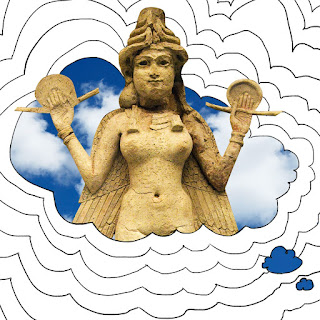
Cuniform from Sumatra
She describes Dearly as 'part of its own zeitgeist', and quotes Ursula La Guin 'Only in dark the light. Only in dying life'. No wonder she then moves on to the 'Great and Terrible Mesopotamian Goddess Inanna' describing the hymns to her as 'fascinating…but they don’t cause the marrow to melt in my bones as they might have done for an ancient listener: I don’t think Inanna may appear at any moment and level a few mountains, though I could always be wrong about that.'

 I have loved and worked with this goddess during the last 10 years, and, okay I don't expect her to level mountains right now either, but the story of her descent into the otherworld and her return from it is one of the the earliest surviving creative pieces of writing In cuneiform script – that is, marks in clay. It was found Sumer, in the Fertile Crescent, and perfectly echoes  'in dark the light. Only in dying life'.

 Usually dated to around 5,500 years ago, the mythic poem, The Descent of Inanna, is powerful writing:


From The Cut; read the article by  Callie Beusman

…She has put a turban, headgear for the open country, on her head. She has taken a wig for her forehead. She has hung small lapis-lazuli beads around her neck. She has placed twin egg-shaped beads on her breast. She has covered her body with the pala dress of ladyship. She has placed mascara which is called "Let a man come" on her eyes. She has pulled the pectoral which is called "Come, man, come" over her breast. She has placed a golden ring on her hand. She is holding the lapis-lazuli measuring rod and measuring line in her hand…

 The Electronic Text Corpus of Sumerian Literature http://etcsl.orinst.ox.ac.uk/section1/tr141.htm

Because she is not afraid to walk in dark places, and live life from those experiences, I work with when I am in such situations  Oh, and she's quite a sexy lady. Here she is speaking to the shepherd who is crazy for her...

My vulva, the horn,

The Boat of Heaven

Is full of eagerness like the young moon.

My untilled land lies fallow.

As for me, Inanna,

Who will plow my vulva?

Who will plow my high field?

Who will station the ox there?


Life is essentially slower for a lot of people now. A chance to walk slowly (alone), to ruminate, to find a seat, to write a poem...any poem you like. Perhaps, to quote Atwood, it might turn out to be a love poem or it could be a song to an ancient deity. It really doesn't matter. Almost the entire point of writing a poem is how  you feel when you get it out of you.

Atwood points out that every poem is created at a particular time, place, and the location the writer happens to be; 'in a study, on a lawn, in bed, in a trench, in a cafe, on an airplane).' She points out there is usually an 'intended audience', anything from 'your nobodies' to 'your fellow Goddess's priestess…They can’t renounce their roots..' 

You can buy a copy of Dearly here


Saturday, 7 November 2020

On the Gallows by Nina Milton: Now on Kindle!


The two detectives had arrived as the body was trundling on a gurney over to the white tent where the pathologist waited like an adjudicator at some macabre contest. The woman was found stripped of any clothing and the technician had thrown a green sheet over her poor mutilated and rotting body for that short journey, but the gurney jerked as its wheels stuck to the walkway, which was so burning hot it was melting the policemen’s thick soles, and the woman’s head slid to the edge, her heavy locks falling free, as if she’d just unpinned them. Despite the river weed and silt, her hair was still glorious; as black as a nighttime lake, not tampered by bleach or dye. 
Detective Sergeant Gary Abbott had stepped forward, his hand outstretched, and touched the woman’s hair, crying out like a distressed relative. “Take care with her, for God’s sake!”

Hinkley Point

I'm proud and delighted to announce that a new Kindle edition of the second of the Shaman Mysteries by 
Nina Milton is up and running. Revised and now called On the Gallows it continues the adventures of
 Sabbie Dare, the Somerset shaman who has burst upon the crime fiction scene. The series is famous for it's dark landscapes, and this second one features the waterways of the Somerset Wetlands, the grim, 
Bridgwater Bay (Wikipedia)

bare coastline with its 'drowned forest' and the continually controversial nuclear power station, Hinkley Point. Nina Milton is also known for her wonderfully descriptive and atmospheric shamanic journeys, undertaken by Sabbie in her search for answers. In this book, she meets a wolf by a Roma camp fire;

    'Beware. If a wolf comes in friendship, it will offer you inner strength and the deepest kind of wisdom. But if it comes as your enemy…'
    'What?'
    'It will bring you down by the neck.'
    'Your otter is right, of course,' said the wolf, as it came up to me. 'I will grant you nothing but the right of terror.'
   'I am here to find Kizzy Brouviche, for good or ill.'
    The wolf grinned as I spoke, as if I’d said something that amused it. 'You will listen to me, Sabbie Dare. You will be show directions. Follow, and you will discover.'
    'Where will I find these directions?'
    'There are many that will appear to you.' His tongue lolled

from his muzzle and saliva drooled and pooled on the ground.          'The place of blame. The place of absolution. The dark place. The place of no escape. You will find little in some, and confusion in others. In some you may be rewarded. Do not expect satisfaction from any answer.'
    'Do I know these places? Or seek them out? Should I look in the obvious places first?'
   'That is shrewd. Now you show me your gums, as we wolves say.'...

On the Gallows (Unraveled Visions in the US edition), opens on the hottest day in August, when a young girl is pulled from a Bridgwater wharf, her body so mutilated that it makes identification impossible. Months later Sabbie Dare’s nemesis DS Abbott is found dead after the Bridgewater Carnival. The Bridgewater police are on high alert.
Meanwhile, Romanies Kizzy and Mirela Brouviche have come to England from Bulgaria in the hope of finding their fortune, but soon after Sabbie meets Kizzy at the carnival, the Roma disappears, leaving her young sister Mirela stranded and afraid for her sister. Sabbie is determined to help her in her search, but her shamanic journeys are confusing…her visions unravelled…and they lead Sabbie into dangerous territoriy. This includes being chatted up by immigration worker Fergus Brown, who is reticent on what he knows about the Romany sisters. And while she begins to suspect that the owners of Papa Bulgaria, where Kizzy and Mirela worked, are somehow involved with Kizzy’s disappearance, she also needs to factor in Eric Atkinson, the leader of a sinister cult, who seems too interested in Sabbie's new neighbours, Drea and Andy. Sabbie journeys into Drea's spirit world and is confrontated with a terrifying anaconda. Drea is shocked and distressed by Sabbie’s revelations and shortly afterwards disappears.

Are Kizzy and Drea’s disappearances related? Is Eric Attkinson's cult a danger? What led Garry Abbott to die alone of a single gunshot to the head in a darkened alleyway? Is his death linked to Papa Bulgaria's carnival float of gypsy dancers? Should Sabbie accept a date with charming Irishman Fergus? While Sabbie is facing these questions, she also has to cope with the discovery of her long-dead mother’s family, whose surprising appearance is set to take the wind out of her sails. A disapproving DI Rey Buckley instructs Sabbie to stay well away from his case…and away from him. Naturally, Sabbie does the opposite, on both counts. Her headstrong nature leads her towards romance...and right to the heart of trouble.

Terri Bischof, the acquisitions editor at Midnight Ink says of Unravelling Visions…I loved the masuscript.The Shaman Mysteries are among my favourite series... this is a great book!

Library Journal says...Sabbie Dare is the most compelling protagonist and Milton’s tale is riveting. 
The visceral suspense Milton creates is commendable, not to mention terrifying. I like pairing her work with Elly Griffiths’s  atmospheric English mysteries.

I hope you'll enjoy it too. Of course, if you haven't yet obtained your copy of In the Moors, it is also on Kindle at just 99p; free with Kindle Unlimited.

Monday, 26 October 2020

Walking into Stories.

Many writers walk to invent their stories. Dickens apparently
 wrote most mornings and walked every afternoon. 

 I think his characters and their senarios walked with him, ready for their creation by pen the following morning. 

I've used this method for years. It doesn't matter if the surrounds are urban or rural, but naturally it's nicer if there are trees and birds. The most important thing is that I am on my own. When I walk with others, I'm bound to chatter. When I walk alone, I chatter to my characters, and they chatter back. In this way, stories develop through my feet. 

I've walked my way through dialogue, scene-building, description, interior monologue, action, development of plot. Holding it in your head is the hard part - I've been known to race back on the home stretch, my hands itching for the keyboard.


 A more recent development has been to walk into my stories. I know where I want to set my scenes, of course, and some of them are fairly imaginary, some of them set exactly in that place. Either way, I like to wander round, explore actual sites, and, even better, I can take other walkers with me; someone who knows the story a bit and can help you chew the fat over, so that, as we walk, we chat
 about the interweavings of plot and character with landscape, throw ideas at each other and iron out problems.

My son Joe is a great walking buddy. We explored the Somerset moors and the Somerset Levels (which are slightly different places in actual fact, although easily muddled; it's all low-lying, reclaimed from marsh, boggy, peaty and full of beautiful wildlife). At that time I was writing In the Moors, the first Shaman Mystery, and we were looking for a good place to hide bodies. Now, we laughingly call these 'murder walks'
On them we search out the best place to dispose of bodies, the best place to commit the crime, the best place to hide from the cops...whatever is required, really. Actually seeing the landscape enhances the final descriptions from guesswork to atmospheric reality and the process of making sure things can really happen - all the hows, whys, thens and theres - becomes accurate and simplified. Luckily, there was no one near to hear our conversation;
 'How about digging a hole at the edge of a marsh?'
 'Easily spotted. How about just dropping them into the huge pools of water that were once peat bogs?'
 'They'd bob up, wouldn't they?'
 'Well, look at those ancient willows over there, in that rhyne. You can see right down into the roots. That would hold a body down. Stop it floating...' 
And so, the scene where Sabbie Dare walks the levels in increasing darkness, until she finds the shallow grave of the little stolen-away boy, was born. The zig-zag route she took, taking bridges over the rhynes and ditches between the boggy fields, the balancing act as she navigates the deep black pools, even the ancient, 'old man willow' who holds the secret of murder, was all there on our walk.

The Shaman Mystery Series is mostly set in Bridgwater, Somerset, UK. My friend Sue was born in Bridgwater, and knows the town far better than I. We've had several great trips down, a couple of them staying for the weekend so we could explore properly, chat to the people, wander the streets, work out which shops are in which centres, getting the 'feel' of places like the library, the town hall, and (most importantly!) the police station. Some years ago, we went down for the November Carnaval and the late-night squibbing event that fills the opening pages of the second Shaman Mystery - On the Gallows (called in it's US edition 'Unraveled Visions').
Squibbing in Bridgwater

For that second book, I needed to visit Hinkley Point power station, and the forsaken coastline beyond; we walked the coastal path to see the sunken forest and the strange cooling tower that stands out to sea. In my head, this is where a body would be found, and the story how how a character found it, all came in start reality as we stared out, against the high, chilly wind.

On the Gallows is to be released in Kindle ready for Christmas reading this year (we may need Christmas reading!). The next blog on this site will be the new cover reveal, so keep a lookout for it!

Such a walking buddy has to be trustworthy...and a bit of a writer themselves, if possible, but mostly any good friend with a pair of lace-up boots would do. In this way, we've marched through forests, along coastlines, been blown off mountains and squelched into bogs.
I once walked all around a Killarney lake and ended up with a love song which, foolishly pen and paperless, I had to carry in my head all the way back to where we were staying. 

With our ability to escape from our own houses being limited a lot of the time at the moment, walking at least is allowed, even if we can't always enter private or even public buildings. If you're in the middle of planning your story, give it a go, take a walk.