Friday, 31 March 2023

Virginia Woolf, A Writer's Joy - (Writers Writing about Writing).


 My copy of Virginia Woolf’s A WRITER'S DIARY

In this occasional series, A Writer's Joy (Writers Writing about Writing), I want to look at how writers use their notebooks and diaries to record their thoughts, reflections and ideas on writing. A wealth of interest and knowledge from down the ages can be found in these pages, often unpublished, but nevertheless facilitating and enlightening. 

 My copy of Virginia Woolf’s A WRITER'S DIARY seems to be a first edition of 1953 from The Hogarth Press. It has that smell of an old book about it – a mix of tobacco, spores and midnight oil. The original owner of the book has written her name in on the first page in slanting black ink...Marjory Todd...and dated it 1/1/54,suggesting that this was a Christmas present. Dipping into it on occasion, as I do, reminds me of  something Virginia wrote...What a vast fertility of pleasure books hold for me! I went in and found the table laden with books. I looked in and sniffed them all. I could not resist carrying this one off and broaching it. I think I could happily live here and read forever...Virginia Woolf’s diaries were kept over a period of twenty-seven years and after her death, her husband, Leonard, gathered extracts from them together. He went through 30 handwritten volumes and selected passages that related only to her writing life. They take us from 1919, when she was 36, to 1941. The last entry, just 20 days before she walked into the River Ouse with an overcoat filled with stones, finishes...I think it is true that one gains a certain hold on sausage and haddock by writing them down. 

    
     It has been suggested that Leonard kept the more intimate areas of Virginia’s diary from publication because she wrote of their relationship, her sexuality and the state of her mental health. But he maintained in his lifetime that the abridgement was far more to do with concentrating on the entries that demonstrated her art and intellect as a writer so that her reputation could be restored. It seems remarkable to me that this might need to be done, but in fact through the 50’s and 60‘s Woolf was not widely read and no university taught her work. She had lost her rating as a writer in the vanguard of modernism and English literature. And so the published diary accompanied her return to recognition; in the 80’s the full diaries were published for the first time and she become reinstated as a great writer.

     Woolf teaches the 21C writer through humility and humanity. She feels ‘like us’; we can empathize on the depressions and mood swings of a writer’s life...I’m a deal happier at 38 than I was at 28; and happier today than I was yesterday having this afternoon arrived at some idea of a new form for a new novel...(January 26th 1920)..the creative power that bubbles so pleasantly in beginning a new book quiets down after a time and one goes on more steadily. Doubts creep in...(May 11th 1920) I expect I could have screwed Jacob up tighter if I had foreseen, but I had to make my path as I went...(October 29th 1922 – all referring to Jacob’s Room). Sometimes she witnessess and records things that feel historic...It is a decaying village (Rodmell) which loses its boys to the town. Not a boy of them, said the Rev. Mr. Hawkesford, is being taught the plough. Rich people wanting weekend cottages buy up the old peasants' houses for fabulous sums...(September 25th 1927)

     Although she is modest in her own appraisal of her writing, clues to the homilies
    people have recently paid to Wolfe can be spotted. I was gripped to read on June 19th 1923.But now what do I feel about my writing?–this book, that is The Hours, if that’s its name? Finally, Woof called the book she was writing Mrs Dalloway, but that The Hours was the title Michael Cunningham chose for his Pulitzer Prize-winning novel about three generations of women affected by Mrs Dalloway. 

     Maybe I shouldn’t be, but I’m often amazed at how organized she was. On April 12 1919, she wrote...Moll Flanders, which I finished yesterday in accordance with my time sheet...Not everyone likes to be so regimented in their work, but any of my students who have suggested to me that they can’t get a routine going will know I do recommend using tick lists, time sheets, work diaries and pie charts to get motivated – I would certainly recommend reading A Writer’s Diary as a wonderful way to inspire your own writing, and one of my students has been doing just that...
     I’ve had a Virginia Woolf splurge this month...she wrote to me... I particularly liked Woolf’s discussions about using her notebook and especially her entry on 20 January 1919 which talks about her freewriting leading to “the diamonds of the dustheap”...She went on to say how the diary contained lots of very useful nuggets of advice on writing generally and this led to me reading To the Lighthouse and Orlando....which has provided some helpful lessons in bending the boundaries of life writing and I was inspired by Woolf’s amusing observation that when the facts aren’t there, sometimes the writer has to make them up... Helen quotes Woolf in Orlando...We have done our best to piece out a meagre summary from the charred fragments that remain; but often it has been necessary to speculate, to surmise, and even to use the imagination...explaining how this affected her  her own writing... With this in mind, I have conflated a number of events to create a more focused story... bringing techniques from fiction, I’ve used some stream-of-consciousness to try to convey the strangeness I felt ... 

    It has been said that writers are ‘born not made’, but they don’t come fully-formed from an egg – they have to practise their skills to hone them.As I write, my son is  playing the same phrase from Chopin over and over again. Perhaps he’ll perfect it and move on before I brain him! But, like musicians, writers do have to practise ‘over and over’, and it really does get better as you do that. Recording the slow improvements you make will help you see real progress.

    Keeping  a diary, as Woolf did, or a notebook in which you only write about your own writing can feel perverse to some new writers; they ask why on earth, when they're so busy writing creatively, why they should stop to talk to themselves about the process. But doing so is invaluable - and reading it back to yourself from time to time  will really inform and inspire you.

    The analysis you attempt will increase your ‘learning curve’ considerably –  do this for a week or two and you will quickly see the affects for yourself once you’ve begun. Reflecting on the progress of your writing life is an important aspect of starting to write.

    Even though it’s possible you may think you have nothing to record at the moment, that simply isn't true. I'm not, after all, suggesting you fill this diary with notes that start I got published today! Instead I'm suggesting you look at the process you use to write.

    At first, you might find it hard to know what to put down. Sectionalizing your analysis may help your understanding. Try writing about:
    • What works for you as a writer, and what you find difficult
    • Your journey through each session of writing.
    • Any advice you read or are given – what you understood and what you didn’t.
    • How any witing exercises you try out went – also make a note of those you wish to extend or repeat
    • Why you’ve chosen certain genres and ways of writing, 
    • What you think about your abilities – track their improvement
    • Explore various ‘parts’ of writing; your thoughts and your preferences on:
      • Dialogue 
      • Description
      • Narrative 
      • Characterization
      • Structure and plot
    • Your understanding and clarification of concepts such as Show, don’t Tell
    • Problems of drafting, redrafting, tightening
    • Discuss themes with yourself; look at how you can add symbolism to your work by exploring themes
    • Add commentaries on the books you have read
    • You can moan about the pitfalls of the writer’s life
    • And of course you can note down anything that feels like progress.
    Start this diary now! 
    A writing diary help you talk through your writing. It’s important to help yourself to make sense how it works for you – how your thought processes relate to your growing battery of skills and understanding. When you put all this down in words it begins to be understood on an intellectual level…whereas, when writing, you may be learning more on an intuitive level. It’s like ‘synergy’ in medicine – the idea that two separate things work okay separately, but together they work many times better. 
    Grab any bit of paper (you can always paste it into a nice book you later buy) and try to answer some of the bullet points above. Don't think too much about what you write. You're writing this to yourself, for you and only you to read back later. Even as you write, you might notice how you're putting your thoughts in order through the things you're jotting down.

    I  will be recommending other writers writing about writing – aptly titled 'A Writer's Joy'. To find these posts  search the Label for 'A Writer's Joy.'

    Meanwhile,  I can’t recommend Woolf’s diaries highly enough to any writer; it won’t matter one whit if you’ve not read anything else of her work...although reading the diary may entice you into the marvel of her novels. Perhaps we should end with Virginia's words; a marvellous description of the June 1927 eclipse of the sun...In our carriage were Vita, Harold, Quentin, Leonard and I. This is Hatfield, I daresay, I said. I was smoking a cigar...so we plunged through the midlands; made a very long stay at York. Then at 3 we got out our sandwhiches and I came in from the W.C to find Harold being rubbed clean of cream....We got out (at Barton Fell, Yorkshire) and found ourselves very high, on a moor, boggy, heathery, with butts for grouse shooting...We could see a gold spot where the sun was, but it was early yet. We had to wait, stamping to keep warm...Then, for a moment, we saw the sun, sweeping - it seemed to be sailing at a great pace and clear in a gap; we got out our smoked glasss; we saw it, crescent, burning red; next moment it had sailed fast into the cloud again; only the red streamers came from it; then only a golden haze, such as one has often seen. The moments were passing. We felt cheated; we looked at the sheep; they showed no fear; the setters were racing round; everyone was standing in long lines, rather dignified, looking out. I thought how we were very like old people, in the birth of the world - druids on Stonehenge. At the back of us were blue spaces in the cloud. These were still blue. But now, the colour going out. The clouds were turning pale; a reddish black colour. Down in the valley it was an extraordinary scrumble of red and black; there was the one light burning; all was cloud down there, and very beautiful, so delicately tinted. Nothing could be seen through the cloud. The 24 seconds were passing. Then one looked back again at the blue; rapidly, very very quickly, all the colours faded; it became darker and darker as at the beginning of a violent storm; the light sank; we kept saying this is the shadow; and we thought now it is over - this is the shadow; when suddenly the light went out. We had fallen. It was extinct. There was no colour. The earth was dead. That was the astonishing moment; and the next when as if a ball had rebounded the cloud took colour on itself again, only a sparky ethereal colour and so the light came back. I had very strongly the feeling as the light went out of some vast obeisance; something kneeling down and suddenly raised up when the colours came. They came back astonishingly lightly and quickly and beautifully in the valley and over the hills - at first with a miraculous glittering and ethereality, later normally almost, but with a great sense of relief. If was like a recovery.


    Wednesday, 15 February 2023

    Symbolism in Writing – The Chair.


    Using symbols to represent abstract ideas or qualities enhances the depths of your 
    writing. Poetry, fiction, nonfiction, film scripts, plays, they all use symbolism  because it offers a subtlety of meaning – a nuance – creating  layers in your work and giving your writing a poetic feel.  

    The crucial words in the paragraph above are 'nuance' and 'subtlety'.  To be  effective, symbolism has to be implied; you can't slam your reader in the face with it. In fact, if you are hitting your reader over the head with symbolism, then you are probably using clichés. 

    I've just read a couple of books that used the image of The Chair as a central symbolism, and this made me wonder – what comes into our heads when 'chair' is represented in story, and how long have writers been using it? 

    In art, the chair often features, making its own point about life. Vincent van Gogh's Chair (1888) shows a  simple, unpretentious rustic chair, wooden with a cane seat. It is clearly Vincent's chair; in the background is an onion box with his name, and a pipe and a pouch of tobacco has left in waiting. 

    In literature, an empty chair can signify a personal loss or absence of an important character or person. It can be the empty chair at a meal; the person dead or cold-shouldering the family. 
    In literature, an empty chair can signify a personal loss or absence of an important character or person. It can be the empty chair at a meal; the person dead or cold-shouldering the family. 

    The silence of the empty chair is used to amazing effect in The Little Red Chairs by Edna O'Brien.  It has wide-ranging themes, but the most clearly portrayed is that of exile; immigration and asylum. The chairs of the title were laid out in rows on the 6th of April 2012, to commemorate the 20th anniversary of the start of the siege of Sarajevo by Bosnian Serb forces. There were 11,541 along the 800 meters of the main street of Sarajevo -- one for every man, woman, and child killed during the siege of the city – many of them small,  representing the hundreds of children killed. This symbolic act is described at the beginning of this amazing novel, and then not mentioned again. You can read a review of the book here.

    In medieval times, chairs were an obvious indicator of a person’s wealth or craft. There is little mention of chairs in the Bible, or in  Homer, and in some plays by Shakespeare almost no one ever sits down. But by the middle of the 19th century, it is a completely different story. Charles Dickens, Thackeray, Hardy, Austin; they all have their chairs, mostly middle-class and often symbolising hearth, home and family.

    But then you can imagine an extravagant chair like a throne which symbolises status. Royalty traditionally are seated on chairs embellished with gold and gems, making the symbolism of  the throne an ultimate status of superiority –

     a place to sit high above the mass of people and judge those below you in order to make decisions about your realm.  As George RR Martin writes;

    When you play the game of thrones, you win or you die:'

    Throughout his series A Song of Ice and Fire, warring houses fight and plot for their moment on the Iron Throne, which stands as a bloody and brutal symbol of power.


    As with power, bondage is  unpleasantly linked to chairs. Think Casino Royal, if you can bear it. Or C S Lewis's  The Silver Chair (number six in the Narnia series), in which the children final find the missing Prince Rilian of Narnia –         
    a wicked witch has been keeping him under a spell, binding him to a silver chair every night, sending him mad to prevent  him  breaking free. Chairs as prisons and the way one can become 'pinned' to them, becomes a dark symbol. 

    This symbol can also represent restlessness. During the Mad Hatter's Tea Party, in Alice in Wonderland, everyone has to change seats (and change perspective), to the annoyance of Alice who finds herself sitting  where there is little to eat or drink, while in Madame Bovary, Emma sits in the chair by the window every day, to watch life pass, and also to see Leon, who never turns his head to return the gaze, even though he is familiar with the house. 
    This restlessness is also used to effect by Yevgeny Petrov in his USSR era satirical novel The Twelve Chairs. Bender is an unemployed con artist who joins forces with a former nobleman who hid a cache of missing jewels in twelve chairs during the revolution. These chairs have been appropriated by the Soviet authorities, and the search  takes the nobleman and Bender from Moscow to  Georgia to the Trans-caucasus mountains. In  1970  Mel Brooks directed the film of the same name, described as 'one of the funniest film in years'.
    Chairs can represent laziness in a big way, especially the easy chair. With sitting being called 'the new smoking', in that a  sedentary lifestyle is known to be bad for the health, the easy chair can become a symbol for that 'drug of choice'.  In film, perhaps the iconic chair is that  of the computer whizz kid, always in the middle of a bag of crisps as he hacks (pr prevents the hack) that will change the world from his enormous black swivel chair, complete with computerisation, in which he is fully enveloped. Or if you like the idea take a look at The Couch Potato by Jory John and Pete Oswald, which is a picture book for small children.
    The Couch Potato has everything he needs within reach of his sunken couch cushion. But when the electricity goes out, Couch Potato is forced to peel himself away from the comforts of his living room and venture outside. And when he does, he realises fresh air and sunshine could be just the things he needs...

    So chairs are fair game as symbols, and there are just so many other ways emotions and storylines can be represented by them. It may be simply describing the chair and thus describing the seated character. Or, like O'Brien and 
    Petrov, it may a symbol of something deeply important to society.

    To read more blogposts about symbolism in literature, click here


    Sunday, 15 January 2023

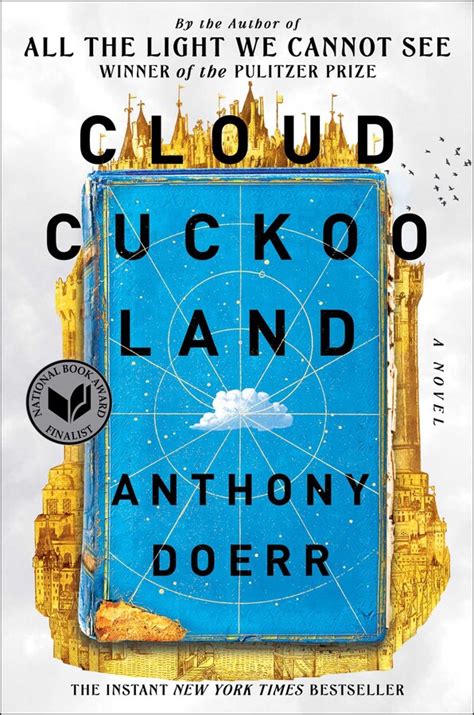
    Cloud Cuckoo Land by Anthony Doerr, Stellar Author


    It’s not often I get to the end a book and burst into tears. So what made me cry, and cry again, as I turned the last few pages of Cloud Cuckoo Land? 

    I think it’s to do with tension released.  We’ve walked dangerous pathways with the five main characters in this book by Anthony Doerr (author of All the Light we Cannot See)  – a tightrope journey over ravines full of spikes – and the knowledge that all of them, in their way, will reach an amazing, a perfect conclusion to their journeys led me to gush with tears of joy and sadness. 

    The Guardian describes this book as ‘a deep lungful of fresh air’ and the  Washington Post as ‘a love letter to books’. 

    We all know what we mean by this fantasy place; it's an over-optimistic, idealistic state of mind where everything appears to be perfect. Someone in cloud cuckoo land believes that impossibly good things might happen and seems unaware of realities.


    The story starts with a Greek play by Aristophanes, The Birds, first performed in 414 BCE, in which Pisthetaerus, a middle-aged Athenian, persuades the world's birds to create a new city in the sky to be named Νεφελοκοκκυγία (Nephelokokkygia) or Cloud Cuckoo Land.  We then move onto The Wonders Beyond Thule, written in Greek by Antonius Diogenes in the second century BCE. Finally there is also a link to The Golden Ass, by Apuleius, written in Latin in the second century CE, in which a traveling man, hoping to experience being in the body of a bird, takes a witch's potion and turns into a donkey

    And so the overlaps, the convolutions, the 'stealing of stories' adds to the complexities of this story, and echoed through the real history, real early literature. Doerr capitalises on this to create a complicated and wide-reaching novel that touches on precisely what being human is all about.

    Anna and Omeir are teenagers living in the 15th-century. Omeir is a farm worker with a cleft lip.  His two beloved oxen, Moonlight and Tree, are dragooned by the Sultan, Mehmed the Conqueror. His great army is on its way to lay siege to Constantinople, where Anna lives, an orphan with a dying sister who spends long days doing needlework for the church. Someone teaches Anna to read Greek, and so, when a manuscript written more than a thousand years earlier comes into her hands (she is stealing from a water-logged tower library to help pay for her sister to have quack treatment) she is able to decipher it as the fantasy of Cloud Cuckoo Land. After her sister dies, Ann flees the city as it falls, taking the precious, seemingly magical, book with her. She meets Omeir, also fleeing from conscription after the death of his oxen. They return to Omeir’s farm where they live out their lives together. 

    Zeno, a veteran of the Korean war, learned ancient Greek from Max, a fellow prisoner of war, a man he falls deeply, unrequitedly, in love with. After Alex’s death, he learns that Cloud Cuckoo Land, discovered in Italy, is being put up, codex by codex, on the internet. He begins to translate it into English. By 2020, we find him, now an elderly man, putting on a play based on the book, working with enthusiastic local children

    In the same place and time – Lakeport, Idaho, 2020 – we meet Seymour, a teenager bullied and distressed by his neuro-diversity,  He has become obsessed with the losses of the natural world to climate change and is groomed by an internet climate terrorist. He enters the library where Zeno is holding his dress rehearsal for Cloud Cuckoo Land,  bringing a backpack full of explosives and with him.

    Konstance is equally young as Anna, Omeir and Seymour. She is a passenger on the Argos, a spaceship which left the Earth 65 years before with the parents and grandparents of its passengers. They are headed to a new, healthy planet, to form a new colony after global devastation has decimated the Earth. Konstance spends a lot of time in the library that exists digitally inside Sybil, the computer. By walking a treadmill, clearly designed to keep the passengers active, she can walk an updated 'Google Earth' which not only takes you around the world, but through the ages. It is now 2146, and Konstance is now the only person still alive on board the Argos and there are hundreds of years travel ahead. How will she survive?

    Reading this almost 600 page-long novel is sometimes a bit of a push. There are times when I was so terrified for the characters I hardly wanted to read on. And there are times when I wondered if Doerr actually knew where he was heading; would  all these disparate stories really come together as one?  There are a lot of characters and plot to keep tabs on, and if you decide to embark on this novel you might find this webpage of use; https://www.marmaladeandmustardseed.com/bookguidesblog/cloud-cuckoo-land

    Diogenes Cloud Cuckoo Land is the golden thread that stops the reader from becoming lost in this labyrinthine story. Written in ancient times, stolen from a ruined library in Constantinople, hidden in a hollow tree until Anna’s death, as I read I kept wondering how the ancient book would turn up in Italy, in  ‘a place books can be safely kept’…another library…rediscovered and digitally distributed, ready for Zeno to translate.

    Years later, Seymour will help create Konstance’s treadmill library for the Argo. Employed first in prison and then in the lab, he uses secret codes to hide disturbing truths.  Kostance discovers she is the great grand daughter of one of of the 6th-graders who are working with Zeno on his play… and other things, which may save her life.

    Throughout the story,  Diogeness book heals, keeps safe and bring joy to those that are sick, lost and troubled. And as the story ends, and the clever twists fall into place one after the other, my tears burst through with the delight of it all.


    Anthony Doerr. Photograph: Deborah Hardee/The Observer


    Thursday, 5 January 2023

    STARTING TO WRITE: The Secret Rules of Writing Golden Dialogue

    Want to write better, snappier, clearer, more empathetic…in fact…golden dialogue? 

    There are rules that help you succeed. They're not exactly 'secret' but certainly they can only be found 'under the counter'. Here they are.

    Handled with energy, dialogue can turn a good story into a winning story.  Readers like a lot of dialogue because it spaces out the words on the page, easing the reader’s eye, but it is also one of the best ways of creating living characters. Dialogue is crucial to modern writing and can be as fast-paced and exciting as action.

    Perhaps a definition of what dialogue is might get us started. Dialogue always takes place between at least 2 characters, just as real conversations involve at least 2 people. 

    If you are a little uncertain that the dialogue you write enables your characters to build their personalities and engage with their readers, you might try the series of exercise we are going to look at in this blog and take note of the Seven Golden Rules we're going to examine. 


    The First Golden Rule:
    Dialogue must never be written for its own sake

    This is one rule that will help you construct conversations you can be proud of: To prevent your characters unwittingly breaking this rule is simple. Always be sure that any conversation you create has at least one of the following functions:


    • Impart information 
    • enrich the characterization
    • move the plot along 
    • develop the characters further within the story 
    • further the complexities of the plot 
    • crank up the pace,
    • enhance the theme or core truth 
    • reflect relationship changes and emotions


    Kitchen Table Exercise one

    Take your notebook to a specific location of your choice where people move or linger, such as a gallery, a country park, a shopping mall. Sit with your notebook closed and observe the way people use the area, listening to snippets of conversation, but also inventing the ‘follow ons’ you don’t actually hear. Think about body language especially, and also reactions to the place. Try to see the place through the eyes of the people there. Start making jotted snatches of dialogue scenes, using what you see and what you hear about you.


    Golden Rule two: 

    For dialogue to feel natural, it can’t ever be natural. 

    Real conversation is dull and repetitive. People stutter, or forget a word. They don’t quite catch what others say, interrupt themselves with inconsequential, often illogical comments, and go off the point, changing subjects, becoming irrelevant. Real people trip over their words and produce poor syntax that sounds unintentionally comic. In fact real speech is 80% inconsequential; humdrum data of living, and at least 10% more is in shorthand, because we know the other person so well, we don’t need to use full speech to get in tune with them – it’s how we human’s mostly communicate. 


    Having listened to people chatting in the mall, you will now be aware that prose dialogue cannot be transcribed directly from real speech – the writer must edit it. As well as smoothing over the verbose cracks, this editing should smooth the ride by breaking up longer speeches with description, action and observation.


    To put this succinctly, for dialogue to feel natural, it can’t ever be natural. This is something that is learnt as one reads, writes and listens, and the more dialogue one writes, the easier it becomes. Try listening to conversations then transposing them into dialogue to help enhance this skill.


    Start a new piece of dialogue between two characters you're working with, or would like to create. But instead of setting it out in the normal format for dialogue, set it out as a script. To create a strong rhythm, emulating the simple A, B, pattern for your two speakers. This can be very liberating, and should at least persuade you to create a scene, with dialogue, if you find yourself generally writing exposition. It will also encourage the dialogue writer who is having trouble with Rule Two  to get into a good A B tempo. Make sure you are naturally changing the line length of each speaker at will__________________________________________________


    Golden Rule Three;

    Dialogue should be pertinent to the character’s personality.

    Don’t allow the character to talk with your voice; they need their own. Don’t allow all the characters to sound the same; this is an ‘early’ mistake and one that can be spotted by reading your work aloud. Try to ‘get into the shoes’ of the person speaking, so that it’s their words on the page…not the writer’s. Allow various characters to have differing speech patterns, but do not go overboard with this; it can lead to reader irritation. Be particularly careful about accent or dialect; use one small thing that can exemplify the speech pattern and leave it at that. Keep well clear of phonic representation. If you read Christopher Brookmyre’s crime fiction, you will see a master of this skill at work, but his passages of lowland Scottish dialect are often difficult to follow.


    Kitchen Table Exercise Three

    Place a character you’re working with, or hoping to work with, in a situation where they have to talk. Think about how they would react. Not how you'd react, but them. 

    See things through your character’s eyes. You don’t need to link this with any writing you’re doing at the moment. This time, use what you’re seeing and hearing alongside what you are imagining. Now is your chance to allow your character to speak as this individual might. Think about this person before you start, and all the way through writing the piece. Allow them to speak to another character, or in some other way, if it helps.____________________________________________


    Golden Rule Four: 

    Be careful how you impart information

    Although Golden Rule One states that dialogue can be used to impart information, keep that fact hidden, otherwise speech will sound ‘stagey. Staged dialogue is speech where we overhear characters telling us something the writer wants the reader to know, but the characters already know, usually in creaking speeches...

    ‘How are you Mary?’ asked Sue. 

    ‘Well,’ said Mary. ‘Since the death of John, six months ago, I’ve been very depressed.’

    How do you overcome these problems? One way is to use interior monologue:

    ‘How are you Mary?’ Sue knew that Mary had been depressed since John’s death, but

    even so, she was hoping for more than a grim sigh in answer to her question. 

    ‘No better, to be honest with you,’ said Mary.

    Another is to wrack your brains for a more ‘natural’ approach:

     ‘How are you Mary?’

     ‘No better.’

     ‘What is it now...six months?’

     ‘Yes. But it’s like John’s about to walk in the door any moment.’

    Another approach I recommend is not to worry too much about imparting this sort of information in the first place. Readers like mystery, even if the story isn’t actually genre mystery. They like to be teased, so long as the mystery is solved somewhere along the line:

    ‘How are you Mary?’

    ‘No better.

    ‘What’s it now? Six months?’

    Sue gave a grim sigh. ‘Feels like six years sometimes and six hours at others.’


    Here's another place stagy dialogue rears its head:

    ‘As you already know, Henry, the polyribodigestive test tube results are outstanding. And you also know that we’ve found a guinea pig for the transplant experiment among the staff  - at least, when we say guinea pig, of course, we mean flunky.’ Henry’s assistant leered at him...


    Kitchen Table Exercise Four

    Search through previous pieces of your writing to find some dialogue that now, you might consider 'staged'. Try rewriting it. By treating characters and their dialogue as if the story grew organically out of the world they inhabit, you will find yourself naturally only giving your reader only just enough information detail. ‘Just enough’ can be interpreted as ‘far less than you first imagine they’ll need’. For a start, you don’t want to write down to them, or treat them as fools. But also, they will be quite happy to read along, delighting in finding the details are revealed bit by bit, in just the same way as the example of Mary’s bereavement. 


    Golden Rule Number Five 

    Who Should be Talking?

    It is a standard guideline, especially for short stories, that a conversation should not be reported directly on a page unless a key (focus) character is in it – in other words, characters your story cannot do without. Clearly, both the protagonist and the antagonist are essential characters, but it is up the writer to decide which other characters are key. In actually deciding this, it is quite a good idea to pose the question the opposite way round; which of your characters could actually carry dialogue as the main character in that scene? Crucially, the template is that no scene, no conversation, should take place without one or more facets of the First Golden Rule; and if only minor characters are in that conversation, that is unlikely to be so to any degree.


    Kitchen Table Exercise Five

    Take any piece of writing you are working on, or any you have completed. Look through it, to check to see who  is driving any dialogue and whether they are an essential character. If you find any dubious conversations, ask yourself; does this work? Do I need to re-evaluate the need for this conversation? Is the dialogue going to hold a reader? Does it follow Golden Rule One?______________________


    Golden Rule Six:

    How speech tabs should be used

    Careful handling in the use of ‘tabs’ – the ‘he/she saids’ of dialogue – will really help your dialogue to have a great rhythm and flow. .


    Tags are the verbal additions that describe who/how the dialogue functions. They are sometimes very hard to get just right. The secret is to use ‘said’ as much as you possibly can. This is because it is almost invisible and readers skip over it. It is a functional necessity that does its job like a postman...never really seen. 


    If you can get rid of a tag altogether, that often creates fast-past dialogue – very useful if the scene is also fast-paced.  Also try to break up the tabs by using actions to get a good rhythmic flow… ‘It think it’s time,’ Simon took a sip of his espresso, ‘to talk about the contract.’  By sticking to ‘said’, you will avoid overuse of other tag verbs (muttered, added, chattered, etc).The less you use, the smoother and more readable will your work be; even the most common tags (asked, called, whispered etc), should be cherry-picked; try not to have more than a couple in any patch of dialogue. Some verbs should never be used because they don’t function well as tags at all – laughed is the most common of those...it is almost impossible to laugh and talk at the same time. Chuckle and smiled can be ‘got away with’ but constantly check that certain characters don’t spend all their time smiling as they speak, for instance. Oh, and don't ruin all that good 'tab' work by adding an adverb. Don't tell us the character said something 'bravely'; show us that bravery through the words they use. 


    Kitchen Table Exercise Six

    Spend ten minutes writing a new conversation between two old characters. Perhaps these characters have never met in your previous fiction, or maybe they are already aware of each other. Whichever scenario you chose, make sure this is new dialogue. Free write the conversation first. Then read through it. How did you use speech tabs? Are you already an old hand at getting the dialogue rhythm right with a varied amount of tabs, no tabs, action instead of tabs? Do you mostly stick to 'said'?


    Golden Rule Seven:

    Dialogue should be brief and clear. fascinating and multi-tasked. 

    Brief and clear. Make sure you keep in control of what comes out of character’s mouths. As it progresses, dialogue must take the reader by the hand, and lead their thoughts in the direction you the writer want them to go. This is why it must never ramble away from the point it’s trying to make, even in an attempt to enhance any of the golden rule. Keep conversation tightly on the subject in hand


    At almost no stage of your writing should any character speak for more than three or four lines. That is not to say that this character might have a longer speech to give, and yes, they can give it, but they should be interrupted in various ways. Try to allow the dialogue to be visual so we can see the characters as they speak, breaking up the speech patterns with action, interior thought processes, description of character, etc.  But it must never ‘feel’ broken up. To achieve this, create a rhythm to the dialogue sections, a feel that has a lyrical sensation. Avoid repeated beginnings, and break down repetitive ‘tab’ patterns that might annoy a reader. 


    Fascinating.  Even if the personality you’ve given your character is dull, their speech should not be. If your reader wants to listen to inane speech, they can tune into a TV chat show! Real conversation is pedestrian or repetitive at times because we have to think on our feet while talking. But characters should stand out on the page, and in the same way their dialogue should be larger (although never more grandiose), than real conversation. Characters (or rather their writer) have the luxury of something the rest of us do not have – the chance to think through what they say and say exactly what they mean (presuming they intend to say what they mean...). Polish and buff their speech to create fascinating dialogue.


    Multi-taskedMulti-tasking in dialogue writing is the major area where real conversation alters significantly from dialogue in fiction. It should constantly be focused on that first golden rule – all dialogue should further the story in at least one way from that list – if you can make that two, or three, you are beginning to understand how to multi-task your dialogue. Don’t just let conversations enrich developing characters, make it move the plot along and further its complexities at the same time. And although not every conversation is going to crank up the pace or enhance the theme of the story, make sure some dialogue achieves this – especially towards the end of a short story and at least half way through a novel. Part of this ‘cranking up’ may also reflect emotions, etc into good measure.


    Kitchen Table Exercise Seven. 

    Tap into your writer’s imagination by imagining dialogue when you're not at your writing stations Tune in to your character’s conversations. You may find what they say when they think you are out of earshot will surprise you and add richness to your story


    While you are still learning your writing trade, it does not harm to check the golden rules each time you’ve created dialogue, especially when this is a longer chunk of conversation between characters, because this can feel a very complex aspect of writing creatively. 


    But remember, your first draft does not have to be perfect. You can continue to experiment with dialogue, change it and allow it to grow.